Matthew Zapruder, MFA Creative Writing Spotlight
Image

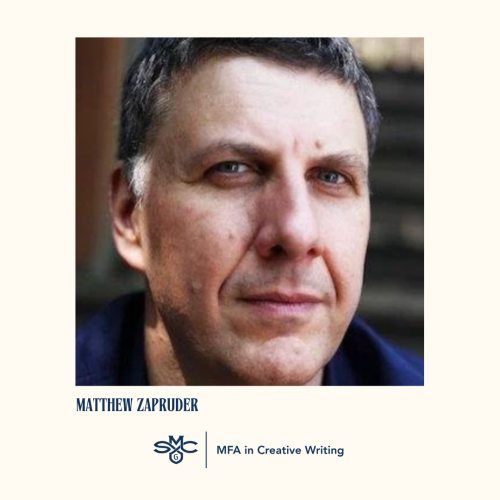
Matthew Zapruder, Professor of Poetry, answers 17 questions from current MFA students. In celebration of the MFA in Creative Writing's 30th Anniversary at Saint Mary's College.
Image
- How did you first know you wanted to become a writer?
I don’t think I really knew that was what I wanted until I went to graduate school for literature and realized that I liked writing poems better than writing papers about them. Once I started trying to write poems with intense dedication, it just became addictive, and then I was already a writer, albeit not a very good one.
- What does your daily writing routine look like? Do you have any rituals around writing?
When I am working well, what works for me is either to have a schedule – time that I block off on the calendar that cannot be messed with in any way, with the exception of family obligations – or a target, like a certain number of words or a poem a day. My main thing though is just to get to my desk. Once I’m there and working, I figure something will happen, even if it’s a terrible paragraph or poem. As the great Robert Hass says, “you can’t revise nothing.”
- Which books or writers have most deeply shaped your writing?
Certain things I have read have had a profound influence on my sense of rhythm in poetry and prose. For instance, the work of José Saramago taught me a great deal about the syntactical possibilities of the sentence (and the line in poetry), just to take one example among so many.
- For you, is writing more about exploration, healing, or profession?/ What drives you to write or come to the page/ What's the greatest joy/pain?
It’s definitely not about profession. I think I write ultimately because I love words and how they can surprise me. How they can show me what I think and believe that I did not know until I started putting pen to page, or typing. If I don’t feel as if I am discovering when I am writing, then I do not feel I am writing at all.
- If you could give one piece of advice to your younger self just starting out in writing, what would it be?
Calm down and enjoy yourself, just keep working and writing will take you wherever you need to go. Don’t worry about the reactions of the external world. The world is a big place full of readers, and whenever you figure out what you really need to do as a writer and start doing it, there will be readers there waiting for you.
- In your writing process, what do you most often argue with yourself about?
That’s funny, I don’t really argue with myself when I’m writing. I think the hardest thing is finding the time to get to the desk. Once I’m there, I’m usually pretty happy. Sometimes I have to argue with the part of myself that thinks I “need” another snack. That part usually wins the argument though.
- Is there a “failed draft” that still influences you in some hidden way?
What an interesting question! I love my failures better than my successes, because they are there waiting for me to continue.
- What do you think is the greatest joy of writing, and what is its greatest pain?
For me the greatest joy is discovery, and the greatest pain is when I feel like writing but choose to fulfill some other ephemeral obligation.
- If writing were not words but a physical activity (running, swimming, sculpting), what would it resemble most?
Sleeping.
- When you hit a difficult passage, how does your body respond?
Like an octopus who has just been handed a ukulele.
- What recent project or class has most transformed your thinking about writing or teaching?
I really did enjoy teaching the recent craft seminar Everyday Creativity. Especially during a difficult time in our culture, it reminded me that helping emerging writers work on their projects and find their imaginations is in and of itself a great pleasure for me. It renewed my faith in teaching and helped me see once again that my job is to provide a productive, exciting, supportive environment where people can explore and ask questions. That’s something I can use my experience to do, and I feel like I can do it far more authentically than being some kind of arbiter about what is “good” or “bad” writing, a position I have no interest in.
- What book is currently on your desk or bedside table?
I’m reading the second volume of In Search of Lost Time, which is an immense pleasure. I recommend it to everyone. Almost nothing happens in it, which means that everything can happen.
- If you could only bring three books to a desert island, which would they be?
In Search of Lost Time (all the volumes), Frank O’Hara’s Collected Poems, and The Oxford English Dictionary.
- Which character (from your own work or someone else’s) would you most like to have a drink with?
I’d like to go for a very long walk with John Keats. Maybe one that lasted years.
- What’s the strangest place you’ve ever written a sentence you kept?
I once wrote a whole poem composed of lines from horoscopes that I cut out of newspapers in a kielbasa restaurant in Chicago.
- If your writing had a soundtrack, what three songs would definitely be on it?
"Pink Moon" by Nick Drake, "Bastards of Young" by the Replacements, and "How Deep is Your Love" by the Bee Gees.
- What emoji best captures your writing style?
That one with the yellow guy with the monocle.
School and Department Information
Chris Feliciano Arnold
Director, MFA in Creative Writing
cfa1@stmarys-ca.edu
925-631-8556
Collin Skeen
Assistant Director of Admissions and Recruitment
cas38@stmarys-ca.edu
925-631-4190