
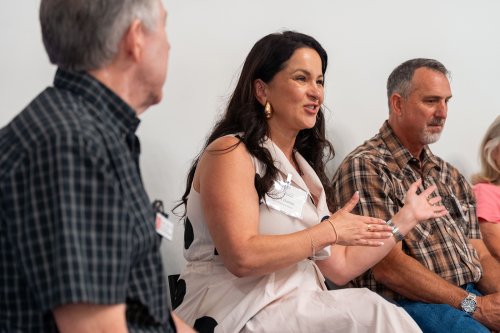
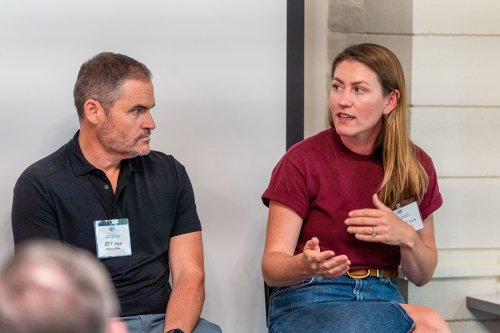
Talking business and wine: From left, SEBA Dean Don Gibson, PhD moderator; panelists Lisa Barker, Norm Peters, Michelle Oltman, Jeff Davis, Maggie Coin
California Wine at a Crossroads: Heritage, Headwinds, and a New Generation’s Palate
Five industry experts share how to thrive in a market where tradition is met with constant change.
This year’s Business of Wine drew industry veterans, alumni, and students into a spirited exchange on the future of California wine, an industry rooted in tradition yet navigating a marketplace in flux. The School of Economics & Business Administration's Matt Rogers Innovation Hub buzzed with the expertise of winemakers and marketers from every aspect of the industry. From vineyard practices to shifting consumer tastes, no topic was off the table, and each insight landed like a pour from a rare vintage.
A Legacy Poured into Every Glass
California wine is a juggernaut, generating $73 billion in economic activity within the state alone and employing over 422,000 people. It is a business rooted in agriculture, hospitality, and storytelling. As Dean Don Gibson reminded the audience, the region’s viticultural pedigree stretches back to the Christian Brothers, who once tended vineyards in Napa Valley. For California, wine is more than an industry; it is an inheritance.
The panelists, each a proud Saint Mary’s Gael, represented nearly every link in the chain:
- Jeff Davis, MBA '10, Co-Founder/Proprietor, Majuscule Wine
- Lisa Barker, MBA '17, Director of DTC, John Anthony Wine & Spirits
- Maggie Coin, MBA '02, Owner, Copper Six Winery and Grand Cru Custom Crush
- Michelle Oltman, MBA '02, Wine Specialist & Educator
- Norm Peters, MA '03, Director of Vineyard Operations, Silver Oak
From Tasting Rooms to TikTok: Rethinking Direct-to-Consumer
Much of the discussion circled back to how wine reaches the glass. The three-tier system of producer, distributor, and retailer remains the default, but California’s ability to sell directly to consumers has rewritten the playbook. For boutique wineries, DTC is not just an option; it is survival. Barker spoke of omnichannel experiences, from intimate tasting salons to digital engagement, noting that the narrative is as important as the pour: “There’s no date on a White Claw,” she said, “but a vintage marks a moment in history.”
Innovation is also shaping the experience. At JaM Cellars, the “Sip and Play” program pairs wines with curated playlists, matching Chopin with Chardonnay or reggae with rosé. The goal is to make tastings more interactive and memorable, inviting guests to explore how music influences the way a wine tastes. It is playful and approachable, and it reframes wine as an experience rather than just a product.
The Consumption Conundrum
The elephant in the room was clear. Americans are drinking less wine, down about 15% since 2021. Baby boomers are aging out of peak consumption years, while Gen Z and younger millennials are just as likely to reach for craft cocktails, low-alcohol spritzers, or cannabis products. Some panelists cited the “COVID hangover,” where lockdown-era subscription spikes gave way to cancellations as cellars filled and wallets tightened.
The industry’s counterpunch lies in experience. Wine, argued the panel, needs to reassert itself as a social catalyst, meant for shared tables and lively conversation rather than solo sipping on the couch.
Sustainability: Beyond the Buzzword
In the vineyard, climate volatility is rewriting best practices. Peters described how hotter summers, late frosts, and more frequent wildfires have forced shifts in canopy management and row orientation to protect grapes. Coin and Oltman stressed site-specific sustainability: regenerative farming, dry-farming in suitable AVAs, and lighter packaging are not only environmentally sound but also stories consumers can connect with. Still, the panel agreed that while eco-conscious farming resonates with some buyers, the broader market has yet to fully embrace its higher costs.
The Price-Point Divide
If the downturn is felt most in sub-$20 bottles, ultra-premium wines priced from $25 to $300 have been more insulated. Even at the top end, the panel noted overproduction, brand saturation, and a “silent shakeout” of wineries that expanded too aggressively. In the Central Valley, falling grape prices are prompting growers to rip out vines and switch to crops like almonds and citrus, creating a quiet reset that could ripple north in the next two years.
Looking Ahead
Despite the headwinds, the panel’s tone was far from fatalistic. They see opportunity in alternative varietals beyond the Chardonnay, Cabernet, and Pinot trinity, and in capturing younger consumers through experience-driven marketing. The consensus is that wine is cyclical. Palates evolve, generations age into their drinking years, and the romance of a well-made vintage endures.
California wine, like the vines themselves, has a long memory. While 2025’s harvest will never be repeated—the weather, the market, and the mood all uniquely its own—the people who tend these vines are playing the long game. As Oltman reminded the crowd, “We all tell our individual stories with our passions.” In this industry, passion is the one ingredient that never goes out of style.


