
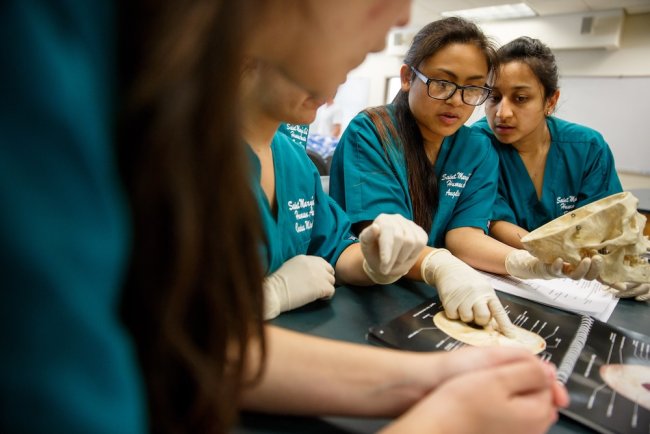
A model program to meet healthcare needs: Enrollment in the Nursing program is open to both current Saint Mary’s students as well as transferring students. / Photo by Steve Babuljak
To Meet the Moment in California Healthcare Needs, Saint Mary’s Launches a New Bachelor of Science in Nursing Program
Nursing classes begin fall 2025, with new enrollment opportunities for spring and fall 2026. The innovative curriculum led by experienced faculty bring together rigorous theoretical training and practical experience.
With the beginning of the 2025–26 academic year, Saint Mary’s College of California is introducing a new Bachelor of Science in Nursing Program. The innovative curriculum and approach are geared to ensure that graduates are successful as they embark on their careers—and that they’re ready to serve as leaders in the healthcare field. Building on SMC’s Lasallian and liberal arts traditions, this undergraduate Registered Nursing program will deliver a holistic and compassionate educational experience.
The program has been officially approved by the California Board of Registered Nursing (BRN) and accredited by the Western Association of Schools and Colleges (WASC) Senior College & University Commission (WSCUC). The five-semester program has admissions opportunities for both students who completed their lower division coursework at Saint Mary’s College and for transfer students. Students beginning their studies at SMC can already see the courses and program listed in the course catalog for the new academic year.
This fall’s first cohort of incoming nursing students includes current and former Saint Mary’s College students as well as transfer students. The transfer students are already on campus this summer, taking courses in preparation for the nursing curriculum—including Collegiate Seminar, a signature part of the Saint Mary’s curriculum for all undergraduates.
Empowered Leadership and a Model Curriculum
The Nursing program is part of the School of Science and directed by Dr. Pamela Stanley, who brings decades of experience in the Bay Area as a nurse, director of nursing, and educator. She has a Doctorate of Nursing Practice (DNP) as well as a Master’s in Nursing and a Master’s in Business Administration, and has worked with colleagues at SMC over the last several years to lay the groundwork for the Nursing program.

What’s special about the Saint Mary’s program? For one, it integrates an approach pioneered by nursing theorist and researcher Dr. Maria O’Rourke, who advocates for “Role Clarity” and leverages a holistic framework centered on the principle of “Do No Harm.” O’Rourke has partnered with Saint Mary’s during the development and launch of the program, designing an innovative approach that sets SMC’s program apart, and that will benefit nurses and patients alike.
In essence, the underpinnings of this program foster role accountability and empowered leadership. Students graduate as skilled clinicians equipped with the knowledge and confidence to excel in complex, dynamic healthcare environments while serving diverse populations.
“We are preparing a professional workforce that is deeply service-driven and compassion-centered—individuals for whom justice, equity, and the core values we hold dear are not just ideals, but essential to their practice,” says Carol Ann Gittens, PhD who serves as Senior Vice President for Academic Affairs and Provost at SMC. “The O'Rourke Role Clarity Model for Professional Nursing Practice is going to be a signature of Saint Mary’s Nursing program. And already other institutions are saying, ‘That’s a great model.’”
The fundamentals of a Saint Mary’s educational experience are shaping the program. Along with that, Gittens is excited about the fact that the College is further broadening its commitment to educating professionals—such as established programs that prepare teachers and mental health practitioners, in the Kalmanovitz School of Education, where she has served as dean. “The BSN program is designed from the ground up to prepare our nursing students for real-world clinical practice. It integrates academic rigor with hands-on experience so graduates are ready to lead in today’s dynamic healthcare environments.”
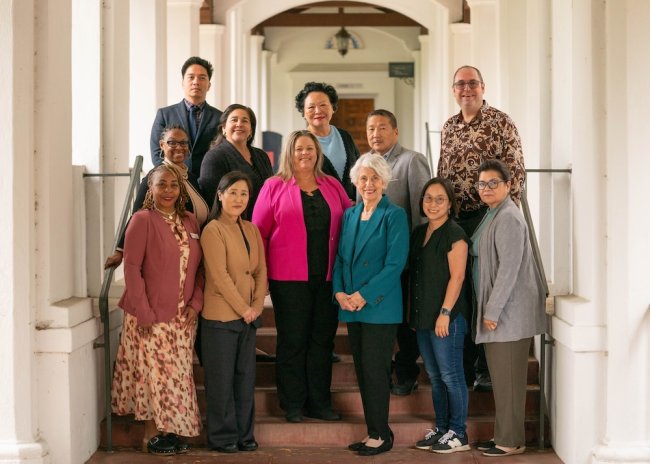
A cohesive, diverse, skilled and experienced cadre of faculty will teach in the program, partnered with experienced staff to keep things running. In designing the program, Gittens says, Director Pamela Stanley and the faculty team she has put together brought their experience as nurses and faculty elsewhere and asked: “What would a first-class, top-notch program look like? That required a vision—it required a nimbleness to translate the standards of preparation into a program grounded in theory and purpose. What Maria O'Rourke brings to the table, and what professional role theory offers, is the ability to embed a mindset into our program—one that continually asks: What will this be like, authentically? What responsibilities will I carry? What difference will I make as a professional nurse?”
For Saint Mary’s, it’s a matter of meeting the moment—grounded in Lasallian values. “The launch of this program reflects our College’s deep commitment to the well-being of our communities and the rising demand for skilled healthcare professionals nationwide,” notes Saint Mary’s President Roger Thompson, EdD. “The BSN program is designed to prepare students with the knowledge, compassion, and hands-on experience needed to thrive in today’s dynamic healthcare landscape.”
Making the Right Decisions at the Right Time
“The whole grounding in Dr. Maria O’Rourke’s work ties us back to really understanding our professional role,” says Pamela Stanley. “We’re really focused on the scope and practice, which shapes their decision-making ability, how they can transfer what they know into the right actions at the right time, for the right reasons, in the right way. That's evidence-based patient care.”
Students learn by doing from the first weeks of the program, and they graduate prepared to step into their professional role. “Typically there is a huge gap between nurses in student role and transition to professional role, if what students learn is not grounded in scope of practice,” Stanley says. At Saint Mary’s, the mentoring of students is built on that scope of practice. As Stanley also notes, O’Rourke was instrumental in writing the nursing professional act. “Other organizations are trying to change to meet the standards,” Stanley says. “We are starting out with them.”
Along with directing the program, Stanley, like the rest of the faculty, continues to serve as a practicing nurse as well. One thing that concerns her: In the field, she says, she sometimes works with nurses who don’t understand their standards and scope of their role. “We need to have people who do.”
State-of-the-Art Technology—and a Human Connection
Central to the educational experience for the Nursing program is a new state-of-the-art Simulation Center. Currently under construction in Filippi Academic Hall, with an official grand opening set for the beginning of spring semester, the center will provide an immersive environment—not just one patient at a time, but for simulating a range of situations nurses are likely to encounter. These will let the learner step up to the bedside and decide how they need to take care of the patient.
Lucinda Allen ’01 directs the Simulation Center and the Certified Nursing Assistant Program. “I’m excited about the type of simulation we plan on doing, which is the multiple patient ward-based hospital nursing—day in the life of a hospital nurse,” she says. “It will help to prepare our nurses to be ready when they start nursing in a hospital.”
With years of experience as a nurse, manager, and educator, Allen has seen what happens when nurses aren’t prepared. “They can't manage their time. They don't know their role, they lack the professionalism they need.” Part of the problem is that they may approach the work in a task-oriented way. “They're just doing it, not knowing why they’re doing it. And then they’re not making decisions in the right way when things are changing.”
“We’re very compassionate about nursing. I’m pretty much a nurse first. That’s my superpower.”
— Lucinda Allen ’01
Allen studied at Saint Mary’s and completed her degree in nursing through the partnership SMC then had with what is now Samuel Merritt University. As she sees it, her educational experience has profoundly shaped her work and made her a better professional.
“I'm so Lasallian!” she says. “We want professionals to come out of this program ready to nurse, ready to to advocate, ready to make lives better for patients. That’s our goal: to make lives better. You can't teach somebody to care. But always looking through a lens of what’s best for this person, this patient, and looking at the whole person—who they are, where they live, their circumstances, and what their needs are—that’s how you can better advocate for them.”
Coming home to Saint Mary’s is a special opportunity for Allen. “We’re very compassionate about nursing,” she says. “I’m pretty much a nurse first. That’s my superpower. Really, I know nursing.”
One of the defining factors of Saint Mary’s College is the commitment to first-generation college students. Allen knows first-hand the value of that as well. She was both a first-generation student and a single mother when she began her studies. So she also recognizes that there are challenges many students face along with taking classes. And she knows how instrumental the right support system, mentoring, and commitment to meeting students where they are can be when it comes to transforming lives.
For Nursing Program Director Pam Stanley, the Lasallian approach is a further strength of the program—and aligns with the goal to meet healthcare needs in a diverse range of communities. “I grew up poor in East Oakland,” she says, “so that perspective changes how I think about students and the challenges they have faced. It’s important to approach our work with humility and that understanding—so when students come here, they can find a faculty member who has walked the similar path to them, who looks like them. That’s important.”
Clinical Partnerships
Clinical partnerships are another defining element of the Saint Mary’s program. Along with partnerships with the Veterans Administration and other hospitals in the Bay Area, SMC is partnering with USC Verdugo Hills Hospital in the Glendale area in Southern California. During the clinical partnership at Verdugo Hills, the cost of housing for students is covered by the Nursing program. It’s an opportunity to work in another environment with a different population, and the clinical experience will offer something fairly unusual.
“Normally students do clinicals one day a week for 16 weeks,” Stanley says. “One group of students is going down to Verdugo for a week at a time. So instead of learning to ride that bike every Monday, you get five days, then you get to come back, we do more stuff with you here, and then you go back for another five days.”
Not only that, Stanley says, “We are actually going into the clinical space to be value added. We're working with our partners to identify what we as faculty are going to do that can give them additional resources on the unit to care for the patients.”
Along with partnerships with the Veterans Administration and other hospitals in the Bay Area, SMC is partnering with USC Verdugo Hills Hospital in the Glendale area in Southern California.
Nora Chavez, one of the program’s academic directors, whose work includes clinical contracts and a focus on clinical compliance, says that goal of providing value-added support is deeply welcomed. “The clinical partners, when we reviewed what our new program would entail, they were so pleased,” she says, “because we are trying to change what they're seeing too often with nursing students. We’re instilling more professional behavior, more knowledgeable understanding what their roles are.”
Pam Stanley and Nora Chavez also emphasize that students will gain clinical experience outside the hospital. “Clinical nursing, mobile clinics, and community health—which is huge,” Chavez says. “This is a program meant to create something that’s really extraordinary and that's really needed. Right now, the world is in turmoil and community health is hugely important. We need to teach our students that and give them opportunities to work in the community.”
Integrated with Campus and the SMC Experience
The Nursing program joins an array of Saint Mary’s programs connected with healthcare. SMC offers an interdisciplinary program in Health Science and undergraduate and graduate studies in Kinesiology. The Kalmanovitz School of Education offers graduate degrees in Counseling and Forensic Psychology. Also starting in fall 2025 is a new major in Public Health.
One special Skills Training Lab classroom for nursing will be in Brousseau Hall, which provides lab space for a host of programs in the School of Science. With the Simulation Center located in Filippi Academic Hall, it will share a home with the program in Counseling, along with others—and be next door to the Joseph L. Alioto Recreation Center, as well as near health and wellness student services.
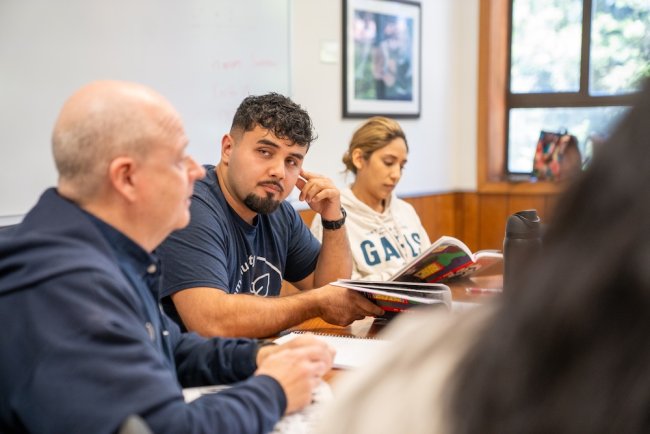
Gina Zetts, who manages operations for academic affairs at Saint Mary’s, underscores that students in the Nursing Program will be very much a part of the SMC experience. That includes academics, such as the Core Curriculum—with Collegiate Seminar one of the real jewels—along with vibrant student life on campus, from the arts to Club Sports.
“And once students enter the nursing program, they’re going to have a core community that they’re going through the program with,” Zetts says. “They’re going to have this group of support, not just from the faculty, but from fellow students.”
Practice Ready, Practice Safe
One of the key factors in attracting students to the program is an outstanding team of faculty. At Saint Mary’s, the combination of the theoretical and practical approach of the Nursing Program—and the grounding in Lasallian values—have been a major draw for faculty, too.
Sharonna Dunlap, who will be teaching a variety of nursing coursework, including medical-surgical clinical, has also served as a director of nursing at hospitals. When she looked at what was coming together at Saint Mary’s, “I saw the quality that they were putting into the program. I saw the passion behind the scenes. And I really fell in love with what we’re doing with the simulation lab, applying the enhanced training in a controlled setting. When they're going into the actual clinical setting, students will be able to see better, judge better. It’s bringing professionalism, of course, in leadership at the bedside. And emphasizing that component of compassion in the nursing profession.”
Just as Saint Mary’s seeks to educate the whole person, nurses coming out of the program will understand how crucial it is to see the people they are caring for as a whole person. It’s not enough to see a patient in a room number in bed B with pneumonia.
“Who would I want to take care of me when I'm in the hospital?” Sharonna Dunlap asks. “I need to look at this person as my parent, not just a person off the street. No, this is my mom, this is my dad. How would I want someone to take care of them?”
Just as Saint Mary’s seeks to educate the whole person, nurses coming out of the program will understand how crucial it is to see the people they are caring for as a whole person.
Nursing faculty member Glenn Morimoto has more than 20 years of experience as a nurse and educator, with extensive work in critical care and emergency rooms. “I always tell the students, if you're laying on that bed, you're laying on that gurney, what kind of nurse do you want treating you?”
For Pam Stanley, that’s where the opportunity to create a program is so meaningful. “It is very hard to change a culture anywhere. Here, we're getting to build a culture, and we're and building a culture and having those conversations about what's important.”
In interviews, students who are pioneering the program as part of the first cohort made it clear that they admire the commitment of the program to do no harm. “That’s really the ultimate goal: not to do harm, and to really have really good outcomes,” says Nora Chavez. “Nursing is not just a task, it’s so much more. Nurses are like activists, problem solvers; sometimes we’re social workers, privately investigating. We really encompass a whole different kind of role. So it’s important for us to understand what ‘do no harm’ means.”
As nurses step from the Saint Mary’s program into their first professional roles, it’s not only with a breadth of knowledge; it’s with an understanding of what it means to be “practice ready, practice safe,” Stanley says. “‘Practice ready’ means they're ready to go now and transition to that new position where learning still occurs. And ‘practice safe’ means you're speaking up and saying, in the situations where it’s necessary, ‘I haven't done that before. Can you support me with this?’”
Glenn Morimoto says he understands the hesitancy many have to do ask for guidance. “People, when they’re professionals, don’t want to say, ‘I don't know.’ But that’s when they need to say, ‘Let me get someone that can help me do this the correct way.’ When you don't ask and you make a mistake, it’s a tragedy. But when you ask and you make the right moves, it's a gain for everybody.”
“That’s where the self-awareness comes in,” says Sharonna Dunlap.
Meeting a Deep Need
Along with teaching at Saint Mary’s, faculty will continue to draw from their ongoing experiences in healthcare environments in the Bay Area. “We actually want our faculty to be out there touching patients and doing direct patient care,” Stanley says. “I still work as a house supervisor. In fact, I did a night shift last night, so we're still in the trenches with what the changes are.”
Another key piece, along with the diverse backgrounds of the faculty: “We have a large number of doctorally prepared nurses—over 60% have the doctoral or doctoral in progress,” Stanley notes. “That is unusual in nursing.”
“Everybody says, ‘It’s so innovative, this is so awesome.’ But really, we should be doing this all the time.”
— Nora Chavez
Glenn Morimoto already knew some of the team members when the opportunity came to come on board at SMC. He wasn’t as familiar with the College itself. But what he learned—about the Lasallian approach to education, the SMC faculty as a whole, and leadership throughout the institution—sealed the deal for him as a faculty member. “When I saw the ethos of what Saint Mary's represents, to me, it was like, This is gonna be good.”
The program has a clear focus on creating a nurse that is both professional in terms of ethics, leadership, team, participation and accountability. But the other piece that we don't often see is having situational awareness, Stanley notes. “Nursing has become, on many levels, a list of tasks to be done and check-offs, computer documentation. And in doing that, learners and nurses often lose the whole picture. What's going on with all the different pieces of patient care, not just in the hospital? What's going on at home? What's the family situation? The social determinants of health is increasingly recognized as something we need to be concerned about. So their focus is to really teach to recognize all the different contributing factors to patient stability and wellness and to acknowledge what are the issues, and then to take the right action.”
With the approach Saint Mary’s Nursing Program offers, there’s no question it’s creating exciting opportunities. It’s also because there are deep needs to be met.
“Everybody says, ‘It's so innovative, this is so awesome,” says Nora Chavez. “But really, we should be doing this all the time.”
Steven Boyd Saum is Executive Director of Strategic Communications and Content at Saint Mary's. Write him.
Story updated July 30 at 4:20 p.m. Pacific


