Anthropology, BA

Anthropology, BA

Live with and study cultures throughout the world. Discover universal truths and distinctions amongst all humans. Our program will challenge you to look at human beings and their communities from every vantage point imaginable—biological, theological, environmental, and sociological, to name but a few. You’ll engage with the past and present through primary sources, hands-on research, and contemporary digital research methods.

With our outstanding, approachable faculty as your guide, you’ll learn how to situate contemporary events within the context of the human narrative while sharpening  you critical thinking and communication abilities. As the culmination of your study, you will create an original work of anthropological research, using the tools and knowledge you’ve gained throughout your time at Saint Mary’s. 


Apply Request Info

Learn More About Our Program

Get to know our well-respected faculty and their academic specialties.

CURRICULUM

Anthropology, BA

Anthropology, BA

BA

Anthropology studies human life in a comparative, cross-cultural, holistic, global perspective, through four subfields: cultural and social anthropology (the comparative study of the range and variability of cultures), archaeology (the study of the human past through material artifacts), linguistics (the origin and development of languages and their use in social contexts), and physical or biological anthropology (encompassing primatology and human evolution). Anthropology is distinct in its insistence that the foundations for theorizing and the comparison of cultures be based on firsthand ethnographic fieldwork. Current faculty in the department have conducted fieldwork or led January Term study abroad trips to places such as China, the Philippines, Hawai’i, American Samoa. In addition to its academic foci, a major emphasis of anthropology is its application in such fields as business, education, medicine, law, human rights, international development, and conflict resolution. Most of our graduates enter the working world, but some join non-government organizations, and a smaller number go on to graduate or professional schools. Our curriculum prepares all students broadly to be literate, informed, questioning, ethical and socially-aware citizens. All students are strongly encouraged to do an internship, learn a foreign language, and to study abroad. Students also can take advantage of a course exchange program to enroll in Anthropology and Archaeology courses at the University of California, Berkeley and California State University East Bay.

Learning Outcomes

  • PLO 1: Analyze the contribution made by applied anthropology to understanding the contemporary world, including the legacy of colonial world systems, imperialism, and globalization in culture change and extinction.
  • PLO 2: Apply anthropological methods of inquiry to cultural data while engaging in critical cultural relativism.
  • PLO 3: Collect, organize, and analyze research data.
  • PLO 4: Communicate anthropological findings and arguments to target audiences using multimedia methods of dissemination.
  • PLO 5: Propose actionable insights based on anthropological research to stakeholders in for-profit and nonprofit business contexts.

Requirements

Required Courses

Take each of the following required courses:

  • Intro to Social & Cultrl Anth (4 units)
  • Intro to Archaeology (4 units)
  • Intro to Biological Anthro (3 units)
  • Intro to Biological Anthro Lab (1 units)
  • Principles of Anthropology (4 units)
  • Linguistic Anthropology (4 units)
  • Anthropological Theory (4 units)

World Cultures

Take one course from this category:

  • Cultural Geography (4 units)
  • World Cultures: N Africa (4 units)
  • World Cultures: E Africa (4 units)
  • World Cultures: Mid Africa (4 units)
  • World Cultures: S Africa (4 units)
  • World Cultures: West Africa (4 units)
  • World Cultures: Caribbean (4 units)
  • World Cultures: C America (4 units)
  • World Cultures: S America (4 units)
  • World Cultures: North America (4 units)
  • World Cultures: Central Asia (4 units)
  • World Cultures: Eastern Asia (4 units)
  • World Cultures: SE Asia (4 units)
  • World Cultures: Southern Asia (4 units)
  • World Cultures: Western Asia (4 units)
  • World Cultures: Cent/E Europe (4 units)
  • World Cultures: N Europe (4 units)
  • World Cultures: S Europe (4 units)
  • World Cultures: Western Europe (4 units)
  • World Cultures: Oceania (4 units)
  • World Cultures: Polynesia (4 units)
  • World Cultures: Melanesia (4 units)
  • World Cultures: Antarctica (4 units)
  • Cultural Geography&Glbl Soc (4 units)

Methods Courses

Take two (2) units from this category. At least 1 unit must be from ANTH 185, and the other unit can be from either ANTH 185 or 186.

  • Anthropological Methods (1 units)
  • Archaeological Methods (1 units)

Electives

Take twelve (12) units from this category

  • Applied & Bus Anthropology (4 units)
  • Culture, Health & Healing (4 units)
  • Gender and Culture (4 units)
  • Kinship, Marriage & Family (4 units)
  • Issues in Globalization (4 units)
  • Anth Persp on Glb Soc Justice (3 units)
  • Ancient Civilizations (4 units)
  • Topics in Archaeology (4 units)
  • Global Perspectives on Race (4 units)
  • Urban Anthropology (4 units)
  • Anthropology of Religion (4 units)
  • Food and Culture
  • Anthropology: Digital Culture (4 units)
  • Visual Anthropology (4 units)
  • Museum Studies (4 units)
  • Special Topics (4 units)
  • Field Experience (4 units)
  • Senior Thesis (4 units)
  • Internship (1-4 units)
  • Independent Study (1-4 units)

Earn an Anthropology, BA and a Single-Subject Teaching Credential at Saint Mary's in just four years through our Single Subject Teaching Credential Integrated Pathway!

Learn More

Anthropology Courses

  • Intro to Social & Cultrl Anth (4 units)
  • Intro to Archaeology (4 units)
  • Intro to Biological Anthro (3 units)
  • Intro to Biological Anthro Lab (1 units)
  • Anthropological Methods (1 units)
  • Archaeological Methods (1 units)
  • Food and Culture (4 units)
  • ANTH Elective (1-5 units)
  • Principles of Anthropology (4 units)
  • Linguistic Anthropology (4 units)
  • Applied & Bus Anthropology (4 units)
  • Cultural Geography (4 units)
  • World Cultures: N Africa (4 units)
  • World Cultures: E Africa (4 units)
  • World Cultures: Mid Africa (4 units)
  • World Cultures: S Africa (4 units)
  • World Cultures: West Africa (4 units)
  • World Cultures: Caribbean (4 units)
  • World Cultures: C America (4 units)
  • World Cultures: S America (4 units)
  • World Cultures: North America (4 units)
  • World Cultures: Central Asia (4 units)
  • World Cultures: Eastern Asia (4 units)
  • World Cultures: SE Asia (4 units)
  • World Cultures: Southern Asia (4 units)
  • World Cultures: Western Asia (4 units)
  • World Cultures: Cent/E Europe (4 units)
  • World Cultures: N Europe (4 units)
  • World Cultures: S Europe (4 units)
  • World Cultures: Western Europe (4 units)
  • World Cultures: Oceania (4 units)
  • World Cultures: Polynesia (4 units)
  • World Cultures: Melanesia (4 units)
  • World Cultures: Antarctica (4 units)
  • Culture, Health & Healing (4 units)
  • Gender and Culture (4 units)
  • Kinship, Marriage & Family (4 units)
  • Issues in Globalization (4 units)
  • Anth Persp on Glb Soc Justice (3 units)
  • Ancient Civilizations (4 units)
  • Topics in Archaeology (4 units)
  • Global Perspectives on Race (4 units)
  • Urban Anthropology (4 units)
  • Anthropology of Religion (4 units)
  • Anthropology: Digital Culture (4 units)
  • Visual Anthropology (4 units)
  • Museum Studies (4 units)
  • Special Topics (4 units)
  • Field Experience (4 units)
  • ANTH UD Elective (1-5 units)
  • Anthropological Theory (4 units)
  • Senior Thesis (4 units)
  • Internship (1-4 units)
  • Independent Study (1-4 units)

What can you do with a degree in Anthropology?

A degree in Anthropology prepares students to understand human diversity, culture, and behavior and equip them ready to work in public, private, and nonprofit sectors where cross-cultural insight are essential.
(*Some careers may require graduate school or additional study).
Image
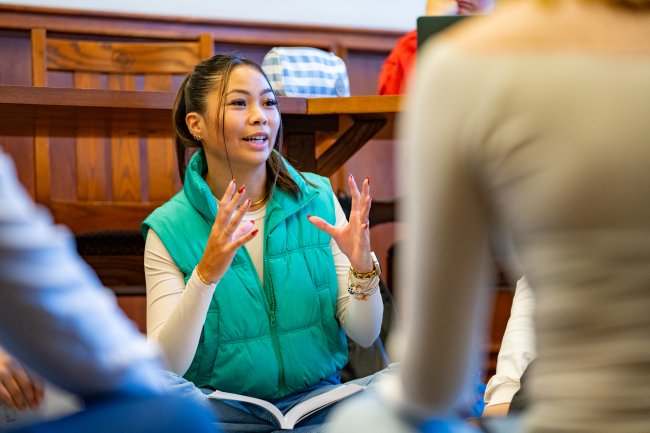
Student in a seminar discussion.

Diversity and Inclusion Officer
Promote equitable workplace cultures and develop initiatives that foster diversity, belonging, and cross-cultural understanding.

Human Resources Representative
Apply knowledge of human behavior to recruit, train, and support employees while enhancing organizational culture.

Foreign Service Officer
Represent national interests abroad by engaging with diverse communities, analyzing global trends, and advancing diplomatic goals.

Public Policy Analyst
Research and evaluate the social and cultural implications of policies to inform government or nonprofit decision-making.

International Nonprofit Administrator
Coordinate humanitarian and development programs that address global challenges through a culturally informed approach.

Market or Social Research Analyst
Collect and interpret data on human behavior and social trends to guide public or corporate strategies.

Community Development Specialist
Design and implement initiatives that strengthen community engagement and address social, cultural, or environmental issues.

Museum or Cultural Program Coordinator
Develop educational programs and exhibits that highlight cultural heritage and human diversity.

Educator or Academic Researcher
Teach, write, and conduct research on human societies, culture, and global issues in educational or research settings.


Saint Mary's Testimonials

“It was because of these professors that I secured a position in my field directly after graduation. This was the result of more than just the skills I was taught, but thanks to my advisor searching and finding field school opportunities specific to me. Without her guidance and support, I wouldn’t be on my current career path.”

Carly Walker, Class of 2018, Anthropology and Art History

School and Department Information