Astronomical Instruments

This collection of astronomical instruments, located on campus, celebrates the rich history of sky observation and measurement. Highlights include the Meridian Plinth, the Gnomon Plinth, a pair of astrolabes , and a two-foot armillary sphere. Designed and built by members of the Saint Mary’s community, these tools invite wonder and exploration through hands-on celestial observation:
Astrolabe
Hanging from the square pillar are two astrolabes. The first is modeled on the astrolabe described in Chaucer’s Treatise on the Astrolabe (the first scientific text written in English). The sighting device allows the user to tell time, to identify celestial objects, and to read off the times of their risings and settings. The astrolabe requires a complex dial that is specific to the latitude of the observer. The second astrolabe’s plaque works for Latitude 35 North. (We are at 37 degrees 50 minutes and 5 seconds north of the equator—37° 50" 5' N. Lat.)
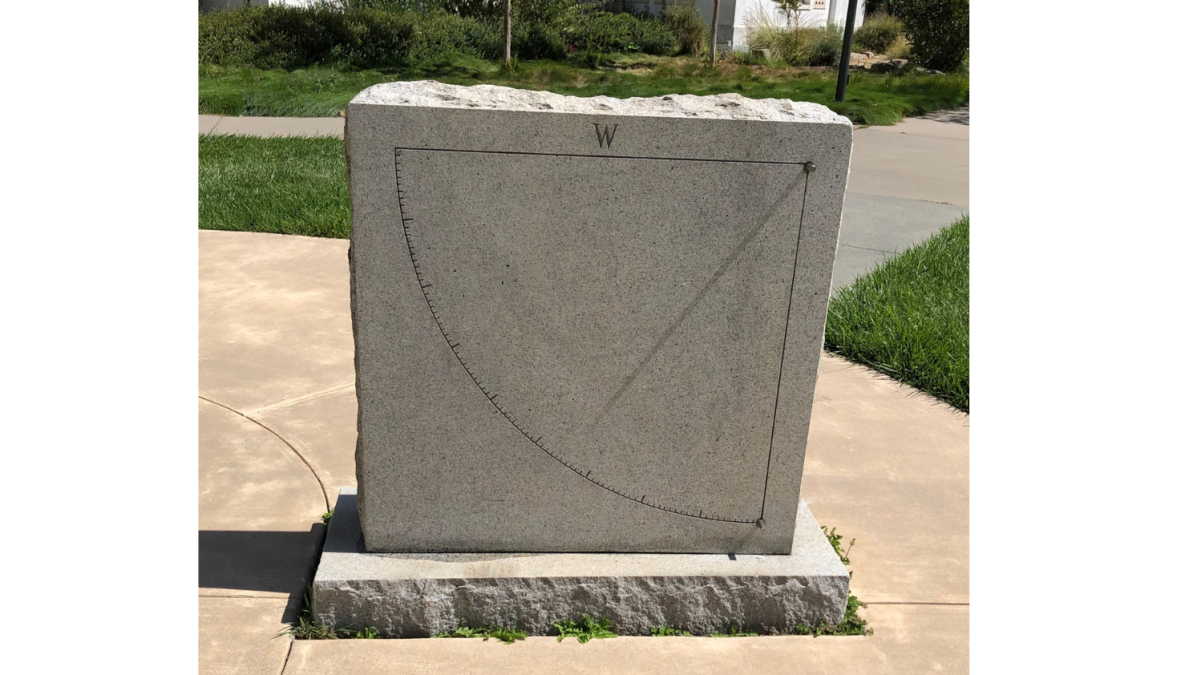
Meridian Plinth
The tombstone-like stone plinth is aligned North – South. The horizontal line along the top of the protractor aligns with the horizon. On its west side is a peg that at local noon, when the sun is highest in the sky, casts a shadow on the engraved protractor and so measures the vertical angle made by the intersection of the line from the sun to us with the horizon line.
Designed by Brother Raphael Patton (after Ptolemy). Donated by Father Edmund Moss.
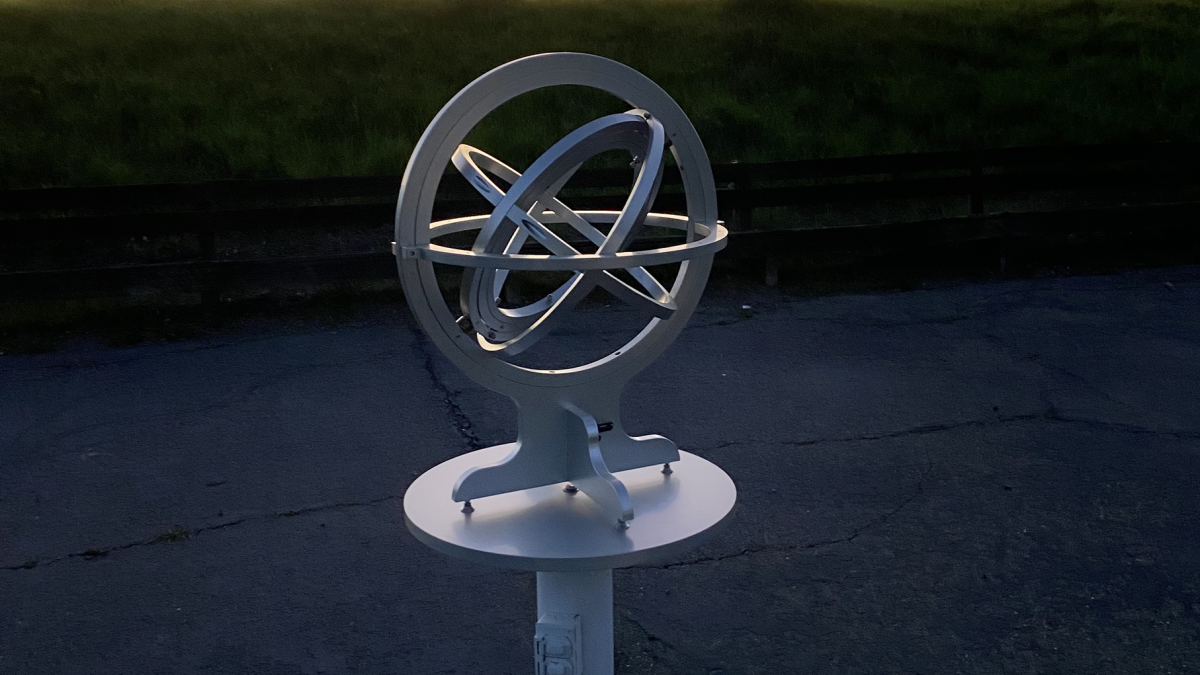
Armillary Sphere
Set up on top of the pillar from time to time is a two-foot diameter measuring device, sometimes called an astrolabe, here called an armillary sphere. The sphere has earth at its center. The rings represent the celestial equator (which divides the sphere of the fixed stars into a northern hemisphere and a southern hemisphere), the ecliptic (the path of the sun through the zodiac during the course of a year), and the local meridian (the great circle that passes directly above us and through the North and South poles).
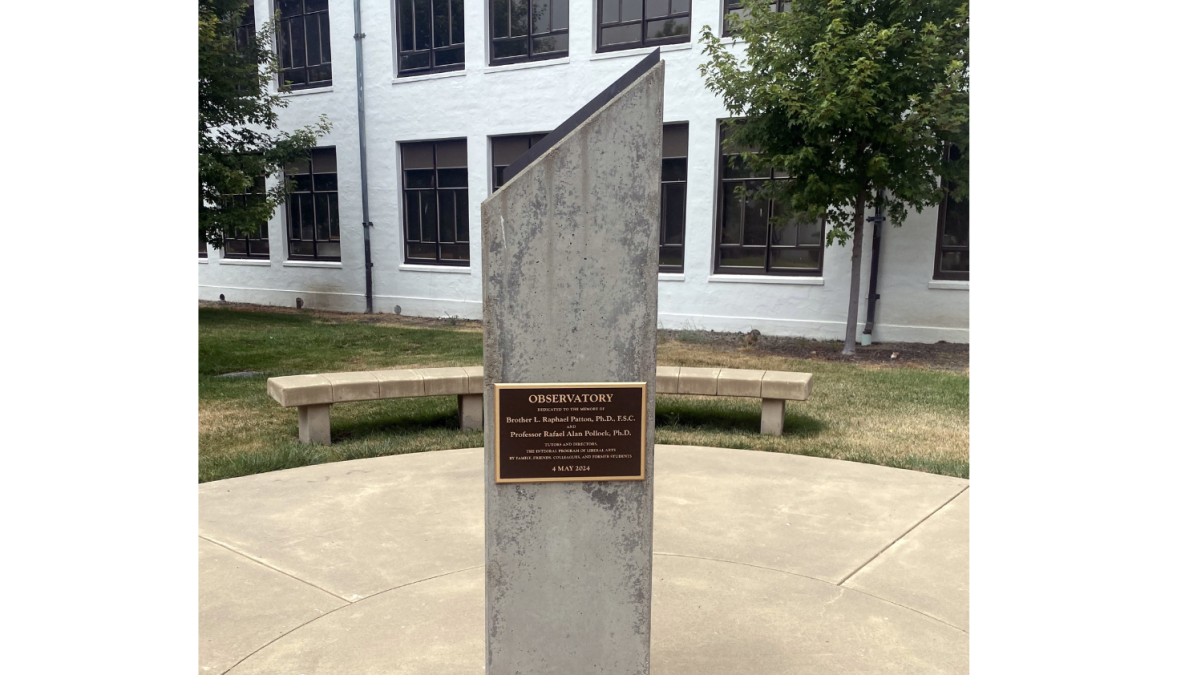
Gnomon Plinth
The slanted edge of the blade atop the tall concrete pillar points at the North Pole. During the day the pointer casts a shadow whose tip traces a line across the cement pad. Read the article below by Brother Raphael proposing that wonder about the shape of this line led to the mathematics of the conic sections. Designed by Jim Smith (SMC ’67), constructed by Pratt Brothers of Canyon, the plinth was funded by the Gabriel Murphy Endowment for the Integral Program Laboratory.