Transform the world by mastering the transformation of matter. 

Our program combines theoretical knowledge, experimental work, interdisciplinary study, and real-world applications to provide you with a solid foundation in this vital and innovative field. You'll develop the skills to solve unfamiliar problems, delve deeply into complex topics, and effectively communicate your findings. With small class sizes and the guidance of our distinguished faculty, you'll form lasting connections within a supportive community of change-makers.

Our program graduates are well-prepared for careers in research, industry, medicine, dentistry, education, and beyond.


Apply Request Info

Learn More About Our Program

Get to know our well-respected faculty and their specialties. Or explore scholarship opportunities and an array of research possibilities.

CURRICULUM

Chemistry, BS

BS

The bachelor of science (B.S.) chemistry major provides a solid foundation for students pursuing careers in technically intensive fields or graduate study.

Learning Outcomes

  • LO1: Use molecular theory and physical principles to explain and predict chemical and physical phenomena in all areas of the discipline (analytical, biological, inorganic, organic, and physical chemistry).
  • LO2: Apply principles of chemical reasoning to solve qualitative and quantitative problems or questions.
  • LO3: Design, perform, and interpret laboratory experiments with both modern instrumentation and classical techniques, using safe and responsible lab practices.
  • LO4: Document and communicate scientific information and experimental work.
  • LO5: Identify and utilize credible scientific literature.

Requirements

Lower Division Chemistry

The following lower-division chemistry courses are required for the major.

  • General Chemistry I (4 units)
  • General Chemistry I Laboratory (1 units)
  • Organic Chemistry I (4 units)
  • Organic Chemistry I Lab (1 units)
  • Organic Chemistry II (4 units)
  • Organic Chemistry II Lab (1 units)
  • General Chemistry II (4 units)
  • General Chemistry II Lab (1 units)

Mathematics

The following mathematics courses are required for the major. Please also see the note regarding math courses below.

  • Calculus I (4 units)
  • Calculus II (4 units)

Physics

Two semesters of physics are required for the major.

  • Introduction to Physics I (4 units)
  • Intro to Physics I Lab (1 units)
  • Introduction to Physics II (4 units)
  • Intro to Physics II Lab (1 units)
  • General Physics I (4 units)
  • General Physics I Laboratory
  • General Physics II (4 units)
  • General Physics II Laboratory

Biology

Students must take either an introductory biology course or take a co-requisite course alongside Biochem 301. Students with strong high school or college biology preparation who obtain instructor approval to enroll in BIOCHEM 301 may waive this requirement for the Chemistry BS major.

  • Fundam. of Cell and Mol. Biol (1 units)
  • Intro Cell & Molecular Bio (5 units)
  • Intro Cell & Molec Bio Lab

Upper Division Courses

The following upper-division courses are required

  • Structural/Physical Biochem (5 units)
  • Chemical Literature (1 units)
  • Analytical Chemistry (5 units)
  • Advanced Inorganic Chemistry (4 units)
  • Instrumental Chem Analysis (5 units)
  • Quantum Mech & Spectroscopy (4 units)
  • Thermodynamics and Kinetics (4 units)

Chemistry Elective

Take at least 3 units of electives from the following list. Multiple mentored research courses can be combined to satisfy this requirement.

  • Environmental Chemistry (5 units)
  • Advanced Organic Chemistry (3 units)
  • Polymer & Supramolecular Chem (4 units)
  • Chemistry Outreach (1 units)
  • Mentored Research (1-4 units)

Notes

  • Calculus III (4 units)
  • Biochemistry (5 units)
  • Survey of Chemistry (3 units)
  • Survey of Chemistry Lab (1 units)
  • General Chemistry I (4 units)
  • General Chemistry I Laboratory (1 units)
  • Organic Chemistry I (4 units)
  • Organic Chemistry I Lab (1 units)
  • Organic Chemistry II (4 units)
  • Organic Chemistry II Lab (1 units)
  • General Chemistry II (4 units)
  • General Chemistry II Lab (1 units)
  • Mentored Rsrch / Indep Study (1-4 units)
  • CHEM Elective (1-5 units)
  • Chemical Literature (1 units)
  • Analytical Chemistry (5 units)
  • Environmental Chemistry (5 units)
  • Environmental Chemistry Lab
  • Advanced Organic Chemistry (3 units)
  • Advanced Inorganic Chemistry (4 units)
  • Polymer & Supramolecular Chem (4 units)
  • Chemistry Outreach (1 units)
  • CHEM UD Elective (1-5 units)
  • Instrumental Chem Analysis (5 units)
  • Survey of Physical Chemistry (5 units)
  • Survey of Physical Chem Lab
  • Quantum Mech & Spectroscopy (4 units)
  • Quantum Mech & Spectro Lab
  • Thermodynamics and Kinetics (4 units)
  • Thermodynamics & Kinetics Lab
  • Independent Study (1-4 units)
  • Mentored Research (1-4 units)

What can you do with a degree in Chemistry?

A BS in Chemistry provides the scientific foundation to understand matter and its transformations, preparing students for careers in research, healthcare, industry, and education
(*Some careers may require graduate school or additional study)
Image
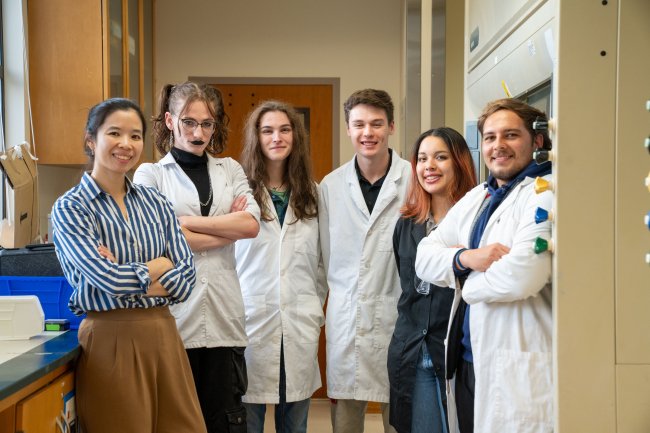
Amy Chu and her students in the lab


Analytical Chemist
Develop and perform tests to identify chemical compositions and ensure product quality and safety.

Chemical Engineer
Design and optimize processes for producing fuels, materials, and pharmaceuticals at industrial scale.

Forensic Scientist
Analyze physical evidence in criminal investigations using chemical and instrumental methods.

Toxicologist
Study the effects of chemicals and substances on living organisms to improve public health and safety.

Pharmacologist
Research how drugs interact with biological systems to develop and evaluate new medical treatments.

Materials Scientist
Investigate and design new materials—such as polymers, composites, or nanomaterials—for industrial and technological use

Quality Control Specialist
Ensure compliance with regulatory standards by monitoring and testing chemical products and procedures

Research Scientist
Conduct experimental and theoretical studies in academia, government, or private laboratories to advance chemical knowledge.

Science Educator
Teach chemistry principles and laboratory techniques at the secondary or postsecondary level, inspiring future scientists

Saint Mary's Testimonials

Person Headshot '14

“As a Chemistry major, I am so thankful for the lab and research skills that I have learned throughout the four years. Saint Mary’s really prepared me for my current job as a lab analyst. The skills that I have learned at Saint Mary’s has helped me thrive at work.”

Jazlynn Gee, Class of 2021

School and Department Information