
Physics, BS
Untangle the mysteries behind the universe, from the velocity of steam to the power of a supernova.
This track is designed for students who wish to pursue careers or graduate study in scientific and technically intensive fields. Using a balance of theoretical, experimental, and computational work, our program will provide you with a foundational understanding of physical phenomena and natural systems. All of this takes place within small, discussion-rooted classes, a hallmark of the liberal arts tradition.
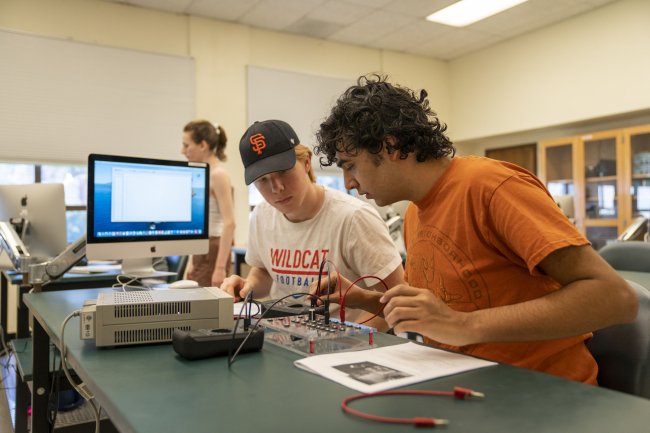
Guided by our renowned, approachable faculty, you’ll hone your ability to wrestle with unfamiliar problems and ethical issues, the tools to investigate topics in-depth, and the communication skills needed to share information with others. We’re committed to providing you with hands-on opportunities through the laboratory, field research at home and abroad, and independent study.

Learn more about our program
Get to know our well-respected faculty and their academic specialties. Or explore scholarship opportunities and an array of research possibilities.
Physics Curriculum
What can you do with a degree in Physics?
A degree in Physics prepares you with a strong foundation in skills applicable to a wide variety of professions.
(*Some careers may require graduate school or additional study).
Software Developer
Design and build software systems and tools, using your physics-driven modeling and coding skills to solve technical problems
Data Analyst
Analyze large datasets, build predictive models, and translate quantitative findings into recommendations for science, finance, energy, or policy teams
Nuclear Engineer
Contribute to nuclear energy, medical radiation systems, or shielding/safety design by applying your knowledge of matter, forces, and energy
Lab Technician
Support scientific and engineering research by running experiments, maintaining instruments, collecting measurements, and documenting results
Research Scientist / Research Assistant
Work in national labs, private R&D, or university labs on problems in materials, optics, energy systems, or astrophysics, designing experiments and interpreting data
Systems / Test Engineer
Plan and run tests on hardware or integrated systems (sensors, detectors, mechanical systems), verify performance, and diagnose failures
Electrical / Instrumentation Technician
Build, calibrate, and troubleshoot electronics, detectors, and control systems used in labs, manufacturing, energy, aerospace, or medical devices
Quantitative Analyst (Entry-Level)
Use mathematical modeling, statistics, and optimization to study market risk, pricing, or reliability; physics majors are often recruited into these roles for their modeling skills
High School Physics / Physical Science Teacher
Teach physics or general science at the secondary level; this path is supported at Saint Mary’s through the Single Subject Teaching Credential
Saint Mary's Testimonials

“My time at SMC prepared me for the challenges of my post-grad life. As an international student, I had to adapt to living far away from home, with classes and life in a different language. Doing a challenging major like Physics added to the challenge of getting a degree abroad. But when I look back I am thankful for all the people I met along the way, who helped me in every step of the process - professors, fellow students, Brothers, and officers such as those who work at the CIP. Now I am fully suited to face the challenges of getting my career started in the engineering field. I recently got a promotion and I look forward to many more successes in the future.”
Javier Rivera, Physics Major 2021


