Biology, BS

Biology, BS

Tackling climate change, saving endangered species, or teaching fifth-grade science—with a Biology degree from Saint Mary’s College, your possibilities are endless.

 Let our Biology Department be the launchpad for your unique aspirations. Our program combines theoretical knowledge with experimental practice, providing a solid foundation in life sciences, from the basics of life to organism structures, functions, and evolutionary processes. Enjoy small, discussion-based classes, a hallmark of our liberal arts tradition.

Guided by our renowned and approachable faculty, you'll develop the skills to tackle unfamiliar problems, ethical issues, and in-depth research topics. You'll also enhance your ability to communicate complex information effectively. We are dedicated to offering hands-on experiences through formal classes, directed laboratory work, field research opportunities at home and abroad, and independent studies.
 

Learn more about the program

Get to know our well-respected faculty and their academic specialties. Or explore scholarship opportunities and an array of research possibilities.

CURRICULUM

Biology, BS

BS

Learning Outcomes

  • DEMONSTRATE a core knowledge in all three major areas of biology: molecular and cellular, organismal, and ecology and evolution.
  • ANALYZE scientific information logically and critically.
  • APPLY biological knowledge to a different context and/or exploration of new areas of inquiry.
  • COMMUNICATE biological research and/or concepts effectively in both written and oral formats.
  • USE biological techniques competently for research.
  • Discuss the ethical, societal, or environmental consequences of biological practices or the role of biology in addressing current ethical, societal, and environmental challenges.

Requirements

Lower Division

  • The following lower-division courses are required for the major.
  • Intro Cell Bio, Molecular Bio, & Biochem (5 units)
  • Intro to Cell Bio, Molecular Bio Lab
  • Introduction to Organisms and Evolution (5 units)
  • Intro to Organisms and Evolution Lab
  • General Chemistry I (4 units)
  • General Chemistry I Laboratory (1 units)
  • Organic Chemistry I (4 units)
  • Organic Chemistry I Laboratory (1 units)
  • Organic Chemistry II (4 units)
  • Organic Chemistry II Laboratory (1 units)
  • General Physics I (4 units)
  • General Physics I Laboratory
  • Take one of the following science electives (lecture+lab) outside of Biology (minimum 4 units).
  • General Chemistry II (4 units)
  • General Chemistry II Laboratory (1 units)
  • OR
  • General Physics II (4 units)
  • General Physics II Laboratory

Math

  • Take one of the following courses (minimum 3 units). MATH 104 and MATH 137/137L fulfill the Mathematical Understanding requirement of the Core Curriculum, while BIOL 308/308L does not.
  • Research Design and Biostatistics (5 units)
  • Intro Probability & Statistics (3 units)
  • Calculus I (4 units)

Required Upper Division Biology

  • The following upper-division Biology courses are required for the major. Ecology and Genetics should be completed by the end of the junior year. Research Writing should be completed during the senior year.
  • Genetics (5 units)
  • Genetics Lab
  • General Ecology (5 units)
  • General Ecology Lab
  • Research Writing in Biology (1 units)

Breadth Requirements

  • At least one upper-division course must be taken in each of the following three groups: Cell and Molecular Biology, Organismal Biology, and Ecology and Evolution.

Cell and Molecular Biology

  • Take 1
  • Biochemistry (5 units)
  • Molecular Biology (5 units)
  • Cell Biology (5 units)
  • Microbiology (5 units)
  • Immunology (5 units)
  • Special Topics in Cell and Molecular Bio (3-4 units)

Organismal Biology

  • Take 1
  • General Botany (5 units)
  • Developmental Biology and Embryology (4 units)
  • Comparative Vertebrate Anatomy (4 units)
  • Comparative Animal Physiology (5 units)
  • Advanced Human Anatomy (5 units)
  • Advanced Human Physiology (5 units)
  • Special Topics in Organismal Biology (3-4 units)

Evolution and Ecology

  • Take 1
  • Evolution (4 units)
  • Macrosystems Biology (3 units)
  • Conservation Biology (4 units)
  • California Flora & Communities (5 units)
  • Aquatic and Marine Biology (4 units)
  • Vertebrate Zoology (5 units)
  • Symbiosis (4 units)
  • Special Topics in Evolution and Ecology (3-4 units)

Lab Requirement

  • Take five upper-division Biology courses that have a lab component, including Genetics and General Ecology.
  • Genetics Lab
  • General Ecology Lab
  • Research Design and Biostatistics Lab
  • Biochemistry Lab
  • Molecular Biology Lab
  • Cell Biology Lab
  • Microbiology Lab
  • Immunology Lab
  • General Botany Lab
  • Developmental Biology and Embryology Lab
  • Comparative Vertebrate Anatomy Lab
  • Comparative Animal Physiology Lab
  • Advanced Human Anatomy Lab
  • Advanced Human Physiology Lab
  • Macrosystems Biology Lab (2 units)
  • California Flora and Communities Lab
  • Vertebrate Zoology Lab
  • Symbiosis Lab
  • Field/Laboratory Research in Biology (1-4 units)

Upper-division Course Requirement

  • Take a minimum of 33 units of 300-level and 400-level Biology courses. After completing the Required Upper Division courses, the Breadth requirement, and the Lab requirement, students are encouraged to take any other upper-division BIOL courses of interest.
  • Intro to Biology for Human Hea (5 units)
  • Intro to Biology for Hlth Lab
  • Protecting Biodiversity (4 units)
  • Introductory Microbiology (4 units)
  • Introductory Microbiology Lab
  • General Biology (5 units)
  • General Biology Laboratory
  • Human Biology (4 units)
  • Human Biology Lab
  • Biology of Women (4 units)
  • Biology of Women Lab
  • Intro Cell & Molecular Bio (5 units)
  • Intro Cell & Molec Bio Lab
  • Intro Organisms and Evolution (5 units)
  • Intro Organisms & Evol Lab
  • Human Anatomy for Kines (5 units)
  • Human Anat for Kines Lab
  • Human Anatomy (5 units)
  • Human Anatomy Laboratory
  • Human Physiology (5 units)
  • Human Physiology Laboratory
  • Anatomy and Physiology I (4 units)
  • Anatomy and Physiology I Lab
  • Anatomy and Physiology II (4 units)
  • Anatomy and Physiology II Lab
  • Genetics (5 units)
  • Genetics Lab
  • General Ecology (5 units)
  • General Ecology Lab
  • Research Design & Biostat (5 units)
  • Rsrch Design & Biostat Lab
  • Biochemistry (5 units)
  • Biochemistry Lab
  • Molecular Biology (5 units)
  • Molecular Biology Lab
  • Cell Biology (5 units)
  • Cell Biology Lab
  • Microbiology (5 units)
  • Microbiology Lab
  • Immunology (5 units)
  • Immunology Lab
  • Special Topics Cell & Molec (3-4 units)
  • General Botany (5 units)
  • General Botany Lab
  • Dev Biology and Embryology (4 units)
  • Dev Biol and Embryology Lab
  • Comparative Vertebrate Anatomy (4 units)
  • Comparative Vert Anatomy Lab
  • Comparative Animal Physiology (5 units)
  • Comp Animal Physiology Lab
  • Advanced Human Anatomy (5 units)
  • Advanced Human Anatomy Lab
  • Advanced Human Physiology (5 units)
  • Advanced Human Physiology Lab
  • Special Topics Organismal Bio (3-4 units)
  • Evolution (4 units)
  • Macrosystems Biology (3 units)
  • Macrosystems Biology Lab (2 units)
  • Conservation Biology (4 units)
  • California Flora & Communities (5 units)
  • Cal Flora & Communities Lab
  • Aquatic and Marine Biology (4 units)
  • Vertebrate Zoology (5 units)
  • Vertebrate Zoology Lab
  • Symbiosis (4 units)
  • Symbiosis Lab
  • Special Topics Evo & Eco (3-4 units)
  • Research Writing in Biology (1 units)
  • Internship (1-4 units)
  • Independent Study in Biology (1-4 units)
  • Mentored Research (1-4 units)

What can you do with a degree in Biology?

A degree in Biology provides students with a strong foundation in skills applicable to a wide variety of professions
(*Some careers may require graduate school or additional study).
Image
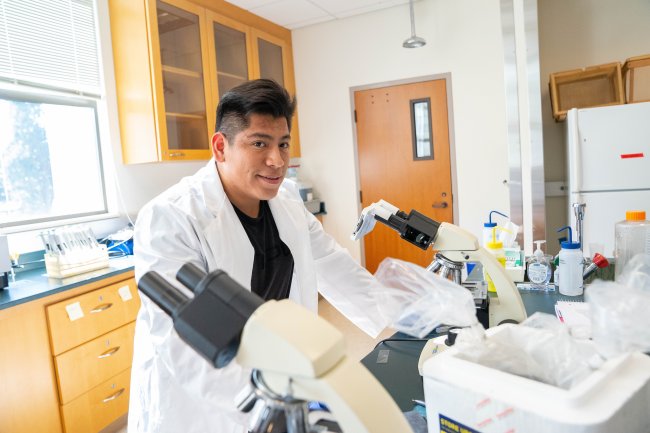
male student standing in a lab coat over microscopes within a lab classroom surrounded by lab equipment, smiling at the camera

Biochemist
Study the chemical processes of living organisms to advance medicine, agriculture, or biotechnology.

Conservation Scientist
Develop and implement strategies to manage natural habitats and protect endangered species.

Biological Technician
Support laboratory experiments by collecting data, maintaining equipment, and analyzing samples.

Wildlife Biologist
Research animal behavior, ecology, and population trends to inform conservation and policy efforts.

Agricultural and Food Scientist
Improve crop production, food safety, and sustainability through biological and chemical analysis.

Pharmaceutical or Medical Sales Representative
Apply scientific expertise to communicate the benefits and applications of medical and pharmaceutical products.

Microbiologist
Investigate microorganisms and their roles in health, disease, and environmental systems.

Environmental Consultant
Assess ecological impacts, monitor pollution, and provide guidance for sustainable practices.

Science Educator
Teach biology in schools, museums, science centers. A single-subject credential at Saint Mary’s alongside a Biology degree prepares students to teach high school.

Science Reporter or Communicator
Research and report on current advances in biological sciences to broad audiences.

Research Scientist
Conduct studies to deepen understanding of life processes from molecules to ecosystems.

Physician
The Biology, B.S. degree prepares students to apply to medical school to become an M.D. and practice medicine. 

Saint Mary's Testimonials

Person Headshot '14

“Pursuing a major in Biology at Saint Mary's College of California allows one to delve into the mysteries and beauty of life. The Biology program allows students to be prepared for future endeavors through educating in a wide range of sub-fields within Biology.”

 Jacinto Obregon, Class of 2021

School and Department Information