Leslie Nguyen-Okwu '27: MFA Creative Writing Spotlight

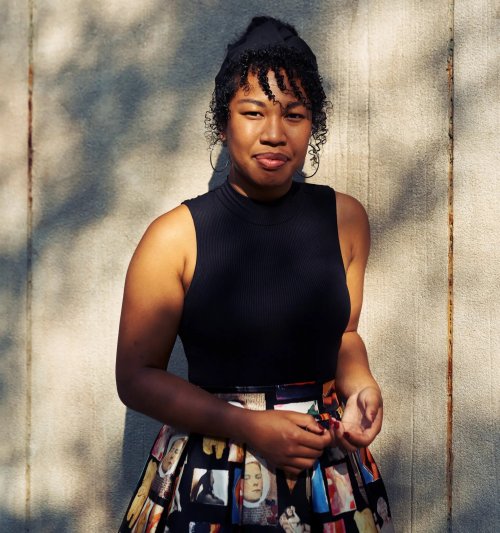
Leslie Nguyen-Okwu, Creative Nonfiction Class of 2027, a Question and Answer session. In celebration of the MFA in Creative Writing's 30th Anniversary at Saint Mary's College.
1. What brought you to writing? And what do you keep finding in writing?
I came to writing through reporting. After Trump was elected in 2016, I bought a one-way ticket and left the country. I spent years as a roving foreign correspondent covering statelessness, border conflicts, and contested homelands. I was drawn to people living in between and displaced communities whose countries had crumpled beneath them. I didn't realize I was also writing about myself. I come from a refugee family myself — my mother fled Vietnam after Saigon fell, my father was born into the Biafran War in Nigeria.
When I got sick with a rare, aggressive blood cancer, I lost the ability to report. I couldn't travel or chase stories. All I had was mine. And it turned out the memoir had been waiting. The questions I'd been asking strangers were the same ones I'd been avoiding about my own family. What did you have to leave behind? How did you escape? Did you ever? When I was seventeen, my parents legally added my mother's Vietnamese surname before my father's Nigerian one, joined by a hyphen, because they believed an Asian name would open doors my African name alone would close in America. That tiny hyphen, both a bridge and a divider, became the larger organizing principle for everything I write now.
What I keep finding is that the big story lives inside the small details. A hyphen. Maybe a citizenship exam question. Perhaps the absence of a box to check for your race on a census form. We don't always need to enter through the wound. Sometimes the most honest way in is through something ordinary that turns out to be carrying everything. I write essays that borrow their structures from my life — including asylum petitions, medical lab reports, tutorials for box braids, even a Nigerian scam email. I take the forms that had power over my life and I write through them until they give. What the form says and who I truly am are never the same thing. The meaning-making happens in the space between.
2. How do you contend with life in the world as it is, and what freedom and truth can you find or land on in your writing?
The world as it is? I grew up watching officers search my Nigerian father during routine traffic stops while they helped my Vietnamese mother during fender-benders. My mother used fake addresses to enroll me in better schools across town because our neighborhood schools were failing. My father taught me to angle the blinds so no one could see inside our house. The world as it is taught me from a young age that sometimes survival requires performance, and that the performance costs me something that I’m still trying to understand.
Writing is where I stop performing. My science fair lab report about color absorption became an essay about which bodies absorb this country's racial contradictions and which ones reflect them back. An imagined travel brochure to my mother's erased village let me write about what happens when the place you come from is bombed into oblivion and no longer exists on any map.
I survived cancer and, soon after, I survived a psychiatric hospitalization. Both times, my body was categorized and filed away in someone else's language. The medical charts never matched what I lived through, so I annotated on top of them and inserted my own voice. Sometimes the truth doesn't fit any form that already exists. So you have to build the shape yourself — invent the structure that can hold it.
I believe that writers are first responders. When authoritarian governments — like the regimes my family lived under — try to seize the agency of its people, the first thing they do is to strangle their voices. They go after the storytellers, the documenters, the writers, the journalists. In America, we're living in a moment where the federal government is rolling back civil rights protections, defunding agencies that track racial violence, and running mass deportation operations that disproportionately target immigrant communities like mine. Black and Asian communities are being pitted against each other by design. Writing about what it means to hold both identities feels more urgent to me now than when I started this book five years ago.
3. What writers would you say are in your literary lineage?
Claudia Rankine showed me that fragmented prose can convey racial grief without over explaining it. Diana Khoi Nguyen showed me how to write toward what the archive erased, the white spaces on the page. Ocean Vuong writes about immigrant silence in a way that made me realize silence is a story too, if you listen long enough. And André Aciman wrote about the "hidden nerve" in writing — the thing beneath style that makes prose tick — and I've been trying to locate mine ever since.
More recently, I read a Trinidadian memoir called How to Be Unmothered by Camille Adams, written in patois. Agents and editors kept telling her the English was "wrong." She published it anyway, on her own terms. That book changed how I think about my own home language — like the Vietnamese-inflected English my grandfather uses or the Nigerian Pidgin my aunt speaks.
I also learn from structure and the shapes of stories. Like Brice Matthieussent's Revenge of the Translator, where footnotes consume the page. And Carmen Maria Machado's In the Dream House, where every chapter borrows a different genre to tell the same story from a new angle.
4. What do you hope to write in your time at SMC?
I'm finishing my memoir-in-essays American Hyphen. The backbone of the collection is already built — essays that borrow a structure from something that shaped my life. What I still need to write are some of the pieces I've been circling the longest. To name a few: a choose-your-own-adventure about my post-cancer trip to Nigeria where paths loop back or dead-ends. An essay where I ask ChatGPT to tell my mother's refugee story and it generates a heroic narrative I have to delete and replace with the real version. A family Wikipedia page where half the entries say [citation needed] because war destroyed the records and fractured my family tree. I want SMC to be where I stop circling those drafts and commit to them, and where the book moves from a collection of experiments into a fully finished manuscript.
5. Every artist has to deal with the messiness of editing and receiving feedback. How have you learned to do that part of the work?
Journalism trained me. When you file a story for the BBC or the Times, an editor sends it back with tracked changes and you fix it by the deadline. There's no preciousness about it. That discipline stuck with me.
But memoir is different. Imagine: someone reads your cancer essay and says the pacing drags in the section about chemo, and you know they're right, but the pacing drags because that's what chemo felt like — everything slowing down, as the drip moves like sticky toffee into your veins. So I have to figure out the difference between a structural problem on the page and an emotional truth I’m protecting. I'm still learning that. I've gotten better at recognizing when I'm defending a sentence because it's good and when I'm defending it because cutting it feels like losing the memory.
I also do a thing now where I apply the "last sentence test" to every paragraph. I read the last line and ask myself: does this explain what I already showed? If yes, I cut it. As I read more, I see how writers write too far past the real ending all the time. I do it too. The instinct is to land the meaning and make sure the reader got it. But the reader usually got it two sentences ago, and the extra lines are for me, not them.
Lastly, the best revision feedback I’ve ever received didn't tell me what I was doing wrong. It told me everything I was doing right and where to lean in harder.
6. What's on your book nightstand (real or proverbial) right now?
My nightstand is a mess. There's a sprig of rosemary I urban foraged (read: thieved) from my neighbor's lawn, a wood wick candle that sounds like a tiny ASMR fireplace, and a York Peppermint Pattie wrapper smeared with melted chocolate from midnight.
There’s a stack of memoirs too. At the bottom, I have Carmen Maria Machado's In the Dream House, which does divine things with borrowed form that make me want to tear apart every essay I've written. I’m on my third read now. Then, Sarah Aziza's The Hollow Half, a new book about bodies and borders that weaves anorexia recovery with Palestinian displacement. And on top, an advance copy of Lorraine Boissoneault's Body Weather: Notes on Chronic Illness in the Anthropocene, which I'm reviewing for a magazine. Her framework of "body weather" gave me language for what it feels like to live inside a body that has betrayed you. As a cancer survivor, I needed that language. I also keep Suleika Jaouad's Between Two Kingdoms close by. It sat on my hospital bedside tray next to my IV chemo infusion pole, and it made me feel less alone when I needed that most. If my writing can do that for one person, that's enough. It remains the memoir I measure all others against.
On the craft side, I have Grant Faulkner's The Art of Brevity on compression and omission — because what you leave out is just as important as what you put in. And Kim Adrian's The Shell Game, an anthology of essays that take their structures from ordinary sources like recipes, tax forms, crossword puzzles, Craigslist ads, and more. I read with a highlighter. I'm always looking for fun structures I can play with.
Bio:
Leslie V. Nguyen-Okwu is a Vietnamese Nigerian American writer working on American Hyphen, a memoir about belonging and balancing on the tightrope between Asian America and Black America. Her essays and reporting have appeared in The New York Times, BBC, National Geographic, The Economist, and Harper's Bazaar. She spent years as a foreign correspondent covering displacement, statelessness, and contested nations. Leslie earned her Bachelor's at Stanford University, pursued a Master’s at Harvard University, and is now working toward a Master of Fine Arts in Creative Nonfiction at Saint Mary's College of California. She currently serves as Director of Strategic Communications at Welcoming America, a national nonprofit advancing immigrant inclusion. Her writing has earned fellowships and residencies from Hedgebrook, Tin House, the Banff Centre for Arts and Creativity, Mesa Refuge, Disquiet International Literary Program, Voices of Our Nations Arts Foundation, and the Community of Writers.
School and Department Information
Chris Feliciano Arnold
Director, MFA in Creative Writing
cfa1@stmarys-ca.edu
925-631-8556
Collin Skeen
Assistant Director of Admissions and Recruitment
cas38@stmarys-ca.edu
925-631-4190