Explore and master the field Albert Einstein called “the poetry of logic.”

The Bachelor of Arts degree is for students who desire a broad liberal arts education with an emphasis in mathematics. This degree is appropriate for students who wish to major in mathematics as part of a broader interdisciplinary program, such as undertaking a minor or a second major.

Guided by our renowned, approachable faculty, you’ll hone your ability to wrestle with unfamiliar problems, the tools to investigate topics in-depth, and the communication skills needed to share information with others. We’re committed to providing you with hands-on opportunities through the laboratory, field research at home and abroad, and independent study.


Apply Request Info

Learn more about the program

Get to know our well-respected faculty and their academic specialties. Or explore scholarship opportunities and an array of research possibilities.

Math Curriculum

Mathematics, BA

BA

Mathematics, BA

The Bachelor of Arts degree is for students who desire a broad liberal arts education with an emphasis in mathematics. This degree is appropriate for students who wish to major in mathematics as part of a broader interdisciplinary program, such as undertaking a minor or a second major.

Secondary Teaching

The Math major has two pathways to prepare future middle and high school classroom teachers. Students declare a different Mathematics degree for each pathway.

Math BA, Teaching Credential & Masters Degree (5 years): Students choosing this pathway declare both the specialized Math 4+1 major and JCL minor, described on that program's page: program.

Math BA & Teaching Credential (4 years): The integrated Single Subject Teacher Education (SSTE) pathway enables students to graduate with a Math BA and a California Teaching Credential in 4 years. Students interested in this pathway declare the Mathematics, BA described on this page and select the option to add a single-subject teaching credential to their degree. Students who wish to completing their mathematics and teacher education separately should also follow this pathway.

Students interested in becoming a secondary mathematics teacher are advised to complete the following upper-division courses as part of their mathematics education:

  • MATH 303 - Intro to Upper Division Math

  • MATH 411 - Abstract Algebra I

  • MATH 313 - Probability & Statistics

  • MATH 315 - Number Theory

  • MATH 220 - Linear Algebra with Applications

  • MATH 431 - Topology

  • MATH 450 - Real Analysis

  • MATH 496 - Capstone Experience

Pre-professional field experience: The California Commission on Teacher Credentialing (CCTC) also requires students to obtain “pre-professional field experience”. This requirement is satisfied by course Introduction to the Teaching Profession and course. Students should also speak with a representative of the School of Education to learn of any other requirements of the state of California for prospective secondary teachers.

Learning Outcomes

  • PLO 1: Masterfully explain concepts from single-variable calculus, linear algebra, computer programming, and mathematical logic, and apply them to solve problems.
  • PLO 2: Correctly apply the appropriate definitions, theorems, and problem-solving techniques to address problems of various levels.
  • PLO 3: Communicate mathematical, algorithmic, and computational ideas and concepts correctly and clearly in both oral and written forms using logical reasoning and appropriate terminology and symbolic representation.
  • PLO 4: Use appropriate knowledge and resources to independently investigate a novel mathematical or computational topic.
  • PLO 5: Appropriately integrate technological tools and resources into their mathematical and computational writing, study, and investigations.

Requirements

Required Courses

Take the following required courses:

  • Programming I (4 units)
  • Calculus I (4 units)
  • Linear Algebra (4 units)
  • Calculus II (4 units)
  • Intro to Upper Division Math (4 units)
  • Capstone Experience (4 units)
  • Abstract Algebra I (4 units)
  • Real Analysis (4 units)

Math Elective

Take one elective in Math, at least 3 units. Take either Math 239, Math 240, or any 300- or 400-level course.

  • Calculus III (4 units)
  • Discrete Mathematics (4 units)
  • Finite Mathematics (3 units)
  • Intro Probability & Statistics (3 units)
  • Art & Practice of Math (3 units)
  • Data Science for Liberal Arts (3 units)
  • Applied Computational Thinking (3 units)
  • Applied Math for Scientists (4 units)
  • Applied Math Calc Lab
  • APPLIED MATH CALC LAB
  • Calculus I (4 units)
  • Calculus I Calc Lab
  • Calculus I (3-5 units)
  • Mathematical Understandng Elec (3-5 units)
  • Math Games (2 units)
  • Linear Algebra (4 units)
  • Calculus II (4 units)
  • Calculus III (4 units)
  • Discrete Mathematics (4 units)
  • Transfer Course (1-5 units)
  • Intro to Upper Division Math (4 units)
  • Probability & Statistics (4 units)
  • Mathematical Modeling (4 units)
  • Number Theory (3 units)
  • Differential Equations (3 units)
  • Complex Variables (3 units)
  • Transfer Course (1-5 units)
  • Abstract Algebra I (4 units)
  • Topology (3 units)
  • Real Analysis (4 units)
  • Special Topics in Mathematics (3 units)
  • Internship (1-4 units)
  • Capstone Experience (4 units)
  • Independent Study (1-4 units)
  • Mentored Research (1-4 units)
  • Math Placement C (Calc Ready)
  • Math Placement P (pre-Calc)

What can you do with a degree in Mathematics?

A Mathematics (BA) builds analytical, quantitative, and communication skills suited to interdisciplinary careers.
(*Some careers may require additional certification or graduate study)
Image
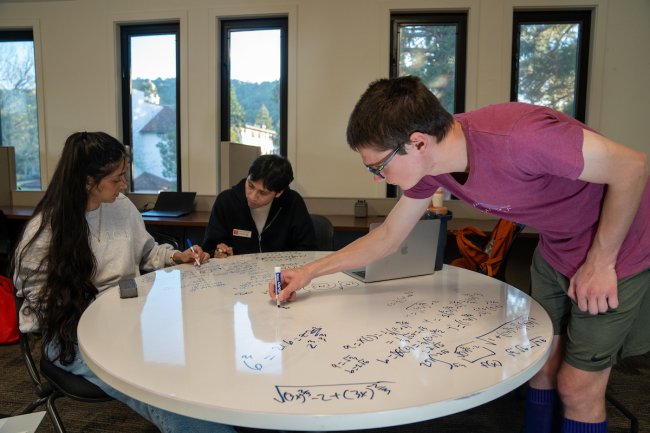
Students in the STEM center studying math


Data Analyst
Query, analyze, and visualize data to inform decisions

Business Analyst
Model processes, define requirements, and improve operations

Financial Analyst
Build forecasts, valuations, and risk models

Operations Research Assistant
Support optimization, simulation, and scheduling studies

Actuarial Analyst (Entry-Level)
Apply probability to pricing, reserving, and risk

Policy or Research Analyst
Use quantitative methods to evaluate programs and impacts

Data Visualization Specialist
Turn complex datasets into clear dashboards and reports

Technical Writer
Translate quantitative concepts into concise documentation

Secondary Math Teacher
Teach foundational math; prepare students for STEM pathways

Explore More Career Outcomes

Saint Mary's Testimonials

Daniel Kao '22

“I must admit that a huge advantage has come from the liberal arts approach that Saint Mary's applies in every class setting, instilling an effective communication which sits at the core of every report, analysis, and presentation I do.”

Dominica Masarova, Class of 2021 (Mathematics, Computer Science Track, BS)

School and Department Information