
Growing green: For Kira Tippit ’27, addressing the climate crisis starts at home. “Building a more sustainable world starts small—and there’s plenty of work to be done right here,” she says. / Photo courtesy Kira Tippit
Can Saint Mary’s Trees Help Create a Carbon-Neutral Future? Kira Tippit ’27 is Working on an Answer
Through the Summer Research Program, this Environmental Science major is conducting foundational research into the carbon storage of plants on campus. It’s work that benefits the College—and it’s equipping Tippit for a career in sustainability.
Looking back, Kira Tippit ‘27 points to family trips to Yosemite and her favorite childhood movie—Pixar’s eco-conscious WALL-E—as early indicators of her path. Not until her final year of high school, however, amidst AP Environmental Science coursework, did she pull all the threads together. “This is what I want to do with my life,” she recalled thinking to herself. “This is the space I want to fill.”
That desire was ultimately what brought Tippit to SMC, where she is currently entering her third year as an Environmental Science major. Back when she was applying to colleges, she was searching for a “more intimate community,” she says, where people cared about each other and their work. “One of the things that really drew me to Saint Mary's was that it felt like a place where people were intentional about their education as well as making an impact.”
This summer, Tippit has worked to make an impact right here at SMC. Specifically, she is documenting the carbon storage of trees throughout campus, taking steps toward understanding how the College can become carbon neutral. Tippit is conducting this research with Nekesha Williams, Program Director of Environmental and Earth Science, through the Summer Research Program. For decades, the program has offered undergraduates like Tippit the chance to work closely with a faculty mentor and delve into a project of their choice.
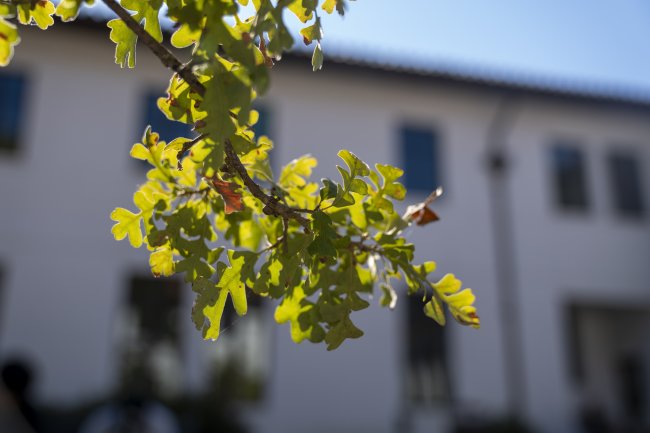
The climate crisis is expansive, requiring large-scale solutions to address it. But it will require small-scale solutions, too. That’s one reason why Tippit chose to focus solely on carbon neutrality at Saint Mary’s.
“There’s something beautiful about investing in your own community,” she says. “Building a more sustainable world starts small—and there’s plenty of work to be done right here.”
Getting the Lay of the Land
Walking around Saint Mary’s lush campus, one can’t help but notice the abundance of trees. Live oaks blanket the surrounding hillsides. Redwoods tower over the classrooms. Cherry trees line the entrance to the College.
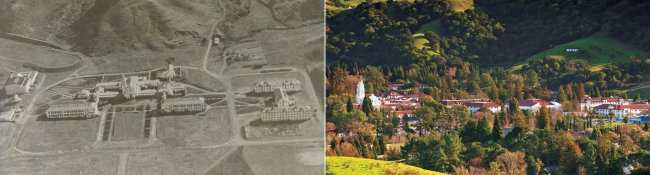
But it wasn’t always this way. When we talked in June, she shared a photograph of the College from 1928. That was the year Saint Mary’s relocated from Oakland to its new home in the Moraga Valley, taking over acres of ranchland. Apart from the buildings and a few shrubs, the campus was a vast, grassy expanse.
Much of the immediate landscape, then, has grown and matured in the last hundred years. Age matters with carbon capture; recent studies suggest that larger, more mature forests are even better at absorbing carbon than new growth. Young or old, though, the trees on campus will play a profound role in moving toward carbon neutrality—something articulated in the College’s Climate Action Plan.
“Carbon neutrality is like an equilibrium,” Tippit explains. “At SMC, that looks like balancing out the C02 emissions released with efforts to remove, limit, or capture them.”
In order to do this, we need to know how much CO2 our trees are retaining. That’s where Tippit’s research comes into play.
“One of the things that really drew me to Saint Mary's was that it felt like a place where people were intentional about their education as well as making an impact.”
Building the Foundation
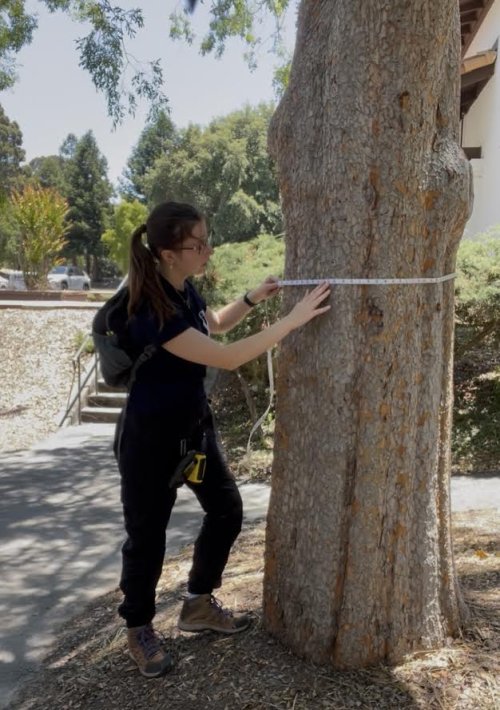
Working alongside scientist Nekesha Williams, Tippit spent the summer sampling campus trees, collecting information on their circumference, height, species, and condition. From there, she is able to calculate their biomass, which directly correlates to “how much carbon they're holding on to,” she explains.
Williams and Tippit assess that the trees on campus offset approximately 6% of Saint Mary’s carbon footprint. The trees are cleaning about 13,118 pounds of air annually, which is equivalent to the pollution produced by ten cars a year.
As it turns out, commuting by car is the third-largest source of carbon emissions on campus. Tippit calculated that trees offset nearly a third of those carbon emissions. So her hope is that, ultimately, her research could lay the groundwork for further action.
One way to move toward carbon neutrality is “planting more trees and native plants,” Tippit explains. Partnering with local agencies on increased public transportation could be another way. So could expanding electric vehicle charging stations, which have come under increasing demand.
As Tippit looks toward her own future, she sees the Summer Research Program as a springboard. “I’m learning how to formulate a project, do field work, and collect and present data in ways that show how we need to change,” she says. “Those are all the foundational skills needed for sustainability work.”
In time, she hopes to bring her experience and skills to a career in resource management, potentially even in forestry. For now, though, she is focused on her immediate environs: Saint Mary’s.
Sustainability is collective work, Tippit emphasizes. “If the climate crisis feels too big to tackle on our own, that’s because it is. But we can build community around the things we lament over. Together, these problems can be met.”
Maddy Hunter '27 is a Student Writer with the Office of Marketing and Communication at Saint Mary's College. Write her.


