
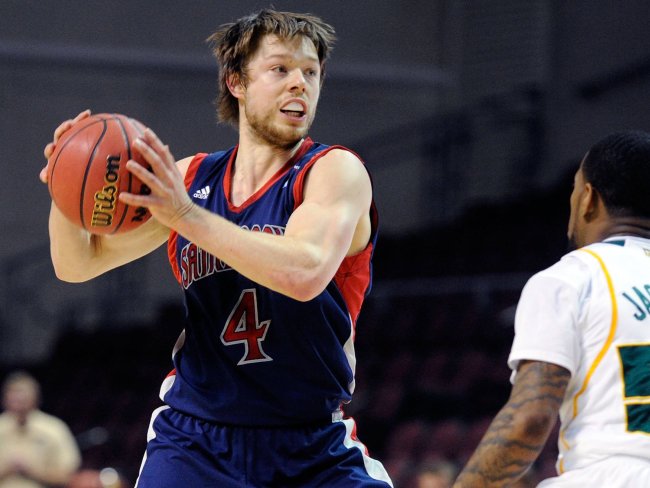
Home game: In his commencement speeches on May 21 and 22, NBA champion and Saint Mary’s alumnus Matthew “Delly” Dellavedova ’13 reflected on life after SMC, encouraging graduates to "get a little bit better every day." / Photo by Bryan Navarro
In His 2026 Commencement Speech, Matthew Dellavedova ’13 Spoke on Failure, Fortitude, and Fatherhood
NBA Champion. Olympic medialist. Accomplished businessman and venture capitalist. Dellavedova has gone far since graduating from Saint Mary's in 2013—and he offered the Class of 2026 encouragement on their own distinctive journeys.
It's not unusual to see a high-profile individual give a Commencement speech at Saint Mary’s, but it’s especially meaningful when that speaker is one of our own. This year, Matthew “Delly” Dellavedova ’13—NBA champ, Olympic medalist, and the first Men’s Basketball from Saint Mary’s to be All-America First Team—stepped up to the podium on May 21 and 22 to speak to graduate and undergraduate students.
Drawing on his experiences navigating professional basketball, Olympic competition, and a post-athletic career in venture capital, Delly returned to a theme of continual growth, reiterating the theme: “Get a little bit better each day.” He shared lessons about taking ownership of one’s development, embracing setbacks as opportunities for learning, and staying curious through reinvention.
He was candid about his wins and his losses. Front and center: attending an NBA draft party at the home of his coach, Randy Bennett, with the only question on everyone’s mind being which team would choose Delly. In the end, no one drafted him. He also recounted getting cut from the Boomers—the Australian national team—twice. With the NBA, he found a way to play with the Cleveland Cavaliers summer league and prove he had the skills and attitude to make valuable contributions to the team—which went on to win the NBA championship.
In his 30s, Delly has embarked on another career in business and venture capital. At the same time, he helped lead the Sydney Kings to a national championship in Australia in April. Above all, Dellavedova said, his most important responsibility is fatherhood and “setting the best example I can for our three kids. Knowing they’re watching how I respond to challenges and setbacks is the best motivation. I want to show them what getting a little bit better each day looks like.”
Watch and read the full speech below.
GET A LITTLE BETTER EACH DAY: That’s why I knew Saint Mary's College was the place for me as soon as I set foot on campus. I knew it was a place where I’d be challenged and surrounded by people trying to get a little bit better each day.
Firstly, I’d like to congratulate all of you graduating here today. It’s an incredible achievement after a lot of hard work. I’d like to thank President Thompson for having me here to speak today. It’s a great honor. I’d like to thank Randy Bennett for bringing me here to Saint Mary’s; my parents and sisters; my wife, Anna, and our three kids, for all of their support. To the graduates—again, huge congratulations! I was sitting where you are today, in 2013, and graduated with a degree in Psychology. Shout out to Mary True. So I know what it took to get to this point. I also know how much you’re looking forward to getting to the plots after this.
When I first arrived at Saint Mary’s, I was a skinny kid wearing an oversized jersey that was basically falling off my shoulders. When I left Saint Mary’s, I was a leader ready to take on the world. College is a period of rapid growth and self-discovery. I’m sure a lot of you have transformed as people during your time at Saint Mary’s and are ready to take on the world, too.
Okay, so how do you get a little better each day?
I’ve still got a lot to learn, but one thing I’ve done a good job of is getting a little bit better each day. It’s great to have big goals, but big goals aren’t achieved in one big effort. It takes a lot of consistent small efforts, over a long period of time, to achieve your goals. Over a day, a week, a month, it may not look like progress, but if you stick with something long enough, you’ll be amazed at the progress you can make, over six months, five years, 10 years, when you look back at where you started.
To do this, you have to take ownership of your own development. Nobody is going to care more about your goals than you do. One thing I realized, leaving Saint Mary’s and entering professional basketball, was that Saint Mary’s is such a structured environment. You’re surrounded every day by other people pushing hard, professors and coaches holding you accountable, and people you’re living with all chasing similar goals. Then you enter the professional world, and suddenly you have a lot more freedom.
And freedom can be a good thing or a bad thing. You can stay up late or go to bed early. Eat junk food or eat something healthy. Stick to a schedule in the off-season, or just float through it without a real plan. For me, in basketball, taking ownership meant never just showing up to the gym hoping I’d improve. Every workout, I have a plan. I know what I need to work on. Coaches help refine the details, and teammates push me, but ultimately, I have to take responsibility for my own development.
I’ve found even less structure in my second career, in business and venture capital. There’s no perfect step-by-step blueprint. No one is there to hold your hand through every decision. There are opportunities everywhere, but you have to stay curious, keep learning, and figure out your own path, not being afraid to ask questions. There are no silly questions.
That mindset of taking ownership while trying to get a little bit better each day is one of the most important lessons I’ve learned in my life. This has really helped me when things haven’t gone according to plan.
Life and careers are a marathon, not a sprint. Progress isn’t in a straight line. And one thing I’d encourage you NOT to do is compare your timeline to everyone else’s. Some people will look like they’re way ahead. Some people will get opportunities early. Some people will take longer to find their path. Everyone is running their own race.
When I graduated from Saint Mary’s in 2013, I thought I had a clear vision for how things were going to go. I’d had a great four years here. I graduated as the all-time leader in points, assists, and wins, had already represented Australia at the Olympics, and my next goal was to make the NBA. I thought I had a great shot at getting drafted after doing 15 workouts with different teams.
I watched the NBA Draft at Coach Bennett’s house, up on the hill, here in Moraga. As the draft kept going, teams I’d worked out for were making picks, but my name still hadn’t been called. Pick 40, pick 50. Then it gets to the end of the draft. Pick 60. Still nothing. Undrafted. There were some tears. I actually came back to the basketball court here, at Saint Mary’s, that night and just started shooting by myself, trying to clear my head. Because I really didn’t know what came next. The chances of making the NBA after going undrafted are extremely slim.
One thing you may experience after graduation is that sometimes even when you work hard and do everything you can, life still doesn’t always go exactly according to plan. And I know many of you here today are probably feeling some version of that uncertainty too. If you aren’t welcomed in the front entrance, sometimes you have to hop the side fence and find another way in.
Fortunately for me, I had a great agent, Bill Duffy, who helped me get an opportunity with the Cleveland Cavaliers Summer League team and eventually training camp. At that point, I knew if I wanted to make the final roster, I had to focus on what I could control: taking charges, diving on loose balls, making the extra pass, and bringing a great attitude, every single day—all the little things that help a team win.
“One thing I’ve learned through all of it—basketball, business, and life—is that the process of improving never stops. Everyone is running their own race. Just worry about what YOU have to get better at. There’s always another opportunity for growth, another challenge to take on.”
One of the biggest perceived weaknesses in my game was defense and foot speed—at training camp, I relentlessly picked up Kyrie Irving full court, and that ended up helping me to make the final roster. And over time, one of the perceived weaknesses in my game became one of my strengths. And it helped me in the NBA Finals, going on to win a Championship with the Cleveland Cavaliers in 2016.
That lesson has helped me outside of basketball, too. You can’t always control outcomes. But you can control your preparation, your work ethic, embracing your role, and your willingness to keep improving.
My first dream was representing Australia at the Olympics as part of the Australian Boomers, the national basketball team. And for anyone wondering, a boomer is a male kangaroo, and a kangaroo never takes a backward step. I was fortunate enough to first make the national team as an 18-year-old right before arriving here at Saint Mary’s. But the next year was the World Championship cycle, and I got cut from the team.
It was incredibly disappointing. Then later on, somebody retired, I got called back into the final selection camp… and I got cut again, from the same team, twice. I don’t know how many people here have been cut from the same team twice, but it’s not a great feeling. After getting cut, I asked the coach for feedback: “What do I need to improve to make the team next year?”

Sometimes feedback hurts. Sometimes failure is embarrassing. Sometimes things don’t go the way you hoped. Facing disappointment head-on and looking at things as a learning opportunity, not the end of the road, can completely change your future. When things don’t go your way, you have to look in the mirror first, and ask yourself, “Did I do everything I possibly could to achieve what I wanted? What do I need to do to improve?” Not looking outwards and blame others. No excuses.
Eventually, I made the Olympic team in 2012 and have been fortunate enough to represent Australia at four Olympic Games. And ultimately winning a bronze medal in Tokyo. Standing on that podium, all I could think about were all the moments that have led up to this—shooting in my backyard in Maryborough with my parents and sisters, junior teams I’d been cut from, moving away from home at the age of 16, and my time at Saint Mary’s.
But... The cycle of challenges to overcome and improving never really stops. At age 33, I got cut, again, from the Australian team, and most people probably assumed my national team career was over. But again, I asked for feedback, went back to work. Fortunately, I earned my way back for the Paris Olympics, and now, my big goal is helping Australia to win gold at the LA Olympics in 2028.
I know many of you here today are still figuring out what comes next. Some of you are starting jobs. Some are going to grad school. Some are moving home. Some are chasing a dream. Some may still not know exactly what the next step looks like—and that’s okay. Your path does not have to be perfectly clear today. The game of basketball has evolved during my career, and I’ve had to reinvent parts of my own game, too. Even now, I’m still trying to get faster and still chasing my first professional dunk.
And at the same time, I’ve been working on finding what life after basketball could look like. I didn’t always know what that was going to be, so I started exploring. I looked into coaching, media, real estate, and different business opportunities. I tried to stay curious to ask questions and learn from people. Eventually, I found venture capital. What drew me to it was how similar founders are to athletes. They’re obsessed with improvement. They’re taking risks. They’re chasing big goals. There are extreme highs and extreme lows. They’re going all in on something they believe in, knowing there are no guarantees of success. That felt familiar to me.
I have learned a lot of the things that helped me in basketball translated directly into business. What you experience in one area in your life, can be translated to other areas. One thing I’ve learned through all of it—basketball, business, and life—is that the process of improving never stops. Everyone is running their own race. Just worry about what you have to get better at. There’s always another opportunity for growth, another challenge to take on.

And over time, your motivation for wanting to get a little bit better each day can evolve. I’ve been lucky enough to play here for Saint Mary’s, represent Australia at the Olympics and win a medal, play in the NBA and win a championship, and achieve dreams I had as a kid. Now my biggest motivation is being a great husband and dad and setting the best example I can for our three kids. Knowing they’re watching how I respond to challenges and setbacks is the best motivation. I want to show them what getting a little bit better each day looks like. Nothing compares to watching them start their own journeys. Being a dad is the best.
So wherever life takes you after today: Stay consistent, keep learning, and keep trying to get a little bit better each day. Absolute best wishes to the Saint Mary’s College Class of 2026.


