
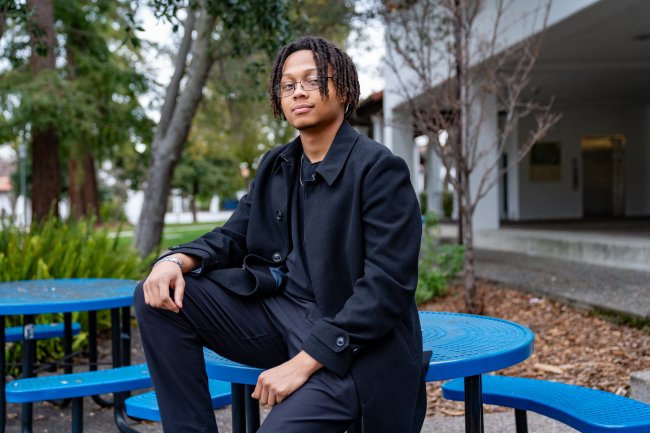
Breaking ground: For Jessiah Jones ’27, a first-generation college student, SMC was “exactly what I was looking for,” he says. “Here, I could really gather my thoughts and gather myself, and have the opportunity to try things out and explore.” / Photo by Francis Tatem
Making Family History: Jessiah Jones ’27 on Finding ‘Calm,’ Confidence, and Community at Saint Mary’s
A Business Administration major and member of the High Potential program, Jones overcame a lot to be where he is. Now, as Vice President of the Black Student Union, he's trying to foster community and empower “first-gen” students like him.
When Saint Mary’s was established in 1863, its founder had first-generation students in mind. Joseph Alemany, San Francisco’s first archbishop, envisioned a college for the “children of Miners, Mechanics, and Agriculturists,” the working people of the fledgling state.
According to the most recent data, around one in three Saint Mary’s students today are trailblazers, the first in their family to pursue a college degree. For many first-generation students—“first-gens,” as they often refer to themselves—the journey to and through college brings unique struggles and surprises. We regularly ask first-gen Gaels to share, in their own words, their history, hopes, and advice for the next generation.
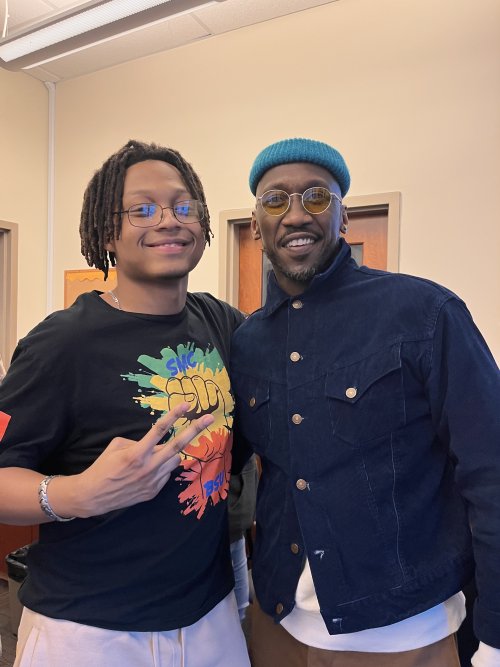
Today, we’re highlighting Jessiah Jones ’27, a Business Administration major with an Entrepreneurship concentration and current Vice President of the Black Student Union. A member of the High Potential Program, he was among those who met award-winning actor Mahershala Ali ’96 when he returned to campus in January 2026. For Jones, SMC has provided him with the space and support to thrive.
“All-Star”
I was always a curious child, kind of a sponge. I specifically loved literature. When I was five or six, my dad had me read A Raisin in the Sun, Lorraine Hansberry’s play. My dad’s family is from Georgia, and they used to call me “All-Star”—which, honestly, stressed me out, putting those words on me. But they always told me, “You’re gonna do great things.”
My early life wasn’t easy. I grew up in the hood of Vallejo, a city in the North Bay. I saw plenty of things I probably shouldn’t have. My parents never married, and my mom and I bounced around from place to place. There was no hate between the two of them, but things were complicated.
Then, when I was ten, my dad passed away. I had lots of love and respect for my father, and after he died, I stopped caring about everything for a while. His parents took me in and raised me, treating me with proper love and doing the best they could. But nothing could quite fill that hole, you know?
Only during my junior and senior years of high school did I start to think, “I want to go to college.” In Benicia and Vallejo, there’s the Willie B. Adkins Scholars Program, which helps kids of color, mostly Black kids, get ready for college, trade school, or whatever they want to do. My grandma had told me about it for years, and I’d never really been interested.
But then, one of my friends started getting on my case about it, too. She’d tell me, “You know, the percentage of Black men in high places is way too low.” She’d give me all these spiels. So one day, I decided to attend the Adkins Program, just to see how I liked it. The more I went, the more I wanted to come back.
Choosing Saint Mary’s
When I do choose my battles, I always stick to something. I’m stubborn that way. So I decided to apply to colleges, mostly in the South. I got into a lot of them and racked up a ton of scholarship money. But I also got into Saint Mary’s, which was one of my top choices.
The spring of my senior year in high school, I came to check out the campus. For one thing, Saint Mary’s was offering me more financial aid than anywhere else. And when I came here, it was exactly what I was looking for. I knew that if I went to a bigger school, in a big city, it would be a grueling process to find my place there. But here, I could really gather my thoughts and gather myself, and have the opportunity to try things out and explore.
Yeah, we’re in this beautiful, calm area, but San Francisco’s not far either. And there are so many different people and cultures here, from all over the world. I know people from Australia; my best friend grew up in Mexico. For me, going to Saint Mary’s really felt like a chance to start over.
“It’s important to really advocate for yourself. Learn what’s right for you, and then get after it, because there’s really only one you.”
Finding his voice—and his people
I’m in my third year now as a Business Administration major, with a concentration in Entrepreneurship. I chose that because I really like working with people and knew I wanted to work for myself eventually. I’m definitely interested in a career in sales or marketing, potentially around video games or tech.
Being at college has really increased my confidence as a communicator. I used to get so nervous speaking in front of crowds. But I’ve been showered with so many experiences, whether in my business classes or in Collegiate Seminar. Every day, there’s a new opportunity to express myself, and I feel like I’m becoming a better speaker and writer.
I’m also a member of the High Potential Program, which the actor Mahershala Ali ’96 was part of, too. Mahershala came to campus recently to speak with HP students, and I resonated with a lot of what he said. He talked about how, for a Black kid from the Bay, coming to Saint Mary’s felt like another universe. And Mahershala’s right—it can be challenging. But that experience really teaches you to find your people. I definitely feel like I’ve found mine.
Fostering belonging
My intention when I joined the leadership team of Black Student Union was to help it grow. Some people assume that, if they’re not Black, they can’t kick it with BSU. So at involvement fairs and things like that, I’ve started shouting, “You don’t have to be Black to hang out with us!” Honestly, it’s helping.
As I see it, BSU is a place on campus for community and support. We care about justice, out in the world and on campus. But we also host fun gatherings and parties, like the big BSU Cookout on February 19, or Black FM on February 24, where we'll DJ music by Black artists from multiple decades and genres.
We have a whole new team now, with Alexis Hackett ’26 as the President, and they’re all raring to go. They all feel as passionate about BSU as Lexi and I do, which is great. We love working with them, and we’re excited about the rest of the year.
Reflections on Black History Month
Obviously, Black history isn’t limited to just one month, and it shouldn’t be. But as a Black man, I do feel like my culture is fairly misunderstood, especially right now. You turn on some news channels or go on social media, and there are false narratives about the livelihoods of Black folks or Latino folks that are taken at face value and lead to a dangerous pipeline.
I think it’s important to say that, for Black activists—whether it was Martin Luther King Jr., or Malcolm X, or the Black Panthers—the goal has never been to take away opportunities from white people. That’s just not true. We just want everybody to have equity. We’re saying, “Give what needs to be given.” I should be able to love my brothers down the street and love my sisters up the street, no matter what they may look like.
Advice to first-gen Gaels
Don’t ever count yourself out. For me, the big realization after meeting Mahershala, this Oscar-winning actor, is that he really is just a guy. And that’s the thing: Nobody is really different from each other, except for the opportunities that come our way and how we approach them.
That’s why we have to learn to put ourselves first, not in a conceited or narcissistic way. But speaking as someone who has navigated a lot of strife in my life, I can tell you: It’s important to really advocate for yourself. Learn what’s right for you, and then get after it, because there’s really only one you. Self-love and kindness make the most difference and allow us to advocate for others.
Never get too frustrated, either. There’s nothing wrong with being down, as long as you’re not out.
(This interview has been edited and condensed for clarity.)
Hayden Royster is the Associate Editor for the Office of Marketing and Communication at Saint Mary's College. Write him.


