
Far from home: In summer 2025, Aruna Silva ’27 traveled to Iceland to collect and analyze sedimentary rock, comparing it to samples collected on Mars. / Photo courtesy Alice Baldridge
Field Notes: Aruna Silva ’27 on Her Otherworldly NASA-Funded Research Trip to Iceland
Silva joined Randy Cabrera ’26 and Professor Alice Baldridge to study the geology of the Stora Laxa river, a planetary analog to Mars. Their work could be key to discovering extraterrestrial life.
Monitoring port pollution in Oakland, unlocking algae’s biofuel potential, building artificial neural networks from scratch—with the Summer Research Program, there’s no shortage of hands-on opportunities available to Gaels. For ten weeks each summer, STEM students delve into a research project of their choice—on campus or off—getting one-on-one guidance from a faculty expert.
Of course, there’s more than one way for a Gael to get research experience. In the series Field Notes, we’re highlighting students who spent their summer doing real-world research outside of Saint Mary’s.
Meet Aruna Silva ’27, a third-year Environmental Science major and Archaeology minor who traveled to Iceland in summer 2025 to participate in research funded by NASA’s Mentorship and Opportunities in STEM with Academic Institutions for Community Success (MOSAICS) program, in partnership with the Goddard Instrument Field Team. Silva worked with Alice Baldridge, the Interim Dean of the School of Science, to collect and analyze sedimentary rock, comparing the samples to those collected on Mars by NASA’s Curiosity Rover. In her own words, here’s what she has to say about the research experience.
One giant leap
Being from Hawaii—whether it was going to summer camps and beaches, or making school projects—I’ve always had a passion for the environment. After my first year at Saint Mary’s, I started envisioning a career in environmental field research. I didn’t know how that would manifest or how I would get there. The Summer Research Program offers so many opportunities to students—but I’ll be honest: I never really thought about planetary science or astrobiology until I heard about this opportunity with NASA.
The program is called the Planetary Analog Field Science Experience for Undergraduates, or PAFSEU. It’s funded by MOSAICS, a NASA initiative that gives faculty and students who may not be at major research institutions the chance to conduct NASA-relevant research. This PAFSEU program, specifically, meant going to Iceland and working with Alice Baldridge, the Dean of the School of Science.
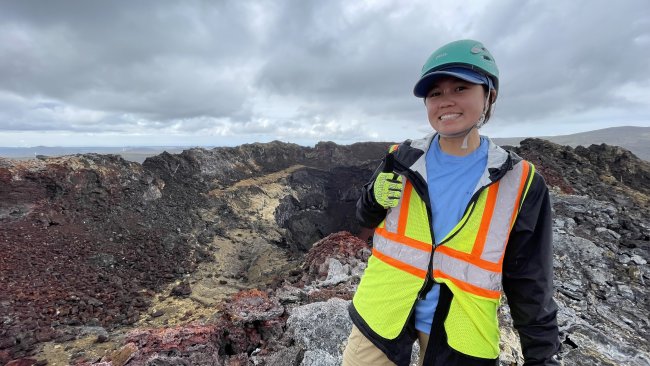
When I heard about the opportunity, it definitely sparked my interest. I first went to my Success Coach, Magalay Arias-Lobatos; at Saint Mary’s, we can sign up for one-on-one coaching sessions whenever we want. We read through and edited my application together. I also went to the Career Center, which helped me tailor my résumé for the application.
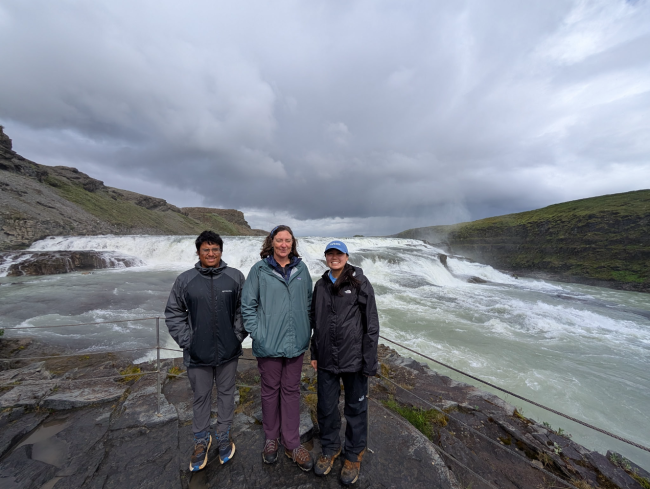
After the application and interview process, I learned that Randy Cabrera ’26 and I were selected. And in June 2025, Randy and I flew to Iceland with Professor Baldridge to join the Southwest Island Field Team, or SWIFT for short.
Like a planet (but not quite)
A big part of NASA’s field research is planetary analogs: places on Earth that mimic or resemble the environmental conditions of other planets. NASA scientists use planetary analogs to train astronauts, test their instruments, and collect samples to study the geological and environmental conditions. These samples can tell us more about the geologic history of Earth and other planets at the same time.
The six research teams in SWIFT were using the Icelandic landscape as a planetary analog for Mars, the Moon, and what NASA calls “ocean worlds.” My group, Team M&M, focused on Mars and mudstone sedimentary rocks, which formed over time under different depositional processes and were then compacted underground to become solid. We were comparing samples from the Hreppar Formation at the Stora Laxa field site in Iceland with mudstone samples from Gale Crater in the Yellowknife Bay region of Mars.
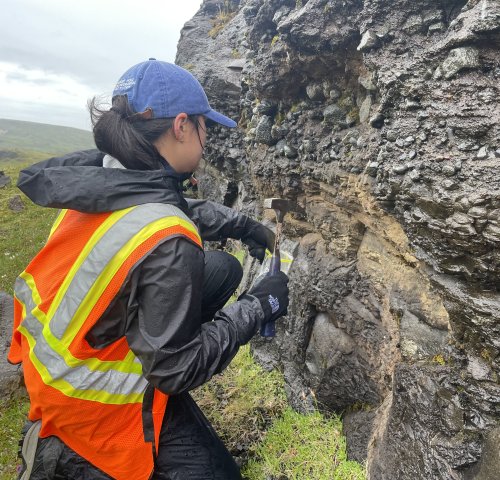
Yellowknife Bay is currently being explored by the Curiosity Rover, which uses the same X-ray Diffraction (XRD) tool that we used to identify the materials inside our rock samples. Using the XRD, we looked into the mineralogy and geochemistry of both Earth and Martian samples. The samples from the Hreppar Formation told us what environmental conditions these rocks experienced on Earth. Then, we were able to compare those to samples from Mars. Our goal was to better prepare future NASA scientists for how to assess physical samples from Mars and other planets
Going with the flow
Looking at the geological conditions in Iceland, comparing that to Mars, can help us understand if there was water, which can help us understand the big question: Was there life on Mars?
During my ten days in Iceland, we specifically examined the mineralogical transition from magnetite to hematite in sedimentary mudstones. The rocks most likely formed through contact with a lava flow 20 million years ago. In this “bake zone,” rocks and loose sediment experience high temperatures, causing thermal alterations like this and making the mudstone noticeably red. The Martian mudstones collected by Curiosity show a similar kind of transition, which we think resulted from a lake experiencing periods of different reduction and oxidation conditions.
Ultimately, we found that both our mudstone samples from Iceland and from Yellowknife Bay have similar minerals, but were formed through two different processes. But water does seem to be a factor in Iceland, rather than lava.
“Overall, the program opened more doors for me...It’s the kind of thing that happens all the time at Saint Mary's, because this is such a tight-knit community where you can really get close with your professors.”
Room to explore
The research teams would gather every morning to eat and hold a briefing before heading out to the various field sites. The family who owned the cottages we were staying in cooked for us and served meals in the reception building, where about 30 researchers gathered to start the day.
However, every day was different for me because I could join as many research groups as I wanted. Each group’s site had different conditions, purposes, and instruments, so it was cool to learn about them all. The team there wanted the interns to have a diverse experience, which was really thoughtful. I felt like they really prioritized my education and my learning experience.
After Iceland, we did two weeks of lab work at the NASA Goddard Space Flight Center in Maryland. I met graduate students there who shared their experiences, which helped me learn more about what a career in research would be like.
A universe of possibilities
Through this opportunity, I got to try out all kinds of research, including research aspects: field work, proposals, lab work, write-ups, and presentations. I made great connections in the fields of environmental science and archaeology through the variety of researchers at the site. It has definitely revealed options for graduate school—but I’m mostly looking into a similar opportunity for next summer. Overall, the program opened more doors for me—not that they were ever closed, but I’m actually looking and aware of them now.
It’s the kind of thing that happens all the time at Saint Mary's, because this is such a tight-knit community where you can really get close with your professors. Also, they are experts who know a lot of people; Professor Baldrige has been connected to NASA for years and many of her students now work for them. So yeah—our professors teach classes, but they also know people! We can’t forget that.
Ultimately, what I learned from PAFSEU is not to rule out anything. When I first got the opportunity, I was so excited, but I also had imposter syndrome. I thought, Oh, I don't know anything. Am I qualified enough? But my advice is: Apply to things, even if they feel daunting or new. If you’re selected, you have a spot there. You earned it, and they see potential in you.
Katie Hayek ’28 is a Student Writer with the Office of Marketing and Communication at Saint Mary’s. Write her.


