Classical Languages, BA

Classical Languages, BA


Classical Languages majors immerse themselves in the world of the ancient Mediterranean.

You will progress toward linguistic proficiency in both Latin and Greek, engaging with the languages through the works of great Greco-Roman writers: Homer, Tacitus, Paul, Sophocles, and Virgil, to name a handful. As the culmination of your study, you will write a senior thesis on either a Latin or Greek author. 

Throughout your journey, you will receive highly personalized instruction from our faculty. 


Apply Request Info

Learn More About Our Program

Get to know our well-respected faculty and their academic specialties.

Curriculum

Classical Languages, BA

BA

Learning Outcomes

  • PLO 1: Parse and translate sacred and poetic texts.
  • PLO 2: Grasp the forms and rules of composition.
  • PLO 3: Demonstrate basic understanding of linguistics and language (word roots).
  • PLO 4: Investigate technical and critical points of analysis in original texts snf standard reference works.
  • PLO 5: Effectively communicate ideas about the Latin, Greek, and English morphology and syntax.
  • PLO 6: Sight-translate and recite Latin and Greek texts.

Requirements

Lower Division

By Arrangement.

  • Elementary Ancient Greek 1 (3 units)
  • Elementary Ancient Greek 2 (3 units)
  • Language Tutorial I Greek (3 units)
  • Language Tutorial II Greek (3 units)
  • Intermediate Ancient Greek 1 (3 units)
  • Intermediate Ancient Greek 2 (3 units)
  • Elementary Latin 1 (3 units)
  • Elementary Latin 2 (3 units)
  • Intermediate Latin 1 (3 units)
  • Intermediate Latin 2 (3 units)

Upper Division

Take 22 units from the following list. At least 15 of these units must be from LATIN or GREEK.

  • Medieval Art (4 units)
  • Renaissance Art (4 units)
  • Classical Mythology (3 units)
  • Empires of Greece and Rome (3 units)
  • Medieval Literature (4 units)
  • Renaissance & 17th Century Lit (4 units)
  • Greek Historians (3 units)
  • Greek Orators (3 units)
  • Greek Dramatists (3 units)
  • Greek Lyric Poets (3 units)
  • Aristotle (3 units)
  • New Testament Greek (3 units)
  • Plato (3 units)
  • Homer (3 units)
  • Special Study (1-4 units)
  • Dark Ages (Birth of Europe) (4 units)
  • Roman Historians (3 units)
  • Patristic Latin (3 units)
  • Roman Comedy (3 units)
  • Roman Law (3 units)
  • Latin Lyric Poetry (3 units)
  • Cicero (3 units)
  • Virgil (3 units)
  • Special Study (1-4 units)
  • Origins of Christianity (3 units)
  • Elementary Latin 1 (3 units)
  • Elementary Latin 2 (3 units)
  • Intermediate Latin 1 (3 units)
  • Intermediate Latin 2 (3 units)
  • LATIN Elective (1-5 units)
  • Roman Historians (3 units)
  • Patristic Latin (3 units)
  • Roman Comedy (3 units)
  • Roman Law (3 units)
  • Latin Lyric Poetry (3 units)
  • LATIN UD Elective (1-5 units)
  • Cicero (3 units)
  • Virgil (3 units)
  • Special Study (1-4 units)
  • Elementary Ancient Greek 1 (3 units)
  • Elementary Ancient Greek 2 (3 units)
  • Intermediate Ancient Greek 1 (3 units)
  • Intermediate Ancient Greek 2 (3 units)
  • GREEK Elective (1-5 units)
  • Greek Historians (3 units)
  • Greek Orators (3 units)
  • Greek Dramatists (3 units)
  • Greek Lyric Poets (3 units)
  • Aristotle (3 units)
  • New Testament Greek (3 units)
  • GREEK UD Elective (1-5 units)
  • Plato (3 units)
  • Homer (3 units)
  • Special Study (1-4 units)

What can you do with a degree in Classical Languages?

A degree in Classical Languages develops deep analytical, linguistic, and cultural understanding through the study of ancient Greek and Latin texts.
(*Some careers may require licensure or additional training)
Image
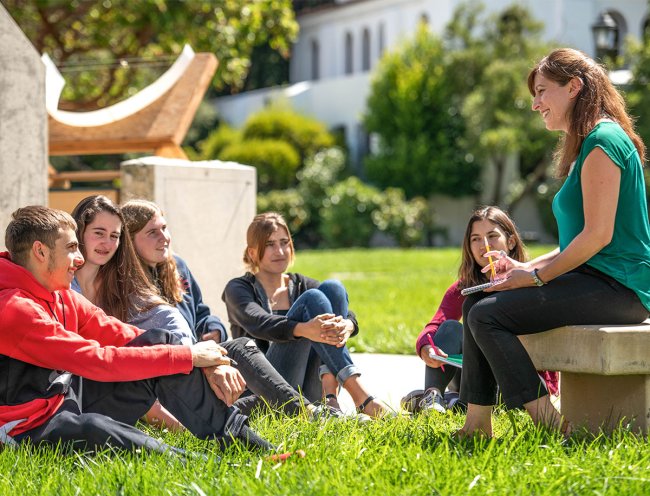
Outdoor class on SMC campus

Translator or Interpreter
Translate ancient or modern texts with precision and cultural insight for academic, literary, or professional purposes

Historian
Research and interpret historical documents and artifacts to illuminate the political, social, and cultural life of the ancient world

Archivist or Museum Specialist
Preserve and organize historical materials, manuscripts, and artifacts for libraries, museums, or cultural institutions

Teacher or Professor
Educate students in classical languages, literature, and history while fostering appreciation for ancient civilizations

Linguist
Analyze the structure and evolution of language, applying philological methods to ancient and modern linguistic systems

Freelance Writer or Editor
Apply strong writing, research, and storytelling skills to produce content for educational, cultural, or historical publications

Anthropologist or Archaeologist
Use cultural and linguistic expertise to interpret ancient societies through texts, artifacts, and historical records

Cultural Heritage Consultant
Advise organizations on preserving and interpreting cultural materials rooted in ancient traditions and history


Saint Mary's Testimonials

“SMC is well known for having an excellent student-to-teacher ratio, but beyond that is the quality of the professors. It was because of these professors that I secured a position in my field directly after graduation. This was the result of more than just the skills I was taught, but thanks to my advisor searching and finding field school opportunities specific to me. Without her guidance and support, I wouldn’t be on my current career path.”

Carly Walker '18

School and Department Information