Physics, BA
Untangle the mysteries behind the universe, from the velocity of steam to the power of a supernova.
This streamlined track provides students the flexibility to pursue additional academic interests like undertaking a minor, completing courses for medical school, preparing for a career in teaching, or preparing for law school.
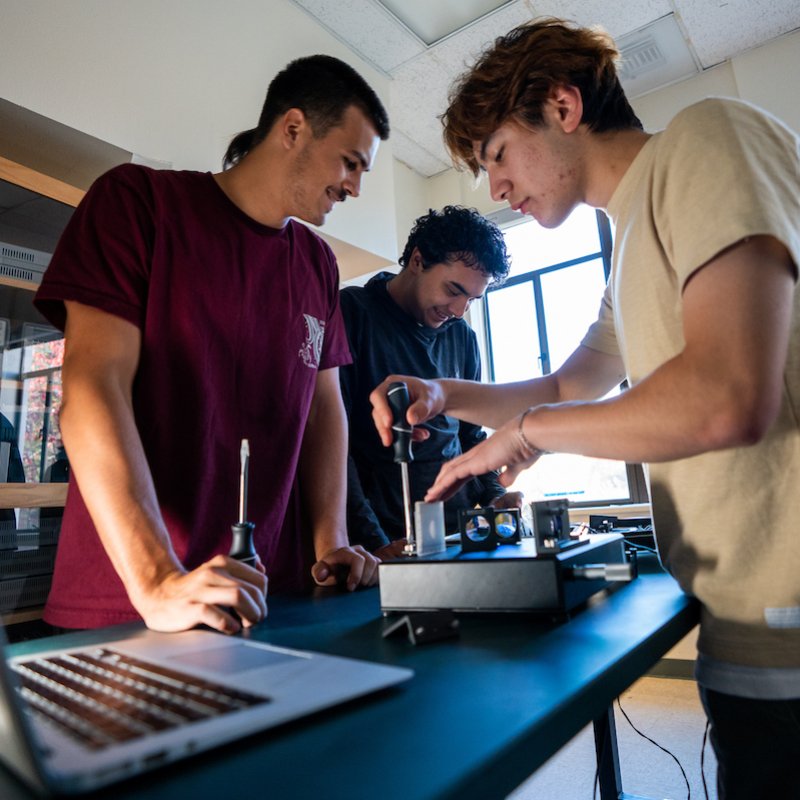
Using a balance of theoretical, experimental, and computational work, our program will provide you with a foundational understanding of physical phenomena and natural systems. Guided by our renowned, approachable faculty, you’ll hone the tools to investigate topics in-depth and the communication skills needed to share information with others. We’re committed to providing you with hands-on opportunities through the laboratory, field research at home and abroad, and independent study.

Learn More About Our Program
Get to know our well-respected faculty and their academic specialties. Or explore scholarship opportunities and an array of research possibilities.
What can you do with a degree in Physics?
A degree in Phsyics prepares you with a strong foundation in skills applicable to a wide variety of professions.
(*Some careers may require graduate school or additional study).
Teacher
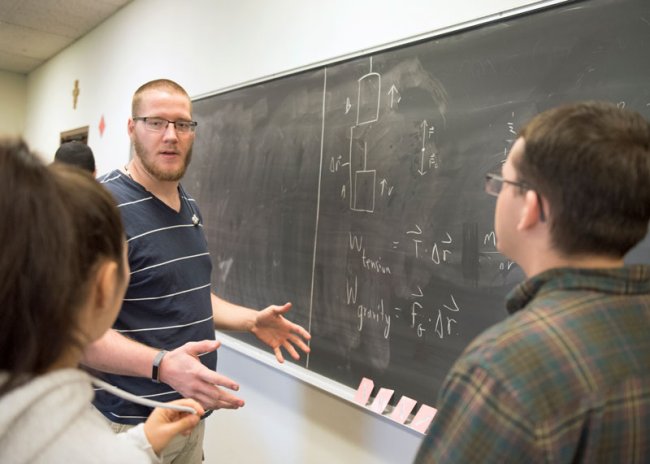
Teach physics or general science in middle school or high school, helping students understand how the world works
Software Engineer
Design, build, and test software systems, using your analytical skills and coding experience from computational physics
Data Scientist
Work with large datasets, build models, and interpret trends for companies in tech, energy, finance, health, or policy
Optical Engineer
Develop and test systems that use light—like lasers, sensors, lenses, imaging devices, or fiber optics—for aerospace, medical, telecom, or defense applications
Systems Analyst / Technical Consultant
Translate complex technical problems into practical solutions for clients or teams, often bridging between engineers and decision-makers
Patent Examiner / Technical IP Specialist
Review inventions in physics-related areas and evaluate whether they are new and defensible, a path that pairs well with law school
Medical / Health Physics Assistant
Support clinical teams with imaging, radiation safety, or diagnostic systems in hospitals or biotech, a path that connects physics and health care
Policy Analyst (Science & Technology)
Help government, nonprofits, or advocacy groups evaluate the impact of energy policy, climate technology, AI regulation, or national security tools
Research Assistant
Contribute to lab or field projects in areas like materials science, instrumentation, clean energy, astrophysics, or climate sensing by gathering data and helping run experiments
Saint Mary's Testimonials

“My time at SMC prepared me for the challenges of my post-grad life. As an international student, I had to adapt to living far away from home, with classes and life in a different language. Doing a challenging major like Physics added to the challenge of getting a degree abroad. But when I look back I am thankful for all the people I met along the way, who helped me in every step of the process - professors, fellow students, Brothers, and officers such as those who work at the CIP. Now I am fully suited to face the challenges of getting my career started in the engineering field. I recently got a promotion and I look forward to many more successes in the future.”
Javier Rivera, Physics Major 2021


