Environmental Science, BS

Environmental Science, BS

Understand our planet, how it’s changing, and learn how to take meaningful action.

This major emphasizes data-driven research and scientific fundamentals. Our program will provide you with a unique, interdisciplinary, layered perspective on our ecosystems and the effects of human society. 

You’ll hone your ability to reason through unfamiliar problems, the tools to investigate topics in-depth, and the communication skills needed to share information with others.  You can gain firsthand research experience in Northern California’s wide variety of biomes, from estuaries to mountain peaks to scrub lands.

With our small class sizes and the mentorship of our renowned faculty, you can make lasting connections in a tight-knit community of difference-makers.


Learn More About Our Program

Get to know our well-respected faculty and their specialties. Or explore scholarship opportunities and an array of research possibilities.

Environmental Science, BS

BS

Learning Outcomes

  • Identify and understand the processes and patterns that shape Earth's environmental systems.
  • Evaluate the credibility of different data sources of environmental data, considering accuracy, bias and relevance.
  • Apply appropriate methods and tools to collect and analyze environmental data.
  • Synthesize the knowledge derived from scientific and social-scientific perspectives to better understand the Earth's environment.
  • Construct ethical and mindful solutions to environmental problems.
  • Communicate skillfully environmental findings through seminars, written scientific reports, or visual presentations.

Requirements

Lower Division

  • The following lower-division courses are required for the major.

Group I

  • Calculus I (4 units)
  • General Physics I (4 units)
  • General Physics I Laboratory

Group II

  • Take EITHER:
  • Physical Geology (4 units)
  • Physical Geology Lab
  • OR
  • Environmental Science (4 units)
  • Environmental Science Lab

Group III

  • Take EITHER of the following groups:
  • Group A
  • Intro Cell Bio, Molecular Bio, & Biochem (5 units)
  • Intro to Cell Bio, Molecular Bio Lab
  • Introduction to Organisms and Evolution (5 units)
  • Intro to Organisms and Evolution Lab
  • General Chemistry I (4 units)
  • General Chemistry I Laboratory (1 units)
  • Group B
  • Introduction to Organisms and Evolution (5 units)
  • Intro to Organisms and Evolution Lab
  • General Chemistry I (4 units)
  • General Chemistry I Laboratory (1 units)
  • General Chemistry II (4 units)
  • General Chemistry II Laboratory (1 units)

Upper Division

  • The following courses are required

Writing in the Discipline

  • Take EITHER:
  • General Ecology (5 units)
  • Research Writing in Biology (1 units)
  • OR
  • Sedimentology (5 units)

Statistics

  • Take EITHER:
  • Research Design and Biostatistics (5 units)
  • OR
  • Intro Probability & Statistics (3 units)

Capstone

  • Senior Capstone (1 units)

Environmental Science Lab Courses

  • Take four of the following courses AND its corresponding lab (upper division Biology courses require both BIO 201 and BIO 202; EES 330 requires EES 110/110L and CHEM 110/110L; EES 350 requires EES 110/110L)
  • General Ecology (5 units)
  • General Botany (5 units)
  • California Flora & Communities (5 units)
  • Environmental Chemistry (5 units)
  • Hydrology (5 units)
  • Earth Materials (4 units)
  • Sedimentology (5 units)
  • Geographic Info Systems (5 units)
  • Coastal Systems (4 units)
  • Wetlands (4 units)
  • Field Methods (4 units)

Environmental Science Electives

  • Take three additional courses from the following upper division science electives (upper division Biology courses require BIO 201/201L and BIO 202/202L; EES 330 requires EES 110/110L and CHEM 110/110L; EES 350 requires EES 110/110L)
  • General Ecology (5 units)
  • General Botany (5 units)
  • Conservation Biology (4 units)
  • California Flora & Communities (5 units)
  • Aquatic and Marine Biology (4 units)
  • Environmental Chemistry (5 units)
  • Environmental Problems (4 units)
  • Hydrology (5 units)
  • Special Topics (4 units)
  • Earth Materials (4 units)
  • Environmental Geology/Natural Disasters (4 units)
  • Sedimentology (5 units)
  • Sustainability (4 units)
  • Geographic Info Systems (5 units)
  • Environmental Geology of the Parks (5 units)
  • Coastal Systems (4 units)
  • Wetlands (4 units)
  • Field Methods (4 units)

Environmental Science Policy Elective

  • Take one of the following Environmental policy related courses
  • Environmental and Natural Resources Econ (4 units)
  • Environmental Policy (4 units)
  • Environmental Justice (4 units)
  • Environmental Politics (3 units)
  • Environmental Law and Regulation (3 units)
  • Earth Systems (4 units)
  • Earth Systems Lab
  • Physical Geology (4 units)
  • Physical Geology Lab
  • Environmental Studies (3 units)
  • Environmental Science (4 units)
  • Environmental Science Lab
  • Climate Change (4 units)
  • Climate Change Lab
  • Urban Environmental Issues (4 units)
  • Urban Environmental Issues Lab (1 units)
  • Sustainability Living (1 units)
  • Environmental Problems (4 units)
  • Environmental Problems Lab
  • Hydrology (5 units)
  • Hydrology Laboratory
  • Special Topics (4 units)
  • Earth Materials (4 units)
  • Earth Materials Lab
  • Envir Geol/Natural Disasters (4 units)
  • Sedimentology (5 units)
  • Sedimentology Laboratory
  • Sustainability (4 units)
  • Sustainability Engaged Learn (1 units)
  • Geographic Info Systems (5 units)
  • Geographic Info Systems Lab
  • Envir Geology of the Parks (5 units)
  • Envir Geology of the Parks Lab
  • Coastal Systems (4 units)
  • Coastal Systems Lab
  • Environmental Policy (4 units)
  • Wetlands (4 units)
  • Wetlands Lab
  • Field Methods (4 units)
  • Field Methods Lab
  • Internship (1-4 units)
  • Senior Capstone (1 units)
  • Independent Study (1-4 units)
  • Mentored Research (1-4 units)

What can you do with a degree in Environmental Science?

 A degree in Environmental Science builds field and lab skills, data analysis, and science-based problem solving for roles across government, nonprofits, and industry. 
(*Some careers may require additional certification or graduate study).
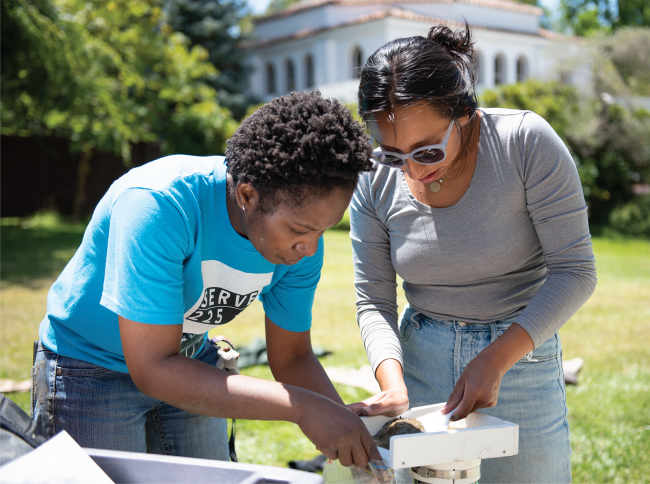
 

Image
Professor Nekesha Williams with a student

Environmental Specialist
Monitor air, water, and soil quality; ensure compliance with environmental regulations and permits

Environmental Health Officer
Assess environmental hazards affecting public health; enforce codes and guide risk mitigation

GIS Analyst (Geospatial Specialist)
Collect and visualize spatial data; build maps and models to guide environmental decisions

Hydrologist / Water Resources Specialist
Measure streamflow and groundwater; model floods/droughts and plan sustainable water use

Environmental Public Health Practitioner
Investigate environmental factors that affect public health, such as water contamination, air pollution, and waste management. Collaborate with local agencies to prevent disease and promote community health

Environmental Consultant
Conduct impact assessments, prepare CEQA/NEPA reports, and recommend practical, science-based solutions

Environmental Lawyer
Use knowledge of environmental laws and regulations to advocate for conservation, pollution control, and sustainable policy. Represent clients or organizations in court, prepare legal briefs, and advise on compliance with environmental standards

Science Teacher
Teach biology, chemistry, earth science, or environmental studies at the middle or high school level. Develop lab and field activities to build student understanding of ecosystems, climate, and sustainability


Explore More Career Outcome

SAINT MARY'S TESTIMONIALS

“As an EES Major at SMC it was incredible to experience the connection students had within their cohort as well as with professors. Our departmental graduation consisted of 18 graduates and most of us had been working closely and taking most of the same courses together since our first year….I am very thankful for my time spent within this program and at St. Mary’s.”

Madeleine Vine, '21

19.5

Average class size

School and Department Information