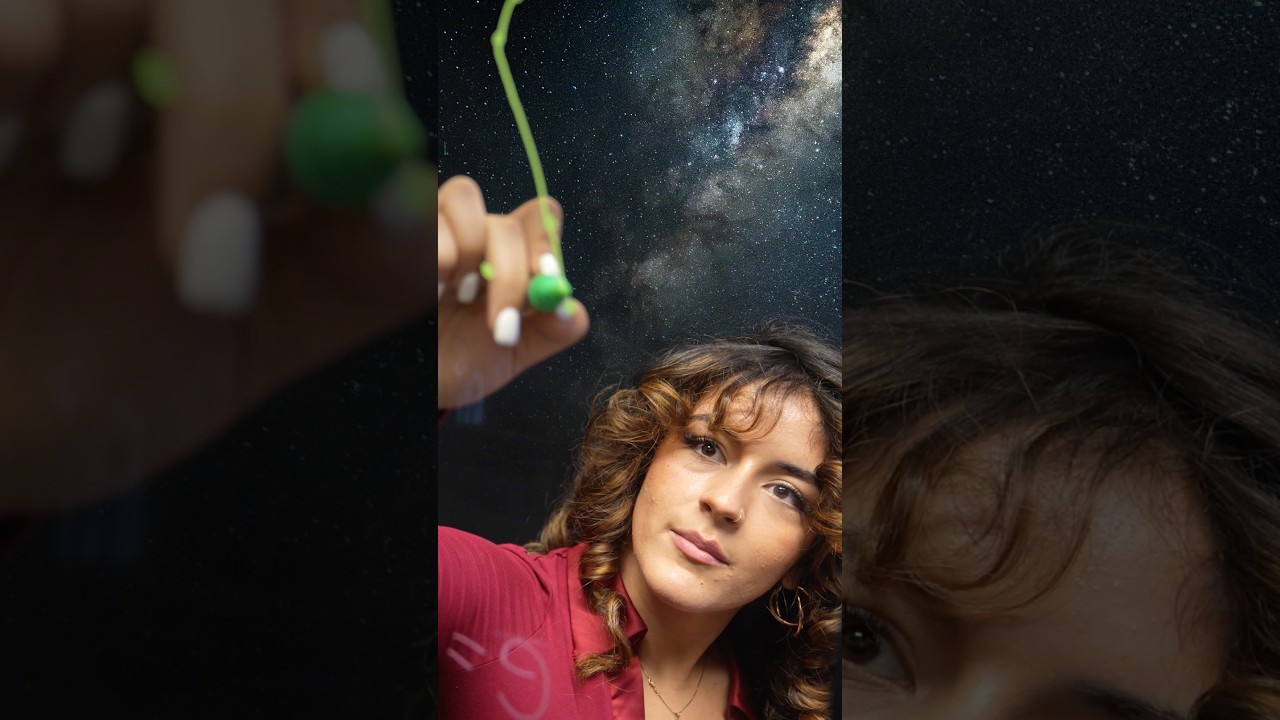
Interstellar investigator: From our earthly vantage, stars may appear close together even if they're not. But simulated skies like those Angelina Cervantes ’28 created as part of a research project in physics can offer a clearer perspective. / Photo by Francis Tatem
Angelina Cervantes ’28 on Using Machine Learning to Map Out the Universe
Working with Associate Professor of Astronomy and Physics Aaron Lee through the Summer Research Program, Cervantes spent 10 weeks simulating where stars exist in space. The experience shifted her perspective—on the galaxy and her own trajectory.
Even with all that we’ve discovered about the universe, our understanding can still be pretty two-dimensional. That’s not entirely our fault, Engineering major Angelina Cervantes ’28 explains. “If you look up at the sky, stars look really close together. But without depth, you can’t really actually know.”
This past summer, Cervantes tackled that precise problem. Through the Summer Research Program—which pairs undergraduates with faculty experts on hands-on research projects of their choosing—she partnered with Associate Professor of Astronomy and Physics Aaron Lee. They spent ten weeks using machine learning to create 3-D models of constellations and simulate where stars exist in space.
It’s the kind of cutting-edge research that “can help us to understand how these stars are formed, how they distribute energy, and…even find things like where alien life exists in the universe,” Cervantes says. The experience altered her perspective—on the galaxy, but also personally. With grounding in engineering, she had been focused on work in the biomedical field. With hands-on experience in computational astrophysics, the idea of doing more work in the area exerts its own gravitational pull.