
Mission ready: Jared Ralleta ’24, an Artemis Mission Support Scientist, is part of the team that helped the Artemis II astronauts conduct scientific research on their historic lunar flyby. / Photo by Luna Posadas Nava - NASA - JSC
‘Privileged and Blessed’: Jared Ralleta ’24 on His Role in the Artemis II Lunar Mission
A first-generation college student, Ralleta’s flightpath to NASA began at SMC, conducting research with Professor Alice Baldridge. Now, he has a seat in Mission Control, helping the Artemis II crew capture the lunar surface and transmit data to Earth.
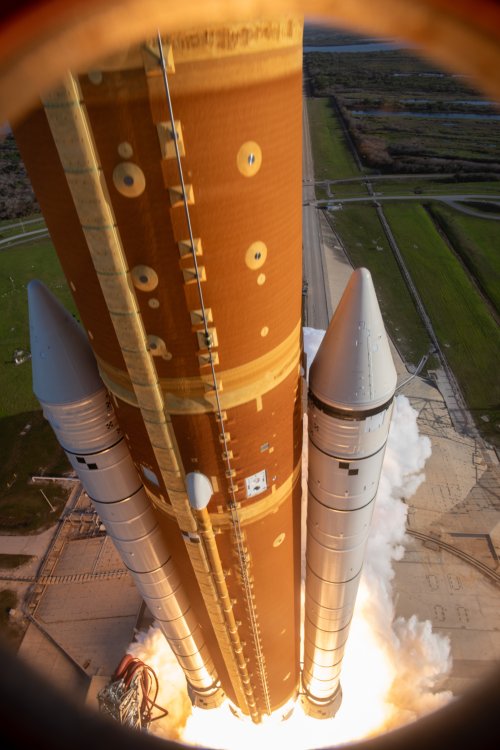
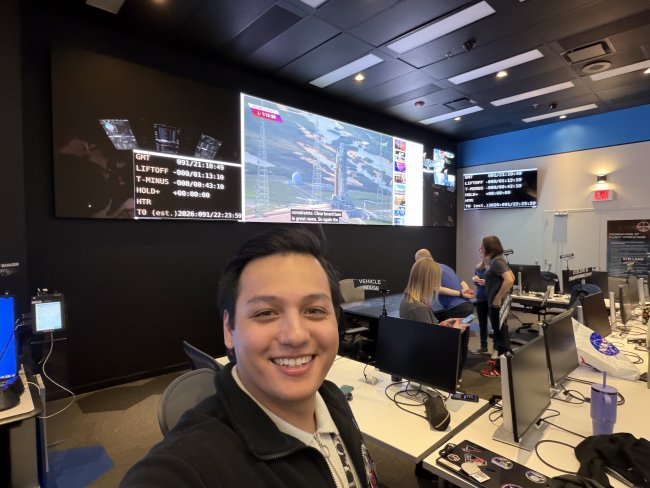
On the afternoon of April 1, as millions tuned in to watch the Artemis II launch, Jared Ralleta ’24 had one of the best seats on Earth. He got to see the rocket lift off with his colleagues in the Science Evaluation Room (SER) at NASA’s Mission Control Center in Houston, Texas. There, he and the science team are helping astronauts conduct research on the first crewed lunar flyby in over 50 years.
Ralleta’s official title is Artemis Mission Support Scientist, and before this mission, he spent his workdays at NASA’s Goddard Space Flight Center in Maryland. How did he land there? Back in 2022, Ralleta was a student at Saint Mary’s, the first in his immediate family to attend college. That February, he received an email from a professor from whom he hadn’t taken a class—or even met—Alice Baldridge, now interim Dean of the School of Science.
An astrogeologist by training, Baldridge had been selected to join a NASA grant that included student researchers. Ralleta had been recommended for the program. Was he interested? “What was I gonna do? Say no?” he told the SMC NewsCenter in 2023.
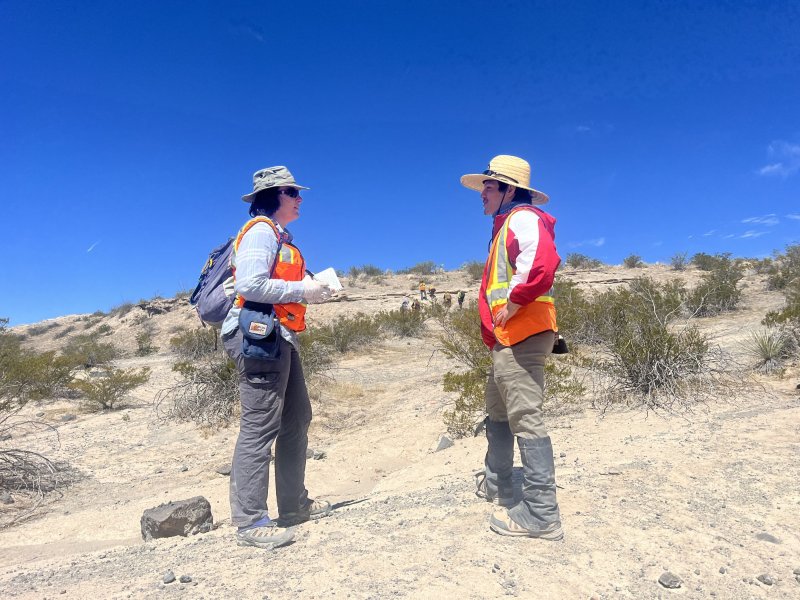
Soon, Ralleta was accompanying Baldridge and the team on trips to the NASA field site, Kilbourne Hole in New Mexico, three years running. He switched his major from Engineering to Physics and presented his findings at numerous conferences, including the NASA Exploration Science Forum in 2023. Those experiences paved the way to Goddard, and now, Artemis.
On April 2 of this year, the day after the launch, we called up Ralleta to ask about his role in the Artemis II mission and his journey to this historic moment. The conversation has been condensed and edited for clarity.
How did the launch go, from your vantage?
Oh man, it was surreal. I've tried explaining this to my family and my friends, and it's really hard to put into words what we experienced in the SER. Our entire science team gathered in one place to watch a rocket take off to send our friends around the moon and back. It's so hard to explain the overwhelming wave of feelings that washed over me as soon as ignition started.
There were probably 30 to 35 of us there in SER, watching. Some people brought their families from Houston. I knew I was sharing this moment with my family, too, who were watching in California. The collectiveness of it all— it was much, much bigger than anything I’ve ever been a part of before.
Talk to me a little bit about what the mission will look like for you. When do you come in?
In just a few hours, actually, the science team officially starts our shift. The next ten days are jam-packed with work and excitement. My role, specifically, is software-based. I developed software tools that help NASA’s lunar geography experts decide which targets the Artemis II crew should photograph and describe. My software is also helping shuttle that data from the spacecraft back to our data analysts on Earth.
The first thing I’m on the hook for is verifying our live encounters guide, which is essentially a tool that presents all available targets for the cruise lunar flyby to the science team. That way, SER can make informed decisions about which craters, basins, and other features on the moon they would like the astronauts to capture.
“I'm so incredibly privileged and blessed to be able to run through the door that [Professor] Alice Baldridge opened for me...I could not thank her enough for her hands-on, experiential teaching style. She really equips students not just to talk about it, but to go out and do it.”
What are the big picture things you and the NASA science team are hoping to accomplish with the Artemis II mission?
Fundamentally, Artemis II is a flight that’s informing us about how to do this again. We definitely want to go back to the moon, land astronauts on the surface, and stay there for a while. Then there is the more personal objective: to see our four friends take off, orbit the Earth, slingshot around the moon, and come back safely. That’s the biggest criterion for success for all of us.
In terms of my own personal success, I’m hoping to see those images come down, present them to the world's leaders in lunar geology, and have them conduct their initial analysis. I just want to do my job the best I can, you know?
How much of your work on this mission is an outgrowth of the research you did as a Saint Mary’s student, working with Alice Baldridge?
Oh, it's absolutely directly connected. Every single skill and experience I gained during my 2023 and 2024 research trips to Kilbourne Hole directly applies. Realizing when there is a problem, and solving it with programming frameworks like Python, JavaScript, HTML, and REACT—that’s exactly what we did in Kilbourne Hole. There’s also a need for real-time analysis in the field and for presenting data quickly and efficiently, which I also did.
I’m curious, throughout all of this, how often you think about the fact that this all started because of an email from Professor Baldridge.
Man, I think about that every single day. I'm so incredibly privileged and blessed to be able to run through the door that Alice Baldridge opened for me. One of the first people I called last night after the launch was Alice. I expressed my gratitude for the experience she provides, not only to me but to all of her students, and how invaluable that is.
I could not thank her enough for her hands-on, experiential teaching style. She really equips students not just to talk about it, but to go out and do it.
I know these next few days will be busy, so we’ll let you go. But any final words for the Gael community?
I just want to empower anyone who is reading this: Whatever you’re hoping to do, take a stab at it. There's no harm in trying your hardest, showing up, and doing your best. And if there's a path in front of you, freaking run down it. Don't look back. Just keep on going.
WATCH THE RETURN: Saint Mary’s Assistant Professor Aaron Lee will bring his expertise as an astronomer to the Artemis mission return. Watch live on KTVU TV on Friday, April 10.
Hayden Royster is the Associate Editor at the Office of Marketing and Communications for Saint Mary's College. Write him.


