
In the lab: Professor of Biology Sonya Schuh, third from left, and some of the students who have worked with her on research featured in The Plastic Detox. Students in lab coats are, from left: Emry Cohenour ’19, Kristen Harnett ’20, Ashley Chin ’22, Tamana Gill ’23, Kimberly Alvarez ’25, Marissa Woolsey ’23, and Maralyce Martinez ’23. / Photo by Francis Tatem
The Documentary ‘The Plastic Detox’ Is Sobering and Startling. Research by Sonya Schuh and Her Students Helps Explain Effects of Compounds Known as Potent ‘Endocrine Disruptors’
The film traces six couples who are struggling to conceive a child and take steps to remove plastics from their lives. It also features research at Saint Mary’s that points to the damage chemicals in plastics cause in development.
There are moments throughout the new documentary The Plastic Detox, released in March on Netflix, that are startling, sobering, and deeply unsettling. Time and again, the film raises alarms about the effects of plastics on the human body. For many viewers, one of the revelations that brings those warnings home comes in a laboratory in Brousseau Hall on the Saint Mary’s College campus. There, Professor of Biology Sonya Schuh works with students on researching the effects of BPA compounds and phthalates on developing embryos and human stem cells.
“We look at the effects on developmental pathways,” Schuh explains in the film, “going from very, very early in development—that sort of mimic the time that a human embryo in a womb would be exposed to some of these chemicals.” Injected with various doses of the chemicals, chicken eggs are then incubated for nearly two weeks. “On day twelve, we analyze them under the microscope.”
“The film is amazing and eye-opening, focusing on the impacts of plastic, microplastics, and the chemicals they leach and their effects on human health and fertility.”
— Professor of Biology Sonya Schuh
What do the pictures through the microscope reveal? “You don't have to be a scientist to even figure it out,” Schuh says. “You can just look at the control embryos versus the phthalate-treated embryos, and the differences are quite stark.”
The effects of the chemicals are borne out in major embryonic defects to the face, head, and body; developmental delays; reduced body size; and decreased body and eye pigmentation. They reveal a body a third of the size of a normal chick embryo. In many instances, organs protrude out of the embryo’s abdominal and chest wall, with disruptions to the heart and stomach. “Some embryos are just completely malformed [to the point] that they stop developing,” Schuh explains. “These are reminiscent of many common human birth defects, and we see that with these very low doses of phthalates and BPA compounds.”
Alarmingly, the work by Schuh and her students shows that environmentally relevant concentrations of these chemicals, similar to what human beings are exposed to on a daily basis, result in these defects—and provide insight into how these chemicals may be causing disastrous effects on human fertility and development.
Shining a Light on Plastics’ Impact on Health
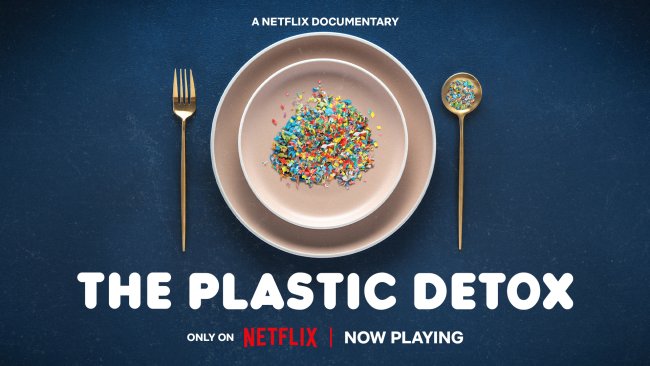
That connection with human development is at the heart of The Plastic Detox. The film follows the stories of six couples who have been struggling to conceive a child. Looking for a solution, they work with epidemiologist Shanna Swan to try to remove plastics from their homes—as well as their lives outside. Swan is 89 years old now and has devoted a fair portion of her career to examining how environmental chemicals affect reproductive health.
BPA compounds and phthalates are similar to “forever chemicals,” and are commonly known as “everywhere chemicals” because of how many products and plastics they are used in and how ubiquitous their exposure is for humans, animals, and the environment. They are also known as endocrine disruptors because of how they interfere with human hormones: They mimic or block hormone action in the body, which can have very negative impacts on development, growth, and fertility.
One database compiles a list of some 16,000 chemicals that are used in plastics, with about a quarter of them considered “highly hazardous.” But only 980 or so are regulated at all. Epidemiologist Swan has made the case that hormone-disrupting chemicals are fueling a worldwide fertility crisis. Studies have tied the chemicals to growing rates of cancer, greatly reduced sperm counts and increased miscarriage rates, increased birth defects, increasing incidence of early heart attacks and strokes, and neurodevelopmental disorders including ADHD.
In the film, Swan acknowledges that the three-month-long work with the six couples is not exactly a scientific study. “We have no control group, it’s very small,” she says. She also makes it clear that she hopes the film will educate viewers. And she plans to apply for a grant to undertake a scientifically sound randomized trial.
This film was created by the Oceanic Preservation Society, “to shine a light on how plastics—and the chemicals used to make them—are impacting human health,” the organization says. The documentary is directed by Josh Murphy and Louie Psihoyos, the latter of whom won an Oscar for a previous documentary he co-directed, The Cove. The Plastic Detox is streaming on Netflix and is now also available for free community screenings.
Taking Research to the Screen
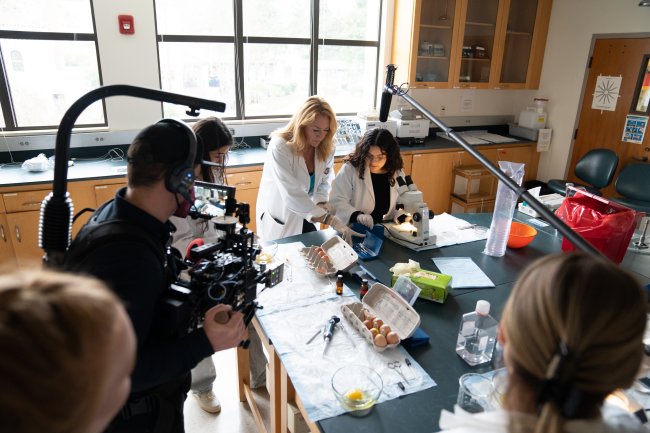
To make The Plastic Detox, filmmakers were on the Saint Mary’s campus to work with Sonya Schuh and students to look at their research at the end of 2022. Along with capturing the biologist and her undergraduate students at work—all women pursuing careers in STEM—there is the unspoken but clear example of a mentor creating fantastic opportunities for future scientists and healthcare professionals.
“The film is amazing and eye-opening, focusing on the impacts of plastic, microplastics, and the chemicals they leach and their effects on human health and fertility,” Schuh says. Needless to say, Schuh is proud of the “outstanding, brilliant, hard-working students who’ve been by my side—experimenting, scienceing, creating, collaborating, laughing, speaking, filming, never giving up, and getting our work out to the public.”
For Schuh as well as some of her students, this wasn’t the first time seeing their work make it to the screen. In 2022, HBO Max released the four-part docuseries Not So Pretty, which brought to audiences an understanding of the research Schuh and her students have done on unregulated chemicals and toxins in skin care and other beauty and personal care products.
The involvement of undergraduate students in research is a hallmark of Schuh’s work at Saint Mary’s. In 2024, the Association for Women in Science’s Northern California chapter presented Schuh with the Judith Pool Outstanding Scientist of the Year Award for her impressive research and mentorship of women in STEM. Many of Schuh’s previous students have gone on to top-notch PhD, MD, and other professional health programs around the country and world.
That includes the Saint Mary’s alumni who appear in The Plastic Detox. Kristen Harnett ’20 is currently completing her PhD in Biomedical Sciences at Oregon Health & Science University. Emry Cohenour ’19 has held a postgraduate research fellowship at Yale and is currently completing her PhD at Oxford University in the United Kingdom. Maralyce Martinez ’23 is completing her PhD in Medical Sciences, Stem Cell Biology, at Texas A&M University. Tamana Gill ’23 is working on her MD at the University of Queensland Ochsner Clinical School, in New Orleans and Australia. Ashley Chin ’22 is completing her Physician Assistant program at Northwestern University. Marissa Woolsey ’23 is working as an EMT while applying to physician assistant programs. And Kimberly Alvarez ’25 is working as a pediatric medical assistant and applying to physician assistant programs.
Steven Boyd Saum is Executive Director of Strategic Communications & Content at Saint Mary’s. Write him.


