
Honoring achievement: Class of 2026 participants at the inaugural Disability & Neurodiversity Cultural Graduate Celebration / Photo by Maggie Sanjuan
SMC Holds Inaugural Disability and Neurodiversity Cultural Graduate Celebration
A milestone evening of community, recognition, and celebration for the Class of 2026
On May 12, Saint Mary’s College of California hosted its first-ever Disability and Neurodiversity Cultural Graduate Celebration—a milestone years in the making and a powerful addition to the College’s tradition of cultural graduate ceremonies.
The event, held in celebration of the Class of 2026, brought together graduating students with disabilities and neurodivergent identities, along with their families, friends, faculty, and staff. They gathered to honor not just degrees earned but the resilience, self-advocacy, and determination that carried each student to the finish line.
A Dream Realized
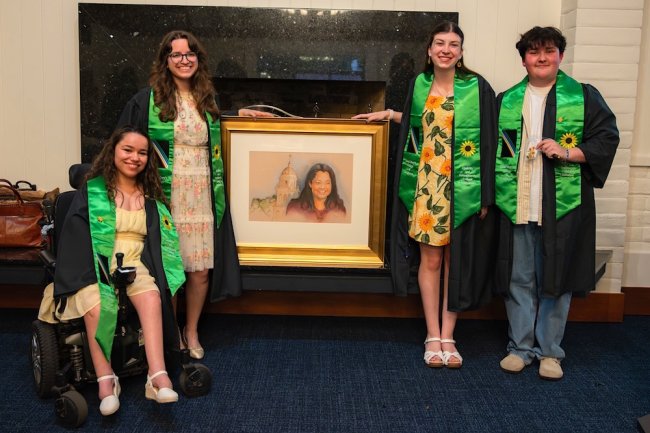
The celebration did not happen overnight. Credit for its founding belongs largely to Molly Floberg ’26, a double major in English Literature and Creative Writing, who first conceived of the idea during her first year of studies at Saint Mary’s after noticing that—unlike other historically underrepresented groups—students with disabilities had no dedicated cultural graduation ceremony of their own.
Over the following three years, Floberg lobbied and planned, eventually partnering with the Student Disability Services (SDS) office, the InterCultural Center (IC), and fellow student leaders Aya Banaja ’26, Luca Swann ’26, and Brianna DeBranca ’26 to bring the vision to life.
“This is truly magical,” Floberg told the audience during her keynote address. “I have been working towards planning this cultural graduation since my freshman year.”
An Evening of Ceremony and Community
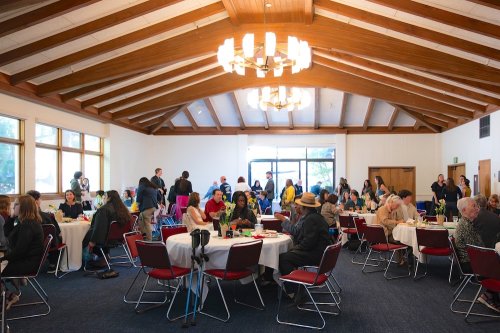
The celebration was emceed by Associate Directors of Student Disability Services Emily Heier and Collin Pugh, who guided attendees through an evening of keynote speeches, awards, stole presentations, alumni pinning, and heartfelt recognition.
In her opening remarks, Heier reflected on the profound significance of the occasion. “Graduation is always an achievement,” she said, “and for students with disabilities, it often reflects a deeper story of persistence, self-advocacy, and navigating systems not always built with you in mind. Your disability is not something you overcame to succeed—it is part of how you succeeded.”
Graduates received custom stoles and two pins: a traditional Saint Mary’s Alumni pin, and a sunflower pin donated by the Anderson family in honor of Hillary Anderson ’97, a Saint Mary's alumna who was the first person in a wheelchair to graduate from the College. The family's contribution was a tribute to Hillary’s legacy of accessibility advocacy and a reminder of the lineage of disabled scholars who paved the way.
Cami West, who has worked in Student Disability Services for 21 years and is retiring this July, pinned each graduate. It was a meaningful gesture not just for the students but a full-circle moment for West as well, as a dedicated member of the disability services community.
Three Student Voices
The heart of the evening was the stories shared from the podium by three student keynote speakers, each bringing a unique and moving perspective on what it means to navigate higher education as a disabled or neurodivergent person.
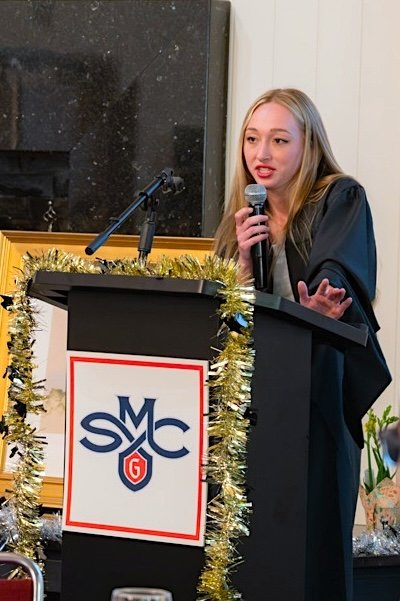
McKenna James ’25, MA ’26, completing her Master of Arts in Strategic Communication, drew on her punk rock upbringing to frame her experience at SMC. Punk, she explained, was never just music in her household—it was a worldview built on radical self-acceptance and questioning systems not designed for you. She spoke candidly about being accused by a professor of cheating, simply because the quality of her work didn't match what the professor expected from “someone like her.” Rather than treating her experience as exceptional, she offered it as a mirror to her fellow graduates: “I’m not telling you that story because it’s unique. I’m telling you because you have your own version of it.” Her message was one of hard-won pride. “You walked into a place that was not built for you and you made it yours,” she told the audience. “As far as I am concerned, that makes every single one of you an honorary punk rocker.”
Aya Banaja, a Psychology major with a concentration in Clinical Counseling, reflected on the small moments of belonging that accumulated into a transformed sense of self. She traced her growth not to a single defining experience, but to a thousand quiet ones—professors who believed in her, friends who let her take up space, and SDS staff who reminded her she was a valued part of the team.
Her speech began with a tiny rainbow spiky fidget ball handed out at an SDS orientation session in 2022. “Being handed a fidget during one of the most nerve-wracking moments of my life was the first time I experienced accommodation without having to ask for it,” she said. “The first time I felt like I might not have to hide parts of myself to belong somewhere.” She closed with a gentle challenge to carry that sense of belonging forward: “Leaving doesn’t mean the end of this community. It means we become it somewhere else.” After graduation, Banaja will be pursuing a master’s degree in Developmental Psychology and Psychopathology at King’s College London, with a goal of advancing advocacy for disabled and neurodivergent individuals in the Middle East, where she grew up.
Molly Floberg, who received the Wang Family Student Leadership Award, delivered a keynote that was equal parts personal narrative and call to action. She spoke about finding her voice through creative writing and channeling her love of storytelling into novels featuring autistic protagonists—filling a gap she had noticed in school library shelves.
Floberg also shared with the audience with a direct message to the institution itself, urging Saint Mary’s to commit to funding the cultural graduate celebration in future years. “By continuing this cultural graduation celebration, we show future students like us that they belong here,” she said. “We will not be viewed as an afterthought. We are one of the strongest parts of Saint Mary’s College, and we deserve to be celebrated.” Floberg will be attending Eastern Washington University this fall to pursue a master of fine arts in fiction writing.
Student and Faculty Awards
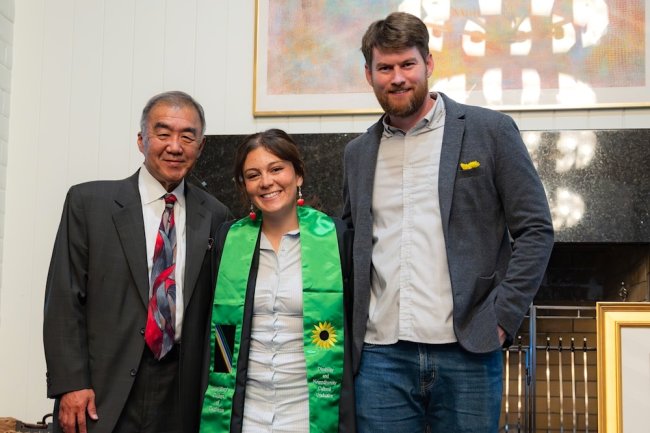
The evening included two formal awards recognizing outstanding contributors to the disability community at Saint Mary’s.
The James Family Disability Advocacy Award, given to a staff or faculty member and selected by students, was presented to Associate Professor James McCauley of the Psychology Department. McCauley joined SMC in 2020 and has become a cornerstone of neurodiversity education and research on campus. He teaches courses including Neurodiversity and the Psychology of Disabilities as well as Infancy and Childhood, and he actively supports student research. This spring, he led faculty workshops on neurodiversity and organized Saint Mary’s hosting of the Bay Area Autism Consortium annual meeting. He was also recognized by the College with an Early Career Scholarship and Service Award.
The award was named after the James family, whose son is an SMC alumnus, and who are major supporters of the Neurodiversity Success initiative on campus, known as The Connect Program.
The Wang Family Student Leadership Award was presented to Molly Floberg, nominated by her peers for her transformative contributions to the campus disability community. Under Floberg’s leadership, the DiverseAbilities club was rebuilt into a thriving organization and named Student Organization of the Year in 2024. She also successfully advocated for the removal of anti-disability language from the grading rubrics for Collegiate Seminar—an effort recognized with the College’s Advocacy in Action Award. Flobert also received the Leading for Change Award at the 2026 Campus-Wide Student Leadership Awards Ceremony.
Looking Ahead
As the ceremony closed, graduates processed out to music and gathered for a group photo, the first graduating class to carry the distinction of celebrating at Saint Mary's inaugural Disability and Neurodiversity Cultural Graduate Celebration.
The night was, as Emily Heier described it, “more than a ceremony—it’s a recognition of disability as culture, identity, and community.” And for a campus community that has spent years working toward more inclusive traditions, it marked the beginning of something that many hope will continue for generations of students to come.


