
Scholarship and service: Associate Professor of Psychology James McCauley was recently recognized for his work in the field and for the Saint Mary’s community. / Photo by Francis Tatem
Scholar at Work: James McCauley on Autism, Acceptance, and Building Community
Saint Mary’s hosted a meeting of the Bay Area Autism Consortium this spring—with SMC scholars, alumni, and students showcasing their research.
“At Work” is a series that highlights Saint Mary’s faculty and staff at work in the world. Artists, writers, scholars, scientists—we sit down and dive deep into their latest projects.
One of the foundational principles of Lasallian education is meeting students where they are. What does that mean when we’re talking about autism? That’s one of the questions we sat down to discuss with Associate Professor of Psychology James McCauley.
April marked Autism Acceptance Month—an opportunity to celebrate and honor the experiences and identities of Autistic individuals. That wider celebration comes amidst a series of events and activities on the Saint Mary’s campus this spring to bolster understanding, inclusion, and support. Those range from the convening of the Bay Area Autism Consortium annual meeting on the Saint Mary’s campus, a workshop for faculty on “Neurodiversity, Equity, and Inclusive Practices in Our Classrooms,” and the upcoming Disability and Neurodiversity Graduate Celebration on May 12.
McCauley led the faculty workshop, and he has written extensively on autism and worked with autistic communities. That includes scholarly work in journals including Autism Research, The Journal of Child Psychology and Psychiatry, and the Journal of the American Academy of Child and Adolescent Psychiatry as well as a joint project on autism commissioned by The Lancet. And it was through McCauley’s initiative that Saint Mary’s hosted the Bay Area Autism Consortium on March 6, with the event made possible in part through the sponsorship of the Kalmanovitz School of Education. In between those two events he was honored, fittingly enough, with the Early Career Scholarship and Service Award from Saint Mary’s.
After earning a bachelor’s in Psychology from Santa Clara University, McCauley completed his MS and PhD in Human Development at University of California, Davis and a postdoctoral position at UCLA. He has taught at Saint Mary’s since 2020. Here’s McCauley in his own words.
In the classroom: learning patterns to make sense of your world
Along with Introduction to Psychology and courses on distinct developmental periods, I teach a class on Family Psychology. I teach two sections—it’s a very popular course, and it always fills. Students get a look at understanding family interaction patterns that relate to their own development. One of the assignments is they get to talk about their family history in relation to the patterns that they’ve seen intergenerationally, and how that’s impacting their current ideas of themselves.
One thing I always have to say is: “There are going to be topics I talk about in this class that are relevant to you right now.” Some topics are really relevant for students.
That can be true for me, too. We were just talking today in class about the impact of the pandemic on parenting. I started at Saint Mary’s in 2020, and I clearly remember being online teaching classes…with a three-year-old at home!
Bringing the Bay Area Autism Consortium to campus
On March 6, Saint Mary’s hosted the Bay Area Autism Consortium’s annual meeting showcasing internationally renowned autism researchers residing in the Bay Area. The conference was sponsored by the Kalmanovitz School of Education (KSOE) and Sinica Therapeutics. The theme was “Autism, Education, and Learning: Searching for Common Ground from Basic to Applied Research,” and we brought together over 100 students, educators, scholars, practitioners, and community members. There were experts in basic science—chemistry, biochemistry, biology, and genetics—as well as neuroscience, plus behavioral researchers and clinical psychologists.
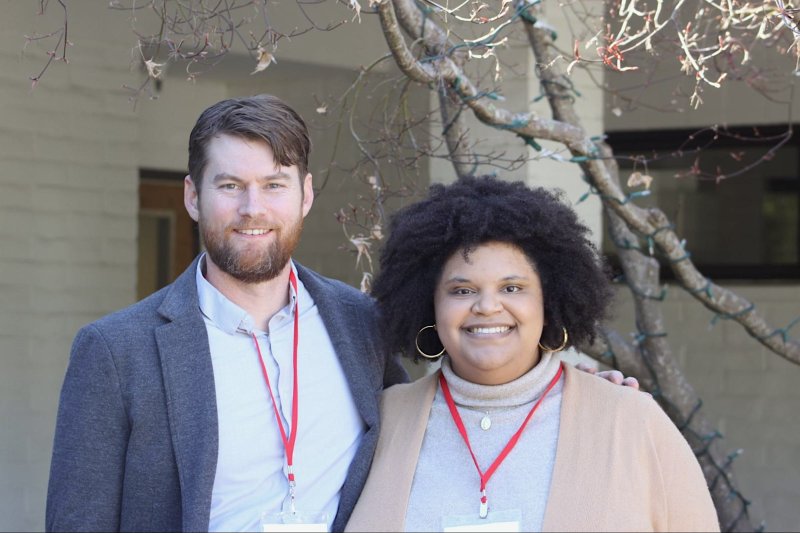
This is an important community event that allows for the dissemination of knowledge with the shared goal of improving the lives of autistic people. From a research lens, we've been trying to increase the utility of the Consortium for people with practical or clinical experience as practitioners.
One goal is to rotate institutions and increase collaborations. The first year I joined, it was at Stanford. My second year attending it was hosted by UCSF, and one of my students, Taylor Odom ’23, won the best poster prize. She was one of the only undergraduates presenting; others presenting are typically grad students, post docs, and medical students.
Taylor and I worked together on a project through the School of Science Summer Research Program in 2022, and we've continued to collaborate, still working on the data we gathered. For the consortium’s meeting this year, she wrote an abstract, and her work was selected for an oral presentation—one of only six! Her presentation was on “Observational Indicators of Emotion, Affective States, and Preference in Autistic Adults With High Support Needs” and summarized some of her work at Saint Mary’s. Taylor completed her master’s in Counseling Psychology and is now delivering therapy for individuals in the Bay Area, with a specialty in neurodiversity-affirming practice.
Scholarly insights and the importance of individualized support
The conference featured keynotes from Dr. Peter Mundy from UC Davis, talking about preschool joint attention—which is one of the factors in learning to play together. In the faculty presentations, Betty Yu from San Francisco State spoke on bilingual families in the Bay Area and some of the challenges that they experience feeling pressured to only use English with their child at home to gain access to services or reduce confusion. It’s important to understand that children who are only getting the monolingual piece are missing out on all these extended relatives that are around who are speaking multiple languages or maybe speaking Mandarin at home. So for a child who is only using English, it may be a bit isolating when their families have multilingual conversations around them.
Loren Frank, a researcher from UCSF, discussed mouse models of learning that are relevant to the genetics of autism. And Aubyn Stahmer of UC Davis emphasized the importance of implementation through her work in community-based participatory research, reminding everyone that evidence-based interventions only matter if they can be meaningfully adopted in real-world settings, together with community partnership and leadership support.
From KSOE, faculty Peter Alter and Marissa Loudon were featured as panelists to reflect on the research priorities to help create meaningful change for autistic people from the perspective of educators and community members. They work in our special ed program, and both of them came from the classroom that day to talk about some of their experiences working with children on the spectrum. They shared their insights when it comes to individualized support; sometimes research misses that perspective.
Showcasing SMC Student Research
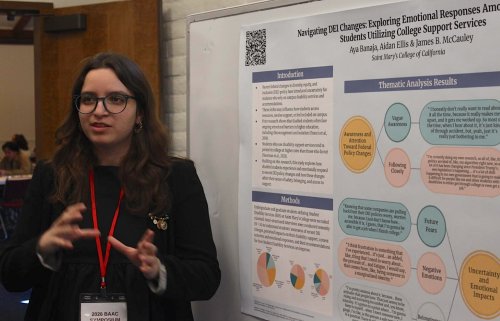
Alongside these presentations, Saint Mary’s undergraduates Aya Banaja ’26 and Aidan Ellis ’28 presented a poster on “Navigating DEI Changes: Exploring Emotional Responses among Disabled Students Utilizing College Support Services.” They worked with data collected at SMC in coordination with the Student Disability Services office, interviewing students to understand their experiences: Do they perceive any changes? What are their emotions around some of these changes? Given conversations and shifts in society overall, some heightened anxiety about their futures is relevant to their experiences.
Aya is finishing her degree in Clinical/Counseling Psychology, and she will be headed for King’s College London to begin a master’s program in Developmental Psychology & Psychopathology. Aidan is studying Psychology, Neuroscience, and Biology and has an interest in medicine. It’s exciting to work with students like this—and the meeting provides them an opportunity to connect with people on a professional level.
Spotlight on Collegiate Seminar
In past years, I’ve also presented with my students some data on how students on the spectrum interact in Collegiate Seminar, because it’s a very social, discussion-driven classroom environment. I walked through some of that data at a session for Saint Mary’s faculty in April, to help navigate some accommodations and barriers that present themselves.
One of the things within Seminar classes: We have these round rooms, and if you have challenges with eye contact, it’s a challenge to know where to look, right? Another challenge is there's a high emphasis on participation. But it turns out, a lot of the autistic students we talked to recognized the value that these classes have had in their professional development, in terms of gaining communication skills. It is challenging to know how to engage and put yourself out there and to stay on topic—or when the topic diverges, how to steer it back. Those are skills that students can be supported on a little more formally within our classroom environments.
The human experience
In many respects, this year’s meeting of the Consortium was about trying to understand the impact that support systems can have. It was valuable to hear perspectives of autistic individuals who are in college or in grad school, who are becoming teachers and educators themselves—reflecting on their experiences of feeling valued. But also important is understanding the need for continuous advocacy—when they've had to fight along the way, to get recognized, to feel supported, to be understood.
“When we’re trying to understand autistic people, we’re also understanding all people, in a way.”
One of the things I take away from some conferences, including this one: When we’re trying to understand autistic people, we’re also understanding all people, in a way. Development occurs in unique ways for each of us, so there are really important contextual influences on development that really help us to understand human experience as a whole.
Differences have value
It has been a kind of tumultuous year within conversations about autism. You know, autism science has advanced a lot when it comes to the understanding of the person. But at the same time, there's still a lot of misunderstandings around the origins or etiologies of autism that get in the way of progress sometimes. Or, when we talk to autistic people, some of these conversations aren't very helpful for their understanding of themselves.
I would say that we are moving from trying to understand autism as a problem—trying to understand its origins and causes—to understanding autism as a human experience that sometimes has differences. And those differences also have value. I teach a course on Neurodiversity and Disability and the fall—where we certainly get into scholarship and writers who recognize the value that autistic people can bring or that they have.
Support on campus
At Saint Mary’s we do have some wonderful support systems in place for students who may be on the spectrum. Through the Connect program, for example, every semester, I work with Student Disability Services and the Career Center to get online and talk to parents of students on the spectrum on campus. It’s an open invite event. I talk a little bit about my research; then Julie Scaff and Emily Heier from Student Disability Services will talk about support and opportunities available for students. It’s wonderful for the parents, because there are some who text to their students, “Did you know that there's a career event tomorrow?” and get them to take advantage of these opportunities. There’s also an emphasis on community—a chance for parents of college students to connect, because it’s kind of hard for them to meet each other. But here’s an opportunity that is fairly unique in a higher education setting.
We also have a Social Connect group that meets every week for students who want a little bit of extra support socially, to meet and to interact. They go out to ice cream, they have movie nights, there was a Mario Kart night the other other week.
Just in the past couple years, it has been rewarding to see students really shine as they work to provide support for one another as well. There’s the DiverseAbilities Club, started by students, with a commitment to build a more inclusive campus community through education and support. They organized a Neurodiversity Celebration last year. That led, this year, to Student Disability Services hosting the Disability and Neurodiversity Graduate Celebration on May 12.
This conversation has been edited for clarity and length.
Steven Boyd Saum is Executive Director of Strategic Communications and Content at Saint Mary’s. Write him.


