
Move fast and fix things: Lachlan Hovany ’27 assisted Assistant Professor of Computer Science Sarah Roscoe ’18 in designing a tool to identify defects in 3D printing models. “It’s all pretty exciting,” Hovany says. “There are essentially no existing tools that do this.” / Photo by Francis Tatem
In Their Own Words: Lachlan Hovany ’27 on Finding the Voids—and Possibilities—in Computer Science
Hovany chose SMC for its Bay Area location, liberal arts curriculum, and tight-knit community. Along with debating great books in Collegiate Seminar, he has designed a groundbreaking tool to detect faulty 3D-printing models.
In Their Own Words is a series in which we introduce you to the Gaels you need to meet—students, alums, faculty, and staff—and let them tell their stories, in their own words.
Today, we’re highlighting Lachlan Hovany ’27: a second-year Computer Science major, tutor at SMC’s STEM Center, and Resident Advisor in Claeys North. In summer 2025 he participated in Saint Mary’s Summer Research Program, working alongside Sarah Roscoe ’18, an assistant professor of Computer Science, to develop a groundbreaking tool to detect defects in 3D-printing models. For Hovany, the Computer Science program provides the fundamentals and flexibility to chart his own path forward.
From Sydney to Saint Mary’s
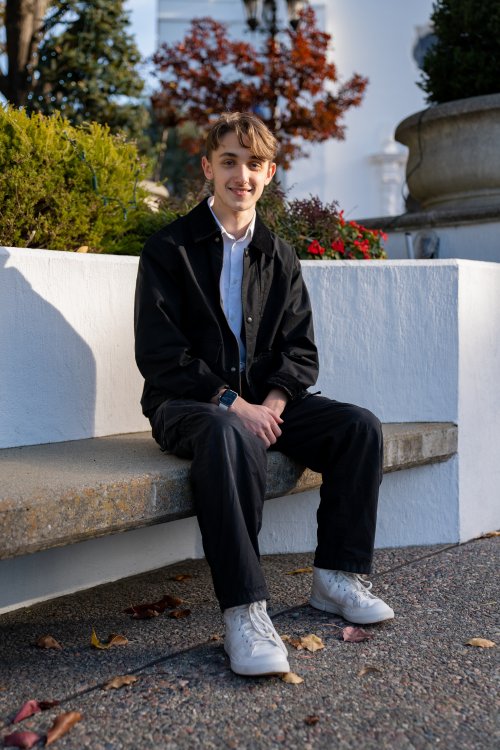
I’m originally from Sydney, Australia, but we moved to the Bay Area in 2015 for my mom; she’s an executive at Clorox, based in Oakland. My dad works in IT consulting, which had a big influence on me. From a young age, he took me to work and spent time with me on computers, teaching me how to program and build PCs, things like that. As I got older, I stuck with it.
By the time I was looking at colleges, I saw myself working in tech full-time. I applied to a few different colleges, but Saint Mary’s was always at the top of the list. As someone who really likes the tight-knit school experience, I knew I wanted smaller class sizes and connections with professors. Plus, the Bay Area has such a concentration of innovation and opportunity.
I also attended a Lasallian high school, Sacred Heart Cathedral Preparatory, in San Francisco, and really appreciated that approach to learning. I wanted a liberal arts foundation, and if I were to study CS at another Bay Area university, I might not get the same kind of education. At SMC, though, you learn more than just your major, which I think is important.
Fundamentals and flexibility
So far, I’m two years into my CS major, and it’s been a great fit. I’m really getting a lot of one-on-one time with professors. I love that I can just meet up with Udayan Das, the director of the CS department, and spend time discussing AI ethics or cryptocurrency. A few of my friends at bigger, research universities have told me they don’t have those kinds of connections with their professors.
I also love how student-focused the CS curriculum is. If we have something specific we’re interested in, professors are more than willing to restructure classes around those topics. I also really appreciated Collegiate Seminar, the great books course every SMC student takes. It’s a very different approach to thinking than you might get in a STEM course. I’m learning to advocate for my perspective, stand on it with evidence, and even debate it with others.
What sets SMC’s computer science program apart from others, I think, is the flexibility to shape your own path. You can do an independent research project one semester and then take a literature course the next. For a CS major, that kind of well-rounded education is actually pretty rare.
“What sets SMC’s computer science program apart from others, I think, is the flexibility to shape your own path.”
Peering into the voids
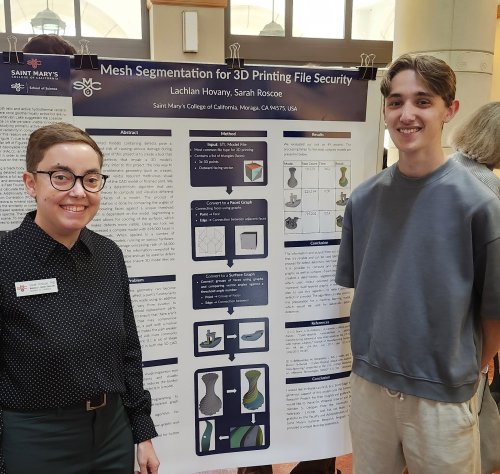
In 2025, I took part in SMC’s Summer Research Program, working with my professor, Sarah Roscoe, on a project that builds on her doctoral thesis. Specifically, we examined voids in digital 3D-printing models. Sometimes, malicious changes can be made to 3D models that impair their functionality, with serious consequences.
Let’s say you’re 3D-printing a blade replacement for a drone, and there’s a slight void in the digital model—so small you wouldn’t even see it on the printed blade. When you attach the blade to the drone, it might snap in mid-air, offsetting the drone and causing it to crash and cause damage. And that’s just a small example. 3D printing is becoming much more common in large-scale manufacturing. Imagine this same scenario with, for instance, a commercial airplane. You can see why this is important!
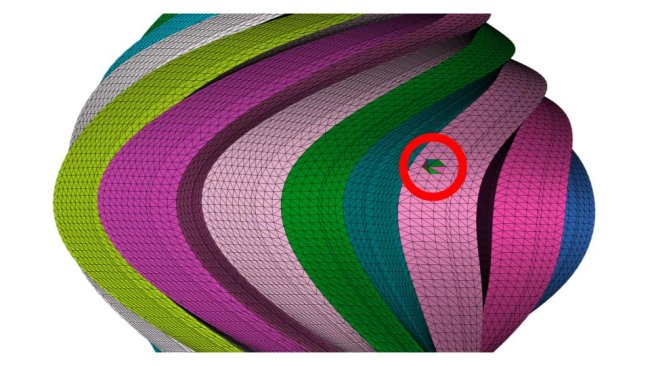
Maybe these voids were intentionally placed, or maybe it’s just bad design. What Professor Roscoe and I were most interested in was whether we could design a tool to detect these voids. So we spent time comparing modified models to unmodified models. The thing about 3D printing models is that their surfaces are, fundamentally, just a bunch of little triangles. So we designed a tool called a “mesh visualizer” that displays a model and assigns colors to its 3D surfaces. We did this to find defects in the surface geometry. By the end of the summer, we were able analyze models with millions of triangles.
During Jan Term, Professor Roscoe and I explored whether we could apply machine learning to finding the defects. It’s all pretty exciting; there are essentially no existing tools that do this. And because I’m at Saint Mary’s, I have a ton of input and can help direct where the research goes.
Preparing to adapt
I’ll graduate in 2027, and I’m still weighing my options. Grad school is on the table for sure, and I enjoy research quite a bit. But I also haven't had a full industry experience, so I might enjoy that even more.
Silicon Valley is evolving so quickly, especially with AI and machine learning, so it’s hard to say exactly where I hope to land when I graduate. But I’m definitely open to trying a lot of things. Honestly, I’m so curious to see where things stand when I graduate. Maybe I’ll dive into a new emerging industry. Three years from now, there may be careers no one has even thought of yet.
Above all, I think it's so important to always be adapting. Growing up, my dad taught me the hands-on, hardware side of things. Here at Saint Mary’s, I’m learning the fundamentals of programming and software. Outside of my classes, too, I’m always trying to learn a new programming language or understand a different aspect of CS. That way, when it comes time to apply for a job, I’ve got experience in a bit of everything. It never hurts to know more.
Hayden Royster is the Associate Editor for the Office of Marketing and Communication at Saint Mary's College. Write him.


