
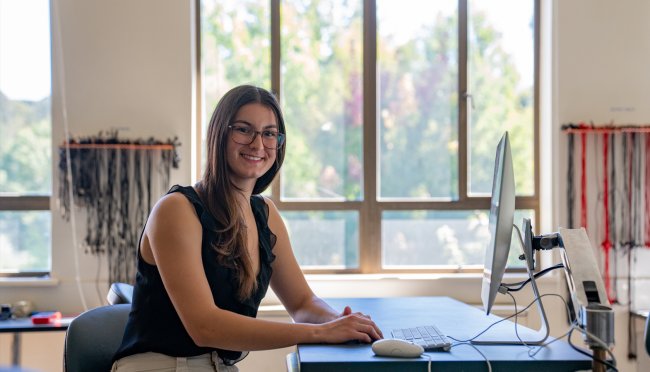
Breaking ground (and particles): It wasn't until Daniela Concion ’26 began her internship at Fermilab that she realized its global significance. “Here I was, working at a lab that’s helping shape the future of the field,” she recalls. / Photo by Francis Tatem
In Their Own Words: Danijela Concion ’26 on Building Software That’s Helping Unlock the Universe
Thanks to the support of Professor Mari-Anne Rosario, Concion landed a competitive summer internship at Fermilab, the premier particle accelerator. She built software that helps researchers better monitor data—and potentially discover new particles.
In Their Own Words is a series in which we introduce you to the Gaels you need to meet—students, alums, faculty, and staff—and let them tell their stories, in their own words.
Meet Danijela Concion ’26: a fourth-year Physics major and Mathematics and Italian minor and member of the Saint Mary’s Women’s Rowing team. This year, Concion secured a competitive summer internship at Fermi National Accelerator Laboratory, commonly known as Fermilab—the world-renowned particle accelerator based in Batavia, Illinois. Working with Fermilab’s computing department, she helped develop a software program to better monitor data from the Large Hadron Collider in Switzerland.
Rowing her way to Saint Mary’s
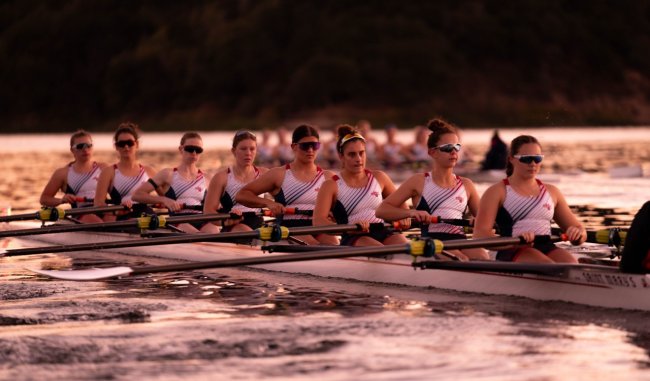
Initially, I was recruited by Saint Mary’s to be on the rowing team. It’s a relatively recent sport for me; I was a swimmer for ten years before joining rowing in my junior year of high school. I found I really like the discipline of rowing. I actually enjoy waking up and practicing before dawn. Having a set schedule like that helps me get all my other work done and motivates me.
Growing up, I always attended small schools near San José, and I knew I wanted a similarly tight-knit college experience. I was looking for a personalized education, one where I could really connect with my professors. I felt that when I visited Saint Mary’s. In the spring of 2022, I came to campus for an official rowing visit. I joined the team at their practice at Briones Reservoir, and really enjoyed the culture. During my visit, I attended some science classes, which solidified my choice in Saint Mary’s. And the campus was so serene and beautiful. It all seemed like the exact environment I was seeking.
An internship at the cutting edge
In the spring of 2025, I was searching for internships and feeling overwhelmed by all the options. I decided to email all my Physics professors and ask if they could share any internship opportunities they knew of. Mari-Anne Rosario, a professor of Physics and Astronomy, wrote back with information about an internship at the Fermi National Accelerator Laboratory, or Fermilab. She encouraged me to apply.
I decided to apply, even though I knew it was very selective. When I got the acceptance email in early April, I was thrilled. I was also very nervous, because the internship was in Chicago. This would be the first time that I’d traveled away from home by myself.
It only really sank in how amazing the opportunity was once I got there. I was chatting with a graduate student from the California Institute of Technology who was also an intern. He told me about pursuing a PhD in nuclear physics, and I shared my story. I asked if an internship at Fermilab would be beneficial when I apply to grad school. And he said, “Do you know where you are? This is one of the best labs in the country, and you are working here. You gotta own it.”
That’s when it hit me. There are so many important people at Fermilab trying to advance physics research. And here I was, working at a lab that’s helping shape the future of the field.
A crash course in collision
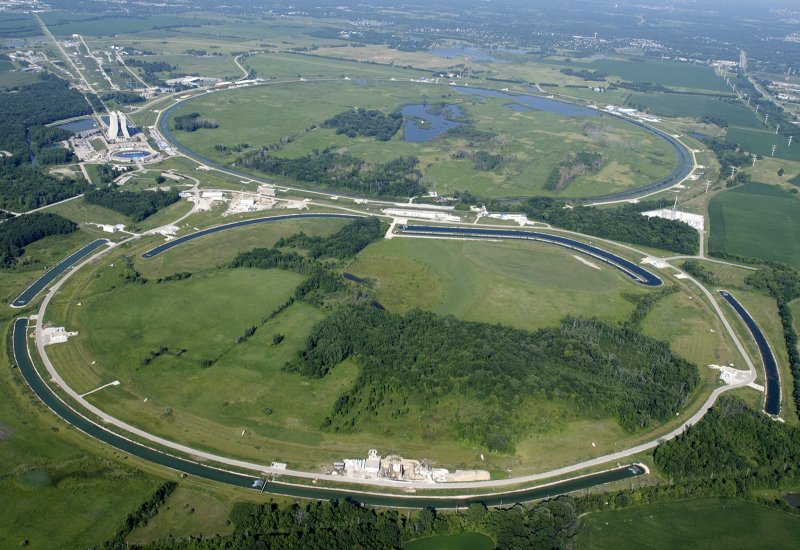
There were 18 of us accepted into the ten-week program. Half of us stayed onsite at the lab—about 35 miles west of Chicago in Batavia, Illinois—while the other half stayed at numerous universities across the country partnering on our experiment.
The first two weeks were an introduction to particle physics, because many of us were new to it or weren’t even physics students, necessarily. We also learned computer languages like C++ and Python, which I had learned at Saint Mary’s, but it was helpful to refresh my knowledge. Then we learned the background of the experiment and how it worked.
The experiment we were assisting with is run by CERN, the European Organization for Nuclear Research. Scientists at Fermilab and CERN were using the Large Hadron Collider—the world’s biggest and most powerful particle accelerator, located in Switzerland—to collide protons, break them apart, and see what they can discover about the universe’s makeup. To capture these collisions, they were using the Compact Muon Solenoid, or CMS: a magnet that acts as a kind of massive 3D camera.
The Large Hadron Collider is circular, and Fermilab has a few circular colliders, too. We got to see those. We also toured the construction site of a new linear accelerator, PIP II. Unlike circular colliders, which accelerate two particle beams in a ring, linear colliders shoot out beams that collide at the end of a very long tunnel. In the case of PIP II—a collider which will generate the world's most intense high-energy neutrino beam—that tunnel is 800 miles!
“Don’t be scared to apply to something you think is out of your reach...Coming from a tight-knit school like Saint Mary’s is an asset. You’re able to get experience and build connections, and if you’re doing your very best, people see that.”
Subatomic mixtapes—and summer in Chicago
I was placed into the computational division of the lab, in software development. The CMS experiment in Switzerland generates a ton of data from the millions of collisions per second, and that data has to be stored somewhere. At Fermilab, they store it on disk and tape. I was assigned to the tape team, assisting with the five massive tape libraries. Essentially, I helped develop software that extracted information from the tape libraries, allowing experimenters to better monitor and track the data coming onto and off of tape.
It was granular stuff, for sure. But, it was amazing to think my software could contribute to the next big particle physics discovery. Throughout the internship, guest lecturers spoke on the Higgs boson: the fundamental particle that gives mass to the universe. Its existence was confirmed in 2012 by the scientists working on the CMS experiment, the same one I was working on!
When I wasn’t developing software, I would travel to Chicago on the weekends. Some of my Saint Mary’s rowing teammates live there, so I was able to visit them. We’d go downtown as a group and walk along the Riverwalk or in front of Lake Michigan, or visit the Art Institute of Chicago. Then, toward the end of the internship, my family flew in, and we explored the city, taking a river architecture tour and trying deep-dish pizza. It was nice to have those moments, being so far from home.
The road ahead
When I finished the internship, I was inspired to look into pursuing graduate school. Now, I’m trying to decide between pursuing a master’s or a PhD in a physics-related field, or continuing on a path toward engineering, as both are intriguing to me. I’m in the midst of applying to graduate programs now, mostly on the West Coast. I’m interested in schools that have partnerships with Fermilab and the CMS experiment. But we’ll see what happens.
Looking back on my experience, my advice to SMC students is this: Don’t be scared to apply to something you think is out of your reach. Honestly, that almost stopped me. I thought a program so prestigious might not accept me. If anything, though, coming from a tight-knit school like Saint Mary’s is an asset. You’re able to get experience and build connections, and if you’re doing your very best, people see that.
I think it’s very important to use all that to your advantage and apply to as many opportunities as you can. The right program for you will accept you, and it'll be an unforgettable experience. It was for me.
(This interview was edited and condensed for clarity.)
Anne Williston MFA ’27 is a graduate editorial fellow with the Office of Marketing and Communications at Saint Mary’s. Write her.


