
Major elevation: For a summer research project, Adrian Madrigal ’27 traveled with Chemistry Professor Joel Burley to research outposts in the Sierra Nevada, examining elevated particulate matter concentration in the air. / Photo courtesy Joel Burley
In Their Own Words: Adrian Madrigal ’27 on Scaling California Mountains to Study the Effects of Dust Storms from China
Through the Summer Research Program, Madrigal and Chemistry Professor Joel Burley traced transcontinental pollution. The project took them to research outposts in the Sierra Nevada, and confirmed for Madrigal: “I want to focus on pollution in my career.”
In Their Own Words is a series in which we introduce you to the Gaels you need to meet—students, alums, faculty, and staff—and let them tell their stories, in their own words.
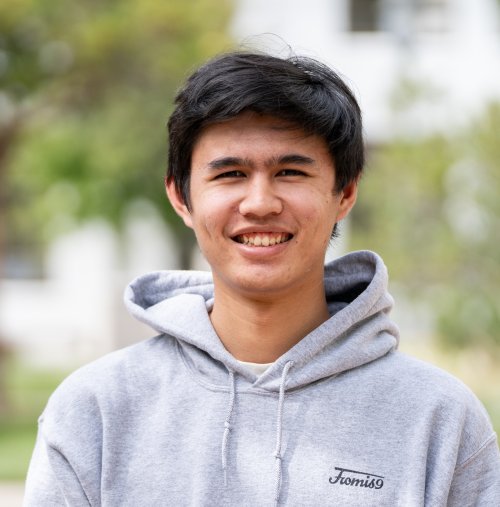
Meet Adrian Madrigal ’27: a third-year student with a split major in Environmental Science and Chemistry. During the summer of 2025, he worked with Professor of Chemistry Joel Burley to examine how sand and dust storms in China are crossing the Pacific and potentially contributing to elevated particulate matter concentrations in California. The research was an opportunity made possible by Saint Mary’s Summer Research Program, a ten-week program where students work with a faculty advisor, gaining hands-on experience on a research topic of their choice.
Finding a fit
Having come from a private high school, I wanted a similar tight-knit environment in college. When I visited Saint Mary’s, the small classes and the beautiful campus environment immediately made me feel comfortable, even though it was a new space. I knew it was the right fit for me.
As to why I chose to pursue Environmental Science, I’ll admit, at first, it was just to choose something. I knew I wanted to cover a wide range of sciences, especially given my desire to pursue graduate school and a career in research. However, as I entered my first year, I began to understand what it might mean to be an environmental scientist and all the possibilities that this field encompasses.
Narrowing the focus
Going into my sophomore year, I wanted to focus on the chemistry side of environmental science, specifically environmental toxicology. A friend and fellow ES major recommended I apply for the Summer Research Program. I was paired up with Joel Burley, a Chemistry professor who has spent years studying air quality in the High Sierra.
Going into this project, I was really interested in sand and dust storms. I’d read that storms in China were traveling across the Pacific Ocean and contributing to pollution and potentially even morbidity in California. I wanted to see if we could trace those sandstorms in our air. Specifically, I looked at PM2.5 and PM10 levels, particles with diameters smaller than either 2.5 or 10 microns, formed by wildfires, vehicle exhaust, construction, or sand and dust storms.
“The fact that I got to dive into this topic, traveling and learning from an expert on pollution like Joel Burley, is something I might not have had the opportunity to do at another college.”
Research with a view
Professor Burley and I approached the project through a trial-and-error system. We used PM2.5 and PM10 data collected by the California Air Resources Board (CARB). These data, in addition to the Chinese particulate matter data we obtained from various research articles, allowed us to assess the extent to which long-range transport was taking place.
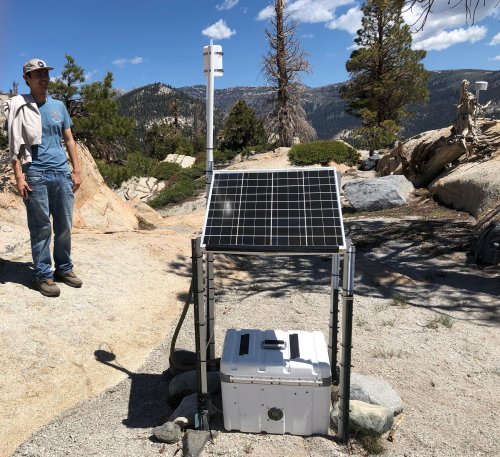
In addition to the sand and dust storm project, we also made measurements of air pollution at high elevation sites in California. In June, we traveled to Devils Postpile National Monument, about 250 miles east of the Bay Area. We hiked up to the top of a local granite dome, where Dr. Burley had installed an ozone monitor.
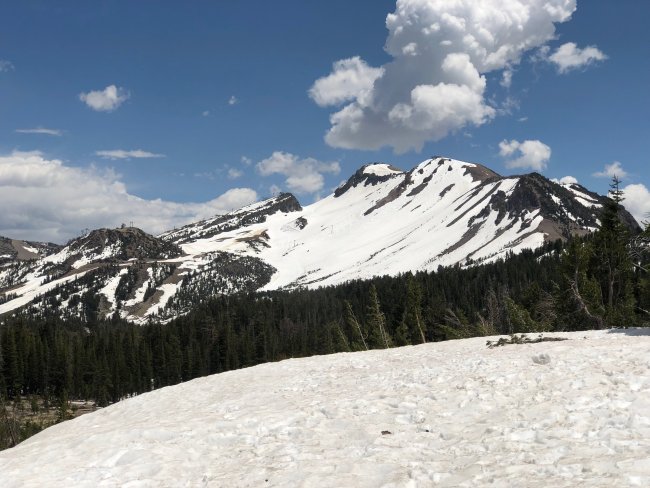
A few weeks later, we traveled to the White Mountains near the California-Nevada Border, three hours from Devils Postpile. At that location, Professor Burley’s measurements also include PurpleAir monitors, which measure particulate matter. Prior to the SRP program, I’ve definitely enjoyed hiking in the past, at Yosemite and places like that. But being at such a high elevation was new for me.
At one point, I had to take a break because I started to feel the elevation. Meanwhile, Professor Burley was fine. He’s used to the mountains by this point!
Takeaways—and a look forward
In the end, I was able to confirm that particulate matter had traveled from China to California. It isn’t incredibly common, but it does happen. And we know particulate matter can lead to respiratory irritation and even illness. In the future, I would like to explore sandstorms and their impact on mortality and morbidity, but that’s a much larger project.
Pollution affects everybody, and the realities of it can be overwhelming. But data can give us control, I believe. With my project, for instance, the data we gathered allowed us to observe the gradual change in pollutant levels over the last few years, stemming from natural sources like dust and sand storms. It enabled us to determine whether they had a tangible impact on the environment.
Overall, the Summer Research Program helped me understand what it takes to become a specialist in a scientific field. The fact that I got to dive into this topic, traveling and learning from an expert on pollution like Joel Burley, is something I might not have had the opportunity to do at another college. The program definitely helped me realize: I want to focus on pollution in my career.
(This interview has been edited and condensed for clarity.)
Story updated October 6 at 4 p.m. Pacific.
Katie Hayek ’28 is a Student Writer with the Office of Marketing and Communication at Saint Mary’s. Write her.


