
Meandering through time: Maddy Hunter ’27, who took part in the January Term travel course Decadence in Venice, believes there’s no better way to engage with history. “The class format allowed me to explore Venice in a meaningful, tangible way,” she says. / Photo courtesy Maddy Hunter
Getting Lost and Making History ‘Tangible’ on a Jan Term Trip to Venice
A reflection from Maddy Hunter ’27, who spent January Term studying in the City of Canals. From visiting stunning churches to forging new friendships, the trip was a “once-in-a-lifetime opportunity,” she writes.
The cold wind brushed our faces as my friend Sophia Constantino ’27 and I traversed the circuitous alleyways and pedestrian bridges of Venice, Italy, making our way to Piazza San Marco. It was our first day in this city on the water, and we were definitely, thrillingly, a bit lost.
Wandering Venice was unlike anything I had ever done before. Earlier that morning, Gabriel Pihas, a former associate professor in Saint Mary's Integral Program who was co-teaching our course, compared Venice to Disneyland, noting its walkability and compact size. I certainly saw his point. Still, there’s a difference between traversing Toontown and navigating Venice, a 1,600-year-old floating city where canals outnumber traditional roads and the fastest way around is usually a water taxi.
Visiting Venice was a one-of-a-kind experience—the sort that Saint Mary’s January Term program provides students like me every year. In January, students can follow their curiosity by exploring a subject or skill they might not encounter in their majors. With the Jan Term Travel courses, Gaels get to go global, with options ranging from learning about coral reefs in the Caribbean to delving into China’s commerce and culture.
Thanks to the Jan Term Travel Scholarship, which covers 75% of the course fee, I was able to jet off to Italy for my class, “Decadence in Venice.” On the first day of class, Professor Pihas defined decadence for us, describing it as both an excessive indulgence in pleasure and a state of decline and decay. This makes Venice the perfect place to study decadence, with its reputation for indulgence, the yearly tradition of Carnival, and its physical collapse that has been unfolding for centuries.
One can certainly see Venice’s appeal, especially in its slanting afternoon light. After 15 minutes of getting turned around and distracted by shops, we finally emerged into the Piazza San Marco. As we approached St. Mark’s Basilica, its towering arches seemed to glow in the sun. Inside, the walls and ceiling were covered in golden, ornate mosaics depicting biblical scenes. Professor Pihas guided us through the church, explaining the significance of the art and imagery.
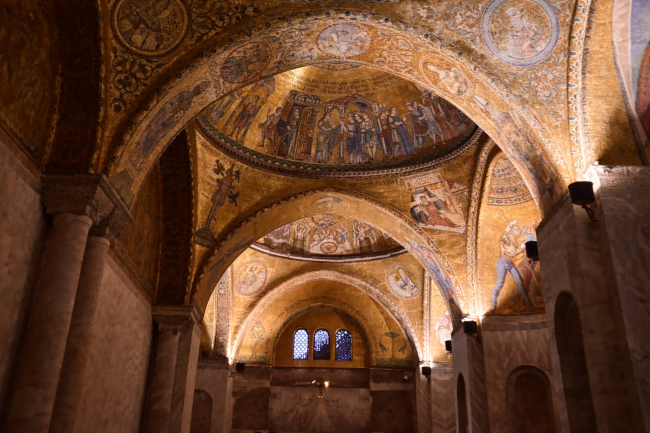
When the excursion was over, I stayed in the church. A quiet descended as tourists exited and early evening set in. I grew up attending Protestant churches, whose architecture and decor were often more modern. So it was moving to sit in such an ancient, ornate Catholic church.
In that moment, I felt a deep sense of gratitude for the opportunity to travel and see parts of the world I had never seen before.
Lived history and connections
We began each day with a lecture by Professor Pihas and Professor Charles Hilken, before heading out on an excursion to a different location on the island. On day four of the trip, for instance, after Professors Pihas and Hilken lectured on the complex political systems that Venice used to elect officials, we visited the Palazzo Ducale, or the Doge’s Palace.
Standing in the courtyard, our professors gathered us around a square carving of a figure resembling a lion. This was a “Boca de Leon,” a letterbox where citizens could anonymously press charges for crimes against other citizens. We’d just heard about it in the lecture; now we were looking at one, marveling at the power a simple stone carving had.
Moving through the palace, we wandered through seemingly endless rooms, taking in the paintings lining the walls from floor to ceiling. Through one window, we caught a glimpse of the famous Bridge of Sighs, where prisoners would walk across and gain their last glimpse of freedom before descending into the prisons. We even went down into the prisons, which required some crouching. Many of us almost hit our heads in the extremely short doorways!
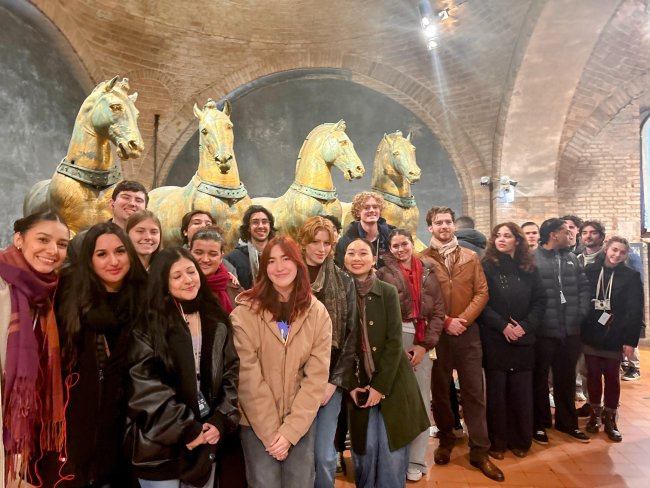
At the end of the day, we returned to our hostel, built on the ruins of the church Santa Maria dei Servi, where all 22 of us were staying. Each night, we cooked and shared a meal together, enjoying the fresh ingredients we picked up from the store each day (and were covered by the class fee). The same table we gathered around for the morning seminar and lecture became a lively space of camaraderie at night. Inevitably, someone was tasked with playing DJ, hooking their phone up to a Bluetooth speaker to add some ambience.
One way that Jan Term classes are unique is that they bring people together who might not cross paths otherwise, due to differing majors or schedules. Spending so much time together reminded me of my freshman year at Saint Mary’s, when everyone had arrived on campus from different places and was meeting each other for the first time. Traveling together gave us a chance to shake things up, step out of our routines and existing friend groups, and to form new friendships.
“The whole city, especially at night, resembles a gigantic orchestra, with dimly lit music stands of palazzi, with a restless chorus of waves, with the falsetto of a star in the winter sky.”
—Joseph Brodsky
Listening to the orchestra
From delving into Venetian history and culture to sightseeing and sailing, every aspect of the trip invited students to engage with the world around them. Part of that is the nature of the course—but part of that, Pihas told me later, is just the nature of Venice.
“Being in a city full of life but with no cars—and where you get lost so easily amongst the millions of alleyways and bridges—makes you feel like you are in another world, and loosens you up and changes your perspective,” Pihas says.
That shift in perspective is one reason why Pihas, now the Academic Director of the Rome Institute of Liberal Arts, teaches this Jan Term class year after year. “We all arrive in a foreign country a little rigid about things that are different or new,” he says. “By the end of the month in Venice, all the students are always so comfortable with everything, and even fall in love with the things that made them nervous or confused at the beginning.
"They gain a lot of confidence in themselves, and come to see that they can handle a foreign city. They can think about living in ways they didn't consider before.”
I have to agree. The class's format allowed me to explore Venice in a meaningful, tangible way, studying the city from multiple perspectives while experiencing it in real time. Coming into SMC, I was aware that the Jan Term Travel Program existed, but of course, I didn’t know how incredible it could be. Now, though, I can say that taking part was easily one of the best experiences in my life.
For our class, we were assigned Joseph Brodsky’s Watermark, in which the Nobel Prize-winning poet narrates his 20 winters spent in Venice. “The whole city, especially at night, resembles a gigantic orchestra, with dimly lit music stands of palazzi, with a restless chorus of waves, with the falsetto of a star in the winter sky,” he writes in one memorable passage.
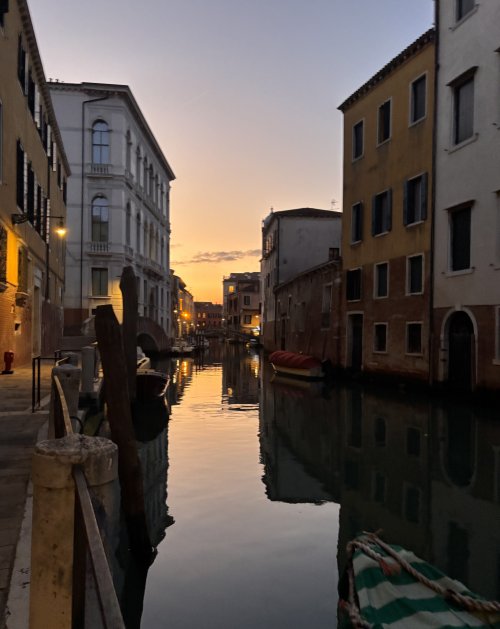
It’s one thing to read Brodsky’s words, but it’s another thing to actually experience the quiet calm of Venice in the wintertime. The waves gently lap against the walls of the canals, creating a quiet rhythm I could hear once I slowed down to listen—like the heartbeat of the city, always pulsing beneath the sounds of everyday life.
Maddy Hunter ’27 is a student writer in the Office of Marketing & Communications. Write her.


