
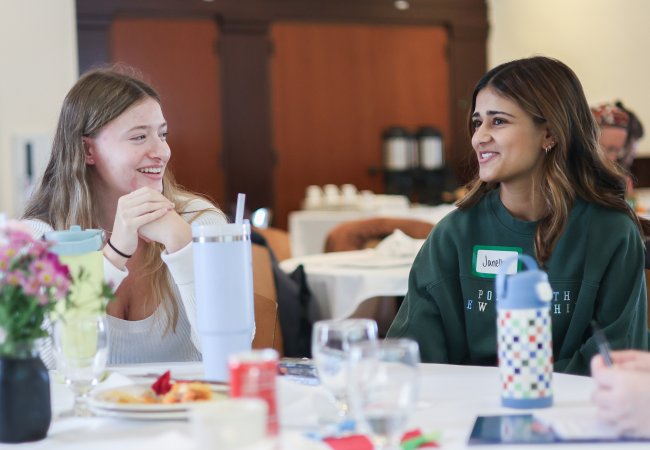
Knowledge nexus: For over a decade, the Saint Mary’s Library has hosted the High School Librarians Workshop, a one-day conference that welcomes library workers and media specialists to share innovative library trends and best practices. / Photo by Noelle Leong
Libraries in a Changing Landscape: Three Takeaways from the 2026 High School Libraries Workshop
For over a decade, Saint Mary’s has hosted a conference for dozens of middle and high school library workers to share innovative trends and best practices. This year, the focus was on AI, inclusivity, and students taking the lead.
If the library is the cultural and intellectual hub of Saint Mary’s, then Saint Mary’s librarians keep that hub humming. They are the ones who manage millions of print and digital texts, who provide students with study spaces and events, and who maintain 163 years of historical material in the College Archives. Even as the Saint Albert Hall Library undergoes its dynamic, full-scale renovation, they are ensuring the library—currently housed in the Power Plant—continues to serve a central role.
Their impact is not just felt on campus, either. Since 2015, Saint Mary’s has hosted the High School Librarians Workshop, a one-day conference that welcomes middle and high school library workers and media specialists to share innovative library trends and best practices. What began as a modest gathering for Bay Area librarians has dramatically expanded. In January this year, 88 attendees from public and private schools throughout California took part.
The workshop is the brainchild of Sarah Vital ’00, the Business and User Communication Librarian, and Sue Bikenseer, a Reference and Instruction Librarian who retired in 2022. Over the last decade, workshops have focused on a range of topics, from navigating the Common Core State Standards to furthering artificial-intelligence literacy among teachers and students. By design, the workshop is low-cost, allowing librarians from schools with small or no professional development budget to take part.
“This workshop is a good fit for SMC because we’re a centrally located campus, within proximity to some of the best public and private schools in the state,” says Julie McPherson, the Education Librarian who now organizes the event. She notes, too, that Saint Mary’s sets the standard in many ways: “We also have a robust and excellent academic library team, library culture, and excel at providing students with high-quality information literacy instruction and research support, well above the national average.”
This year’s workshop kicked off with opening remarks from McPherson before diving into topics like accessibility, the inquiry process, fundraising, student-led advisory boards, and, as in years past, AI. Here are three takeaways from this year’s High School Libraries Workshop.
AI’s Role in the Classroom
Librarians, like anyone, have plenty to consider when it comes to AI. In recent years, workshop talks have centered on the ethical use of AI and promoting AI literacy among staff and students. This year, the workshop took a different tack: exploring how educators and students are currently implementing AI at Saint Mary’s.
The day culminated in four roundtable discussions, two of them led by students like Amélie Boehmer ’28, a second-year Health Science major. Boehmer was candid that, for her and her peers, AI tools are enmeshed in their lives. Of course, she and other students noted, there’s a difference between offloading learning to AI chatbots and using a citation generator or editing plug-in like Grammarly. “When it comes to science, I’m gonna trust my textbooks and my professors,” Boehmer said.
All professors at Saint Mary’s are responsible for setting clear expectations for acceptable AI use, which can vary by subject and course. For instance, in Boehmer’s Health Science courses, AI is not permitted in any form, whereas in some of her English courses, it is sometimes allowed to help create essay outlines.
Boehmer especially appreciates when study groups are encouraged, particularly for assignments that might tempt some students to use ChatGPT, such as reading dense articles or analyzing literature. “For me, I like doing my work with others,” she says. “If I’m with a group of people, [that] motivates me to try a little harder.” The small, discussion-based classes at Saint Mary’s bolster that approach.
Creating Spaces of Belonging
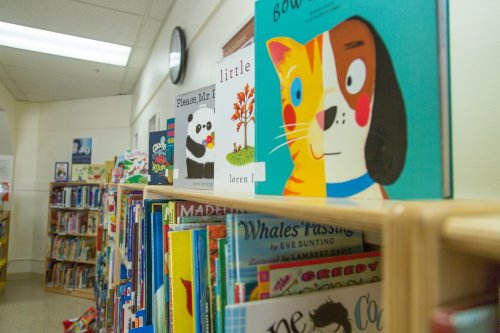
In middle and high schools, libraries can be a refuge for those who may not feel accepted or understood elsewhere. That dynamic was core to a presentation by David Gales, Librarian & Director of Research and Inquiry at Escuela Bilingüe Internacional in Oakland.
When it comes to gender affirmation in library spaces, Gales contended, the stakes—and outcomes—are real. “Reduced fear of harassment means reduced absenteeism from school,” Gales said. “If you’re in class more, you learn more. If you learn more, you do better in school. That’s basic math.”
Gales went on to lay out a few actionable strategies to ensure school libraries are inclusive spaces. Incorporating visible assurances of safety and space, like pride flags, and making an effort to use inclusive language are a couple recommendations. Gales also encouraged the development and intentional labeling of materials and collections that allow LGBTQIA+ students to process their identities, as well as creating on-site gender-neutral bathrooms where possible.
When we chatted later, Gales emphasized that this work can and should be manageable. “Most of the things that you can do to be affirming…are small and easy and not complicated,” Gales said. “Things do not need to be all-encompassing, ambitious, transformative projects in order to have an incredible impact.”
Letting Students Lead the Way
To best serve communities, library workers and media specialists—whether they’re leading or supporting the work of their institutions—are perpetual innovators, striving to meet evolving needs. One of the best ways to do that is to let students take the lead, as Frenchie, the librarian at The Athenian School in Danville, shared during their talk.
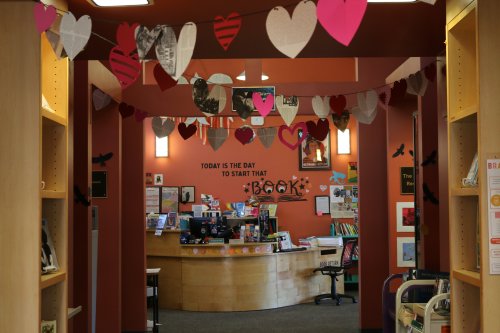
This approach is being implemented at The Athenian School, where students serve on a Library Advisory Board. Those on the board participate in regular meetings with Frenchie, providing critical insight into catalog development and auditing, and leading schoolwide programming such as the annual literary-themed library haunted house. Frenchie also trains those students to navigate library resources, so they, in turn, can help their fellow students with research.
The “long-term vision,” ultimately, is that these students become “advocates of libraries and users of libraries, no matter the situation,” Frenchie said. “We’re empowering them to be more knowledgeable, to be a part of the conversation and to do something about the conversation, and see the library as a lifelong resource.”
It was a sentiment echoed throughout this year’s workshop, no matter the topic. The best way for librarians to serve their community is to let students, scholars, and stakeholders guide the way. Saint Mary’s librarians are already practicing that kind of forward-thinking collaboration—and by hosting this workshop, they’re creating space for others to do the same.
Anne Williston, MFA ’27 is a Graduate Editorial Fellow with the Office of Marketing and Communications and an educator who previously created and managed a school library. Write her.


