
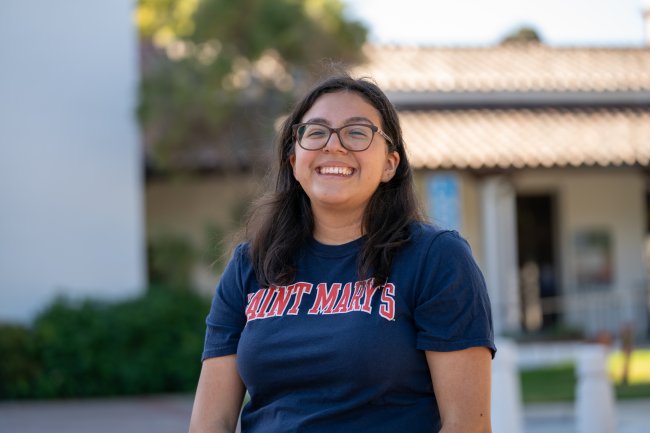
Inspired to inspire: Xochilt Delgado ’25, MA ’27 always wanted to be a teacher. SMC's Noyce Program is making that dream a reality. / Photo courtesy Xochilt Delgado
Making Family History: Xochilt Delgado is Empowering STEM Students in Her Hometown
A “first-gen” college student, the 2025 grad is a recipient of SMC’s new Noyce Scholarship, a program addressing a STEM teacher shortage in high-need schools. She is earning her credential and an MA in Teaching and now teaches in nearby Concord.
When Saint Mary’s was established in 1863, its founder had first-generation students in mind. Joseph Alemany, San Francisco’s first archbishop, envisioned a college for the “children of Miners, Mechanics, and Agriculturists,” the working people of the fledgling state.
According to the most recent data, around one in three Saint Mary’s students today are trailblazers, the first in their family to pursue a college degree. For many first-generation students—“First-Gens,” as they often refer to themselves—the journey to and through college brings unique struggles—and surprises. We regularly ask First-Gen Gaels to share, in their own words, their history, hopes, and advice for the next generation.
Today, we’re highlighting Xochilt Delgado ’25, MA ’27, a first-generation college student who graduated with a bachelor’s degree in Health Science and is now one of Saint Mary’s first Noyce Scholars. Supported through a $1.3 million grant from the National Science Foundation, SMC’s Robert Noyce Scholarship Program aims to address a shortage of STEM educators in high-need, Title I schools. Thanks to the program, Delgado is currently completing her teaching credential as well as a Master of Arts in Teaching.
The road to Saint Mary’s
As the first in my family to attend college, my parents couldn’t offer much help. They’re both from Mexico originally, and they settled in Concord, about ten minutes east of here. They were very open to me pursuing opportunities outside of high school, like trade school or community college. Financially, they were concerned about me going to a four-year school. So scholarships were on my mind when I started applying. During high school, I was part of Advancement via Individual Determination, an academic support system that helped us with college applications and took us on campus visits. They took us to big state schools, where we sat in huge amphitheater-style classrooms to role-play what college would be like. Sitting in those seats, I knew: I would never be able to learn there.
That’s why deciding on Saint Mary’s was one of my best decisions ever. It offered me that tight-knit classroom environment I thrive in and the flexibility to explore majors. Plus, it was local. I was able to live on campus all four years of undergrad and still visit home when I wanted.
Embracing opportunities, on campus and off
When I arrived at Saint Mary’s, I didn’t know if I wanted to study Biology or Chemistry. But then I learned about the Health Science major, which combines both Biology and Chemistry and allows you to select your own classes. I decided to pursue that, and it was a great balance.
As an undergraduate, I took part in every opportunity I could. I was a member of the High Potential program, which offers support for first-generation and low-income college students. And for all four years, I volunteered with the Mission and Ministry Center, helping to plan and execute the Center’s spring retreat in 2025.
I was also excited to study abroad during January Term; that was another reason I came to Saint Mary’s. Thanks to a January Term Scholarship, I was able to join the History of Science travel course my junior year. For three weeks, I got to explore London and Paris with a small group of students and visit important sites like Charles Darwin’s home or the Paris Natural History Museum.
I absolutely loved it, and it helped me realize, Oh, I want to see more of the world and the United States. It really gave me the courage to travel more.
“Deciding on Saint Mary’s was one of my best decisions ever. It offered me that tight-knit classroom environment I thrive in and the flexibility to explore majors.”
Becoming a Noyce Scholar
Honestly, I’ve always wanted to be a teacher. I’ve been working in schools and STEM education since I was ten years old, volunteering and even teaching at a science camp at the Lawrence Hall of Science in Berkeley. But I’d moved away from that path, mainly because my parents worried about it. They thought being a scientist would be more financially stable. So I majored in Health Science, always thinking that I would graduate, find a job in a lab, and then, after a couple of years, go back and get my credential.
But then, during my sophomore year, my Biology professor, Vidya Chandrasekaran, told our class about a new opportunity. Through the Robert Noyce Scholarship Program, Saint Mary’s offers up to $50,000 over three years to students who applied to a new teaching pathway: Transformative STEM Teachers. The program is directed by Mary Raygoza, an associate professor of teacher education who applied for the grant with Vidya.
When I heard about that, I immediately thought, “Yes, yes, this is perfect.” So I applied that spring, and then, that fall, I learned I got it—that I was part of the first cohort of Noyce Scholars at SMC.
The Noyce Network
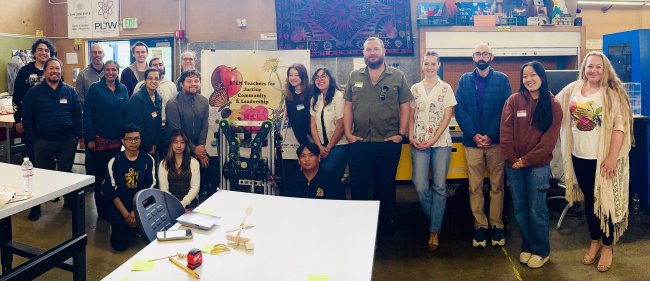
Right now, there are 11 Noyce Scholars at Saint Mary’s. Four are undergraduates, four are earning their credentials and student teaching, and three are in their first year of teaching. We gather monthly with mentor teachers and faculty for professional development, classroom observations, and scholar presentations.
One of the highlights so far has been the Western Regional Noyce Network, which supports Noyce scholars throughout their careers. In summer 2025, for instance, the network helped me land an internship at the Institute for Systems Biology in Seattle. I worked in a lab with a science and education focus, where we tested out new STEM curriculum with students and educators. The Noyce Scholars also get to attend conferences; in February, I attended the Western Noyce Regional Conference in San Diego and then in July, flew to present at the Noyce Summit Conference in Washington, DC.
Of course, the most important aspect is the classroom experience. Currently, I’m a student teacher in the district where I grew up, Mount Diablo Unified School District (MDUSD). I’m at Concord High School, which is a Title I school—meaning, a school that receives federal funding to serve and support low-income students. As someone who attended Title I schools, it means a lot to be part of that community and education system that gave me so much.
Looking ahead—and advice for future Gaels
After I finish my master’s, I hope to settle into a teaching job at a Title I School, preferably at Concord High or another school in MDUSD. I want to stay local and give back to that community, to my hometown. My hope is to bring my students the kind of opportunities I would have loved, like dual credit classes or field trips.
To other students who may be thinking about Noyce, or really any opportunity at Saint Mary’s, I would say: Get involved. I wouldn't have found Noyce or all of my other opportunities without learning about them through my professors, alumni, faculty, and students who have taken those courses. There are a lot of hidden gems at Saint Mary’s that many students may not know about, but they should.
So find mentors and develop connections. It will help provide a guiding light to the direction you want to go.
Anne Williston, MFA ’27 is a graduate editorial fellow with the Office of Marketing and Communications at Saint Mary’s. Write her.


