
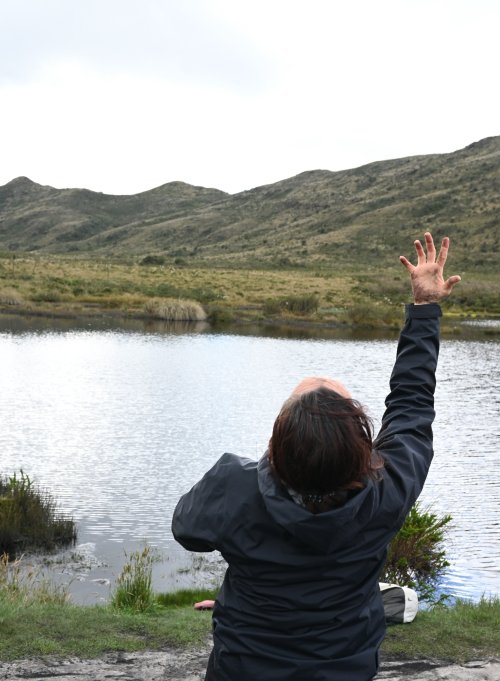
Soaking it in: Director of MFA in Dance Program, Rosana Barragán was recently selected as a Fulbright specialist in Colombia. “What makes a Fulbright research project distinct is the exchange,” she says. “More than anything, my experience was collaborative.” / Photo by Beatriz Vargas
Performing Artist at Work: Rosana Barragán on Returning Home to Colombia as a Fulbright Specialist
She directs the MFA in Dance Program and traveled to Bogotá in late 2024 to lead a Fulbright project focused on sacred water sources. It was a connection across continents and cultures—as Saint Mary’s first Fulbright Specialist.
“At Work” is a series that highlights Saint Mary’s faculty and staff at work in the world. Artists, writers, scholars, scientists—we sit down and dive deep into their latest projects.
For Rosana Barragán, dance, school, and home have always been braided together, less about distinctions than weaving a cohesive whole. She grew up in Bucaramanga, a tropical city in Colombia’s Andes Mountains, in a large house that also doubled as a dance school. Barragán's mother—a classically trained flamenco dancer—converted two rooms into studios, where every day she taught students, including her six children. “Her passion for dance and education lives in every one of my cells,” Barragán says.
In the decades since, Barragán has built her own dance domain. She has performed, choreographed, and taught throughout the Americas and Europe, along with earning a master’s in dance from the Laban Center in London. As a scholar, she has written extensively on “somatic movement”—an approach that focuses on body-mind integration—and how its practice can be a force for decolonization. She has been a dance faculty member at Saint Mary’s for more than 18 years and was instrumental in creating the MFA in Dance Program.
Barragán has lived in the Bay Area for years now, even running a children’s dance school in San Francisco—although not, notably, in her living room. In the fall of 2024, however, she got the chance to return home, this time as a dance scholar. Red de Artes Vivas, an artist collective in Bogotá, was embarking on a Fulbright project at the intersection of somatic movement and decolonization. Knowing Barragán’s expertise, they invited her aboard to lead it.
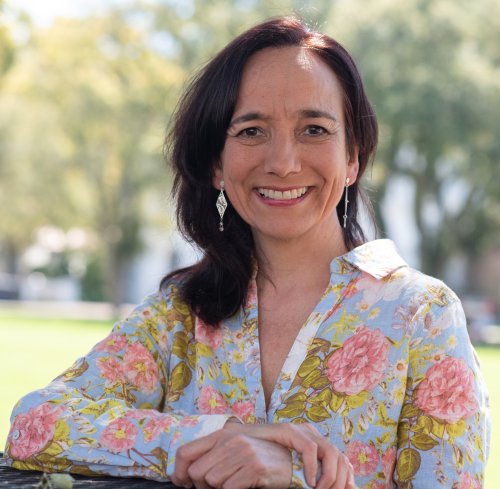
Soon, Barragán was flying to Colombia as a Fulbright Specialist, the first SMC faculty member to earn that distinction. Months later, when she was stateside again, we sat down to talk about the research project and her work at Saint Mary’s—and how those, too, are inevitably intertwined.
A good place to start, I think, is with the MFA in Dance here at Saint Mary’s. How did that come to be?
I first started teaching at Saint Mary’s in 2008. About three years in, Cathy Davalos, who has overseen the Dance Department for many years, asked me to write a proposal for an MFA in Dance. It was truly a team effort to develop the proposal and the curriculum; all the faculty members in the dance program are incredible, and we like to work collaboratively.
After the MFA program was approved, I co-directed it with Cathy Davalos for a while, then paused for a few years. When the previous director, Rogelio Lopez, went on sabbatical in 2023, I came back as director. We’ve been rebuilding since the pandemic, when cohort sizes shrank a bit. This past year, though, we’ve gotten more and more student interest, and the program is growing again.
One reason is that we are the only MFA in Dance program in Northern California. It’s a low-residency program, which is great because it attracts people who work full-time or have family commitments. The students join us in person in January and June for their dance intensives, and then have online courses in the spring and fall semesters. The low-residency model is relatively new for MFA programs, and it’s working well for our students.
What’s the heart of the program?
The core of the MFA is the combination of dance, creative practice, and somatics, using a phenomenological framework, all with a social justice goal. I would also say this is the core of what I do as a scholar, and what I did with the Fulbright project.
Another thing I emphasize with our students is what we call embodied research or practice-as-research in the dance and somatics fields. I tell my students to see themselves as movement researchers, which may not be the case in other dance circles. The MFA program supports research-as-practice and our students who do that type of work.
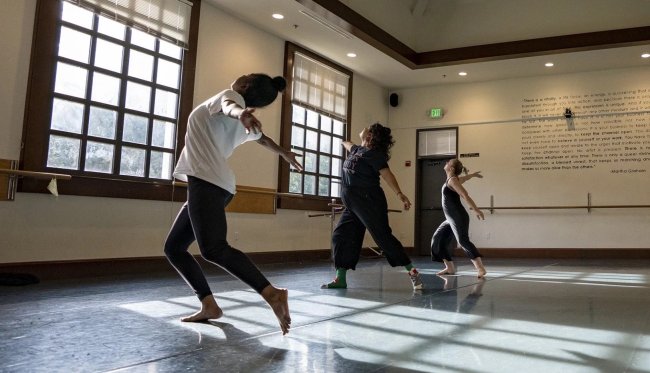
This new generation of graduate students is committed to the work of decolonizing our practice. They’re deeply questioning what the field of dance studies is and what the MFA in Dance program offers. It’s about more than just words or statements; they want to practice what it means to be inclusive in our field, bringing in voices from marginalized places around the world. That’s something we’ve really been focused on in the MFA program, embracing students who represent a wide range of dance traditions, including belly dance and flamenco. I’m really interested in how dance can serve society, both as an art form and a practice that fosters social healing.
Tell us about the recent Fulbright project you completed.
The project was in Bogotá, Colombia, where I worked with a collective of artists called Red de Artes Vivas, or “Network of Living Arts.” They’re a group of performing artists from different disciplines. They came together to create a project for Fulbright Colombia about how—through specific experiences of embodiment, dance, and performance art—we can reclaim abandoned sacred water sources once crucial to indigenous communities who are now gone.
The project was approved by Fulbright Colombia, which said that it could only be done if a Fulbright Specialist could lead and manage it. That’s where I came in. Red de Artes Vivas reached out to me and asked if I’d be open to working with them. They were interested in my research regarding dance embodiment and the new biology of water, which I’ve been writing and presenting about for the last few years.
“I’m really interested in how dance can serve society, both as an art form and a practice that fosters social healing.”
What was it like to return home for this project?
Busy! I spent three weeks in Colombia’s capital city, Bogotá, at the Universidad Javeriana, where most members of Red de Artes Vivas also work as faculty. Universidad Javeriana is also my alma mater, and the first institution I worked at after obtaining my graduate degree. I was part of the team that created their Performing Arts degree as well as the Dance and Somatic Studies majors. Their School of the Arts and programs are large and supported by state-of-the-art facilities, unlike any I have seen elsewhere in the world.
Because of those connections, there was a lot of partnership and collaboration going on. The university invited me to lead a public forum with the two scholars, colleagues I had worked with when I was on staff there. I also ran workshops for performing arts faculty, students, and alumni, which was exciting, too.
And what was the Fulbright experience like?
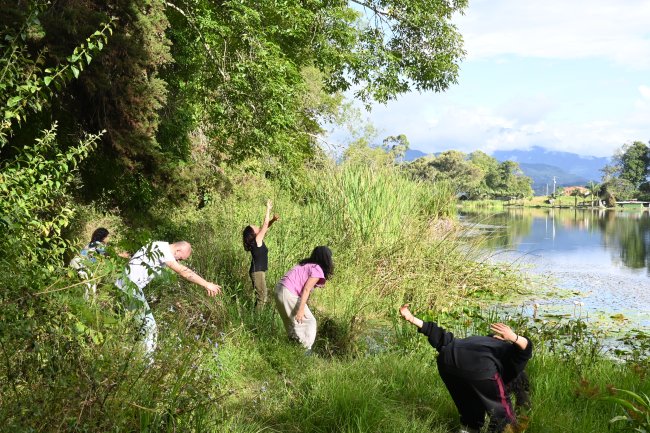
For the project, the artists organized multiple visits to nearby water sources considered sacred by the Indigenous community. The day after I arrived, we traveled to the Páramo, which is a unique ecosystem in the Andes Mountains of Colombia, with a network of high-altitude lakes. The Páramo is characterized by the family of plants that absorb water in a similar way to how the human body processes water, cultivating it in a way that is optimal for health. We took a beautiful hike there, on a trail that was created and cultivated by Indigenous tribes.
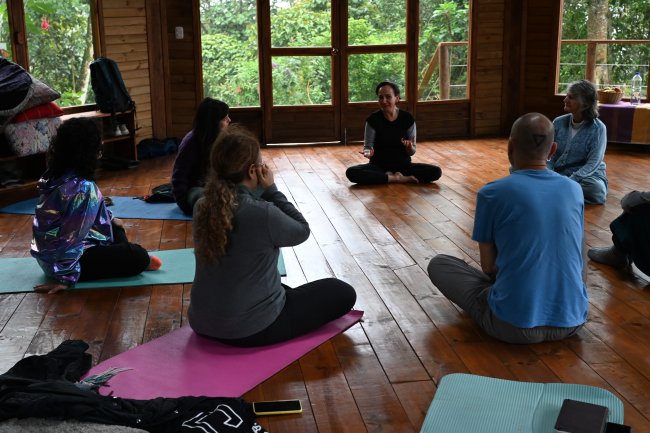
Later, we traveled to three nearby lakes, which actually form a triangle. For the Indigenous people who lived there, the triangle was considered “the uterus of the world.” At one of the lakes, one of the artists owns a retreat center on the shore, which includes a movement studio. We spent a weekend there, doing movement and dance explorations. I guided them through a movement repertoire I've developed, inspired by the research of scientist Gerald Pollack on the fourth phase of water. Pollack suggests water in that phase acts like crystal, with perfect structure and coherence, and is the natural state of water in our bodies. My movement practice helps maintain our water in that optimal state.
What makes a Fulbright research project distinct is the exchange. As a specialist, I went to Colombia with things to offer, of course. But I was also interested in knowing what the host institution does. More than anything, my experience was collaborative.
What did you bring back from this experience as a scholar, artist, and teacher?
If I could highlight one thing, it would be working with students and alumni. I saw what they were doing as young people working in Bogotá, which is a hard city to live in—but at the same time, it has an exciting, artistic vibe. The education program at Universidad Javeriana specializes in decolonization, and they’ve done a lot of bridging between the education and dance departments. I’m still in contact with some of the students and faculty members, because we want to continue the work.
Honestly, they’re more developed in decolonization work than we are in the United States. They focus on what practices are decolonized already, how we can learn from Indigenous communities, and bring in members of those communities to the university to teach. Being able to meet artists in Colombia who are doing very similar work to what I do at Saint Mary’s, and with my research, was really incredible.
I would love for our students at Saint Mary’s to see the work being done in countries that aren’t often highlighted, like Colombia. Wonderful work is being done in these marginalized countries, where people are surviving every day and at the same time wanting to be artists, questioning things with their artistic process. It’s beautiful and very inspiring.


