
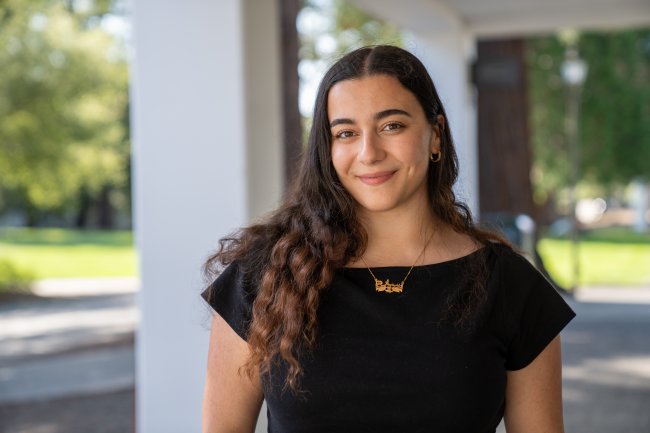
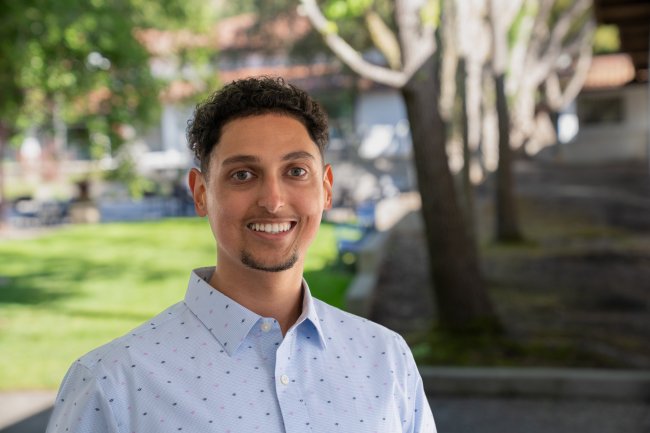
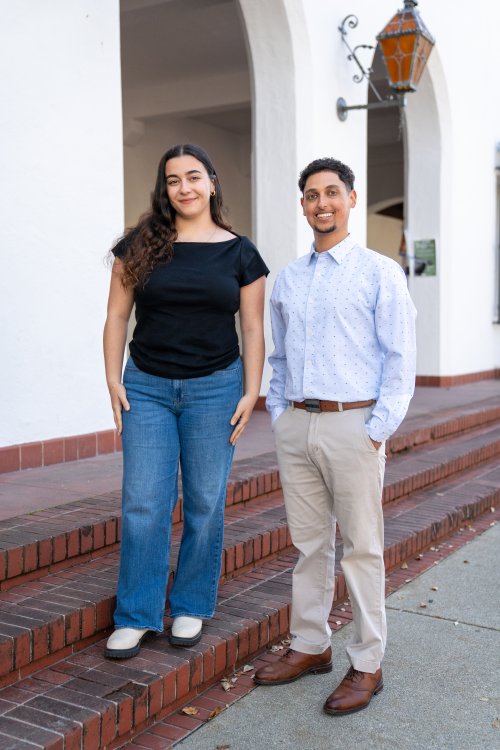
Dream Team: The children of Jordanian immigrants to the Bay Area, Saifo Haddad ’27 and Sara Alhejazin ’26 have known each other for years. The fact that they’re both now students and leaders at Saint Mary’s is “really meaningful to us,” says Alhejazin. / Photo by Francis Tatem
In Their Own Words: Saifo Haddad and Sara Alhejazin on Identity, Leadership, and ‘Passing the Torch’
Saifo Haddad ’27 and Sara Alhejazin ’26 grew up in the same Jordanian-American circles. They’re now co-presidents of SMC’s Middle Eastern and North African Club, sharing their culture and fostering vital dialogue on campus.
In Their Own Words is a series in which we introduce you to the Gaels you need to meet—students, alums, faculty, and staff—and let them tell their stories, in their own words.
Today, we’re highlighting Sara Alhejazin ’26 and Saifo Haddad ’27, co-presidents of Saint Mary’s Middle Eastern and North African Club. Alhejazin, a Health Science major with a double minor in Music and Psychology, is the current director of the Campus Activities Board and a Peer Mentor for first-year students. After graduating, she intends to become an occupational therapist. Haddad, a Finance major, works at his family’s businesses and recently completed a finance internship at Spacelab Healthcare, a medical device manufacturer in Washington State. He hopes to use his degree to work in the finance or real estate industry.
From the Jordan to the Bay
Saifo Haddad: My parents were born and raised in Jordan. My dad moved to the US by himself when he was 17 to go to college. He worked really hard for his 10 other siblings back home, sending money there. Then he married my mom, and in 1996, they started Morning Due, a cafe in San Francisco. For years, my two siblings and I have helped out, working on weekends, weekdays, and after school. Our parents have worked so hard for all of us. We just want to reciprocate that.
Sara Alhejazin: My parents are also from Jordan. My dad came here in 2002 to help his brother out with Crepevine, the local restaurant franchise. They started with two Crepvine locations—one in Berkeley and one in Oakland—and they’ve expanded since then. My mom moved here shortly after they got married, and was a stay-at-home mom at first. But then, once my brother and I were old enough, she went back and got her teaching credential. Now she’s an early childhood educator in Concord.
In fact, Saifo and I actually go way, way back. We attend the same church, and are both involved in the Jordanian American Association. Even before I was born, our parents knew each other; Saifo’s mom even went to my baby shower! So coming to where we are now, as co-presidents of MENA, and thinking about all that—it’s really meaningful to us.
Choosing Saint Mary’s
Haddad: I always loved the idea of Saint Mary’s. It’s close to home, has a great business program, and it’s a tight-knit Lasallian school like the high school I attended. And with the small classroom sizes, I knew I would get that one-on-one attention from professors if I needed.
Another big factor for me was the Arab community here. Throughout my life, I’ve known people from church who have gone here or were going here and had a positive experience. That connection pulled me in. I felt like I could be comfortable and really excel here.
Alhejazin: My journey to Saint Mary’s was a bit different. At the time, I wanted to become a physical therapist and was looking at a few programs, including SMC. But it wasn’t my top choice at first. I didn’t know much about it, even though it’s basically in my backyard.
That all changed after a conversation I had with a parent of my brother’s basketball teammate, Robert Walters ’96. When I told him that I was considering Saint Mary’s, he suddenly turned around and showed me an SMC tattoo on the back of his neck! Robert is an alum, it turned out, and loves everything about SMC. “I own a PT clinic in Walnut Creek,” he told me. “If you do go to Saint Mary's, I’ll set you up with an internship and write you a killer recommendation for physical therapy school.”
After that, it felt like a done deal. I knew the curriculum was excellent, and with the alumni connection, I would have plenty of resources and support.
“I was given opportunities I don’t think I would have gotten anywhere else. People saw the potential in me to lead and lead well. Now I’m in a position to pass the torch.”
—Sara Alhejazin ’26
Making MENA
Alhejazin: Coming into college, I knew I wanted to get involved in as many things as possible. So my first year, I interned on the Campus Activities Board, or CAB. It was at the Student Involvement Fair that I met Sharbel Abouchera ’25. When I learned he wanted to bring back a club for students of Middle Eastern and North African descent, I made sure I was part of it.
We re-started MENA in 2023, with Sharbel as President. It was a great first year for the club, but also really hard, too. People were looking to us for answers and action, particularly around the war in Palestine. In spring 2024, we put on “Let’s Talk,” a series of seminar-style conversations in partnership with SMC Bridge and the Muslim Student Association. Because every Saint Mary’s student takes Collegiate Seminar, using that format turned out to be a great way to have open, respectful conversations about sensitive topics. Dozens of students, faculty, and staff attended. “Let’s Talk” actually won Program of the Year at the Student Leadership Awards.
Sharing culture and spurring dialogue
Haddad: The students before us fought for us to have that community and representation on this campus. We want to continue that. I remember being a first-year student and how excited I was to meet other MENA students. Now, Sara and I attend incoming students' events to show MENA students they have a place on this campus. There’s a community that’s here to support and guide them.
Alhejazin: This year, we’ve really worked on expanding our programming for students from all MENA countries. Food is a real attention grabber for students! We’re also looking forward to performing in the Cultural Night Showcase on April 24. We’ll be performing Dabke—a traditional folk dance with roots in Lebanon, Palestine, Syria, and Jordan—which I choreographed.
We’re also working on bringing back “Let’s Talk” to help SMC students deepen their understanding of the current tragedies happening in the Middle East. At the end of the day, we’re not political affiliates taking sides. We’re students with a culture and heritage that is rarely shown with authenticity. Unless you meet someone from the region, you won’t know what they’re about. That’s why we want to share our culture with the campus.
The significance of Arab American Heritage Month
Alhejazin: I feel like this month is a time where I can be unapologetically myself. Ever since coming to Saint Mary’s and joining MENA, I’ve been more in touch with my Jordanian roots. I love that the Cultural Night Showcase lands in April, too. Standing onstage, wearing traditional costumes, dancing to traditional music, feels extremely powerful. You can’t get that feeling anywhere else.
I also feel proud to think of all the successful MENA individuals who have come out of Saint Mary’s: lawyers, doctors, valedictorians, business people, healthcare workers, and so many more. As I look toward graduation, it’s exciting to be part of that legacy.
Haddad: Yeah, I think this month allows us to reflect on the fact that we're not just Arabs, we're not just Americans, we’re Arab Americans. That shared experience brings the MENA club and community together. We have each other, and we understand each other. We know the feelings and the pain and the joy that go with it.
Attitude of gratitude
Alhejazin: I honestly want to thank Saint Mary's. I'm a very, very different person than I was when I came into SMC, and for the better. Because this is such a close, inclusive environment and community, I was given opportunities I don’t think I would have gotten anywhere else. People saw the potential in me to lead and lead well. Now I’m in a position to pass the torch.
Haddad: We’re definitely proud to be Gaels and represent MENA on this campus. I always try to tell people, whether they are Arab American or not, they’re welcome to hang out with us. If you’ve ever visited Jordan, you know how hospitable Jordanian people are. Sara and I want to create that same feeling on campus, where everyone is invited to the table.
(This interview has been edited and condensed for clarity.)
Hayden Royster is the Associate Editor and Maddy Hunter ’27 is a student writer in the Office of Marketing & Communications. Write them.


