
Just keep swimming: Sofia Yildirim ’27 spent summer 2025 studying the feeding behavior of the common clownfish. The research experience, funded by the National Science Foundation, has opened up doors for a career in marine science. / Photo from Wikimedia Commons
Field Notes: Sofia Yildirim ’27 on Researching Common Clownfish and Finding Her Niche with the National Science Foundation
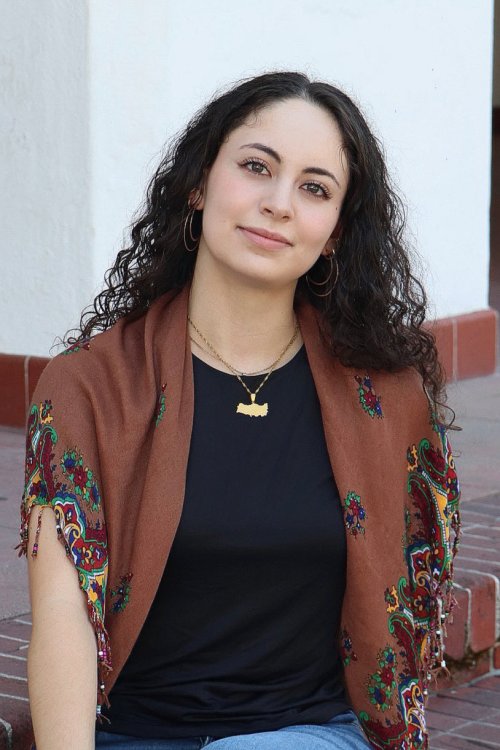
In Summer 2025, Yildirim joined an NSF-funded internship studying the functional feeding niche of clownfish, confirming her desire to be a marine researcher. “Saint Mary’s gave me the foundation,” she says. “This helped me put it all into practice.”
Unlocking algae’s biofuel potential, monitoring port pollution in Oakland, building artificial neural networks from scratch—with the Summer Research Program, there’s no shortage of hands-on opportunities available to Gaels. For ten weeks each summer, STEM students delve deep into on-campus projects of their choice, getting one-on-one guidance from a faculty expert.
Of course, there’s more than one way for a Gael to get research experience. In the series Field Notes, we’re highlighting students who spent their summers doing real-world research outside of Saint Mary’s.
Meet Sofia Yildirim ’27, a third-year double major in Environmental Science and Biology, who spent her summer 2025 with clownfish. That was thanks to a Research Experience for Undergraduates, funded by the National Science Foundation and hosted by Washington State University, where she studied the feeding behavior of clownfish to examine their role in ecosystems and how that role has evolved over time. In January 2026, Yilidirim presented her findings at the annual Society for Integrative and Comparative Biology Conference. Here’s what she has to say about the research experience.
Diving in
I grew up in Alameda, an island in the San Francisco Bay, which means I lived no more than six blocks away from the water my whole life. Because of that, I’ve always had an interest in the ocean and biotic life. Specifically, I’m interested in how species become what they are today, with their weird little adaptations and changes, and how that is influenced by larger ocean conditions. Whatever the environment or climate change forces upon sea creatures, they have to adapt to it.
Going into my second year at Saint Mary’s, I knew I wanted to do some kind of oceanic research. In the fall, I attended one of the workshops that Nekesha Williams holds every year to help STEM students find research opportunities. She is an associate professor of Environmental Science, and she told us about the Research Experience for Undergraduates (REU), which is funded by the National Science Foundation.
These opportunities are free, and anyone can apply, but highly competitive, with students applying from all around the country. The goal is to invest in students at the beginning of their scientific career by providing them with practical work in research settings, so that, in the long run, they will continue contributing to the body of scientific knowledge and the scientific progress of the country.
It all sounded really fascinating, so I scrolled through the REU website, which has dozens of projects. The one that caught my eye was “Robustness and Resistance of Aquatic Systems.” I applied for that program (along with 500 other applicants from around the country!), and within a few months, learned I was selected. Two weeks after my last final, I was on a plane headed to the Pullman campus of Washington State University, in the eastern part of the state.
Fish are friends, not food
The program included a number of individual projects under that larger umbrella of robustness and resistance. I ended up with an amazing primary investigator, Dr. Katherine Corn, a fish biologist, macroevolutionist, and biomechanist at WSU. She essentially said, “This is my realm of study; you can pick anything in it.”
We narrowed it down to a project on the feeding performance of Amphiprion cellaris—better known as the common clownfish—across the functional niche space. In biology, a functional niche is the role or place of an organism in an ecosystem, determined by how its physiological and behavioral traits impact its environment. Every organism has its own unique role. So we were looking at clownfish and asking: How do their anatomy and feeding kinematics affect their feeding performance?
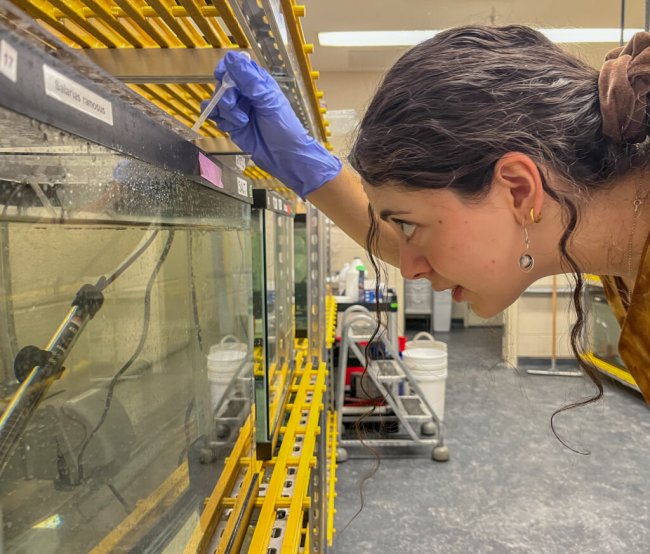
Clown fish are famous for their coloration—and from the movie Finding Nemo, obviously. But they’re also a hearty species within systems. On a normal day, I would do husbandry and prepare for my experiment by making a feeding paste with gelatin, shrimp, seaweed, and garlic, applying it to four to five different feeding structures, and putting those in the tank. Then I would watch the fish go for it, weighing the structure to see how much they could bite off, while video recording them to count how many bites they took. Over time, you do get to know the individual fish. They have their own personalities, even though they’re fish.
“My educational foundation from Saint Mary’s helped me succeed in my research. My science courses, research experience, writing skills, and lab techniques—all of that came from SMC.”
Building a foundation
We did multiple trials with various convex and concave structures to see how much food the clownfish ate off of them. As a comparison, we also used Salarias ramosus, or starry blennies, a species distantly related to clownfish, but with a different feeding mechanism. Starry blennies have modified jaw morphology for scraping algae, while clownfish, with their blunt faces, are more flexible feeders, picking and grazing as well as suction feeding.
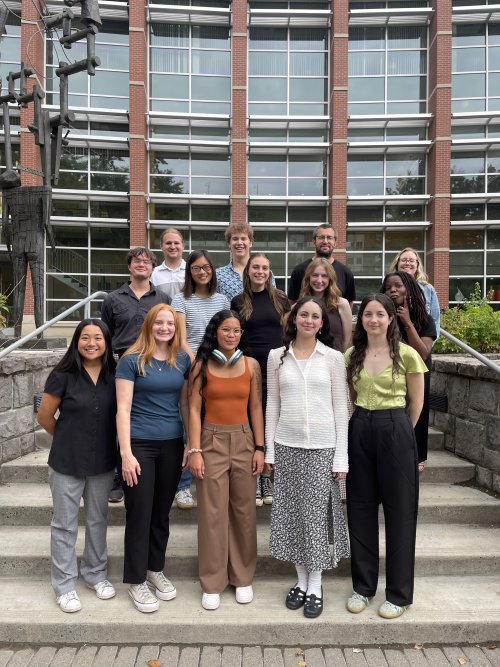
The days were long, with the experiments running about six hours, plus all the preparation and analysis. But it was really fruitful; the project I did was so large, actually, that I’m still doing analysis on the data. A fellow student back at WSU is now running the same experiment on more starry blennies. By the end of next year, I will hopefully be a first author on a published paper on this research. And in January, I traveled to Portland to present my research, as I was selected to compete in the Best Student Poster Session in my division at the annual Society for Integrative and Comparative Biology Conference.
Overall, I feel so much more confident as a scientist. Professional development workshops were built into the program, where we learned how to write grant proposals and cold-call professors. It felt like the next step in my educational journey. My classes at Saint Mary’s gave me the foundation; this helped me put it all into practice.
Open waters
I went into the REU knowing nothing about biomechanics. But my educational foundation from Saint Mary’s helped me succeed in my research. My science courses, research experience, writing skills, and lab techniques—all of that came from SMC.
Right now, I plan on applying to graduate programs next fall and studying some aspect of marine science. Because of the REU, I’m thinking about biomechanics and evolution. My REU experience has been really transformative in helping me figure out what I ultimately want to pursue in my career.
For a STEM student pursuing a career in research, an opportunity like this is such a valuable experience. Even if you’re not an expert, that’s okay; uncertainty is kind of the point. Research opportunities offer students like me a chance to figure out what they might be interested in and begin to build a name for themselves. Within science, there are so many different niches you can fall into, and the world needs people to fill them.
Katie Hayek ’28 is a Student Writer with the Office of Marketing and Communication at Saint Mary’s. Write her.


