Creative Writing, BA

Creative Writing, BA

As part of a close-knit community of literary artists, Saint Mary's Creative Writing majors study the art and craft of poetry, fiction, nonfiction and drama, learning how to generate, polish and publish original work that captures the diversity and complexity of our world.

As a Creative Writing major, you will study and receive mentorship from nationally recognized writers—including the College's permanent faculty, was well as Distinguished Visiting Writers—producing and discussing poems, stories, essays and plays in workshops, studying classic and contemporary literature, and honing the professional skills and knowledge necessary to lead a life of letters.

Creative Writing majors will graduate prepared for careers wherever memorable storytelling and attention to language are in demand: writing, publishing, film and television, creative agency work, graduate study in the literary arts, and more.


Apply Now Request Info

Learn More About Our Program

Get to know our well-respected faculty and their specialties, as writers and scholars. Or explore scholarship opportunities and an array of internship possibilities.

Curriculum

Creative Writing, BA

BA

As part of a close-knit community of literary artists, Saint Mary's Creative Writing majors study the art and craft of poetry, fiction, nonfiction and drama, learning how to generate, polish and publish original work that captures the diversity and complexity of our world. As a Creative Writing major, you will study and receive mentorship from nationally recognized writers-including the College's permanent faculty, as well as Distinguished Visiting Writers-producing and discussing poems, stories, essays and plays in workshops, studying classic and contemporary literature, and honing the professional skills and knowledge necessary to lead a life of letters. Creative Writing majors will graduate prepared for careers wherever memorable storytelling and attention to language are in demand: writing, publishing, film and television, creative agency work, graduate study in the literary arts, and more.

Learning Outcomes

  • PLO1: TECHNIQUE: Students will identify, analyze, and use the elements of literary craft in various genres. Students will develop a personal style, apply craft techniques that they learn during workshops, and choose from several strategies to revise written work.
  • PLO2: WORKSHOP: Students will identify and learn to use the most effective workshop practices. They will learn how to critique the written work of their peers, both orally and in writing, in constructive and mutually beneficial ways. As students learn to critique written work, they will encounter various perspectives, and learn to appreciate the value of diverse lived realities.
  • PLO3: MULTIPLE PERSPECTIVES: Students will understand the value of different experiences, especially from traditionally marginalized and underrepresented groups, and of their own voices. Students will learn to understand their positionality in relation to texts and their own creative work.
  • PLO4: LITERARY EXPERTISE AND KNOWLEDGE: Students will read, analyze, and evaluate contemporary and other literature, and learn techniques and concepts of literary analysis. While the emphasis will be on studying literature from the perspective of creative writing, this study will also prepare them as readers, writers, critics, editors, and scholars. There will be a particular focus on diversity and a variety of lived realities.
  • PLO5: PROFESSIONAL EXPERTISE AND KNOWLEDGE: Students will learn to evaluate, discuss, and research contemporary literary publishing and editing.
  • PLO 1: TECHNIQUE: Students will identify, analyze, and use the elements of literary craft in various genres. Students will develop a personal style, apply craft techniques that they learn during workshops, and choose from several strategies to revise written work.
  • PLO 2: WORKSHOP: Students will identify and learn to use the most effective workshop practices. They will learn how to critique the written work of their peers, both orally and in writing, in constructive and mutually beneficial ways. As students learn to critique written work, they will encounter various perspectives, and learn to appreciate the value of diverse lived realities.
  • PLO 3: MULTIPLE PERSPECTIVES: Students will understand the value of different experiences, especially from traditionally marginalized and underrepresented groups, and of their own voices. Students will learn to understand their positionality in relation to texts and their own creative work.
  • PLO 4: LITERARY EXPERTISE AND KNOWLEDGE: Students will read, analyze, and evaluate contemporary and other literature, and learn techniques and concepts of literary analysis. While the emphasis will be on studying literature from the perspective of creative writing, this study will also prepare them as readers, writers, critics, editors, and scholars. There will be a particular focus on diversity and a variety of lived realities.
  • PLO 5: PROFESSIONAL EXPERTISE AND KNOWLEDGE: Students will learn to evaluate, discuss, and research contemporary literary publishing and editing.

Requirements

Introduction to Creative Writing

8 units required. ENGL 260 must be taken twice.

  • Creative Writing: Multi-Genre (4 units)
  • Visiting Writers Series (2 units)

Theoretical Foundations

The following courses are required

  • Intro to Literary Analysis (3 units)
  • Issues in Literary Study (3 units)

Genre Techniques

Take two of the following courses

  • Poetry Workshop (4 units)
  • Dramatic & Cinematic Arts Work (4 units)
  • Fiction Workshop (4 units)
  • Nonfiction Workshop (4 units)

Professional Expertise and Knowledge

Choose 4 units from

  • Digital Photography (4 units)
  • Sequential Art (1 units)
  • Experimental Film/Video (4 units)
  • Artist's Bookmaking (4 units)
  • Writing Adviser Training (1 units)
  • Writing Adviser Staff Workshop (1 units)
  • Advanced Composition (4 units)
  • Arts and Culture Writing
  • Public History / Narrative (4 units)
  • Linguistics (4 units)
  • Law and Literature (4 units)
  • Internship (1-4 units)
  • Copyediting & Layout Indesign (1 units)
  • Social Justice through Profes (4 units)
  • Special Topics in Prof Writing (3 units)
  • Writing for Nonprofits (3 units)
  • Writing Internship (1-4 units)

Advanced Workshop

Take one of the following courses

  • Advanced Poetry Workshop (4 units)
  • Adv. Dramatic & Cinematic Arts (4 units)
  • Advanced Fiction Workshop (4 units)
  • Advanced Nonfiction Workshop (4 units)

Diverse Voices in Literature

Take at least 7 units of Upper Division English Literature courses that introduce the MULTIPLE PERSPECTIVES learning objective, including but not limited to:

  • Medieval Literature (4 units)
  • Renaissance & 17th Century Lit (4 units)
  • Restoration & 18th Century Lit (4 units)
  • 19th-Century Literature (4 units)
  • American Lit Before 1800 (4 units)
  • American Literature 1800-1900 (4 units)
  • American Literature 1900-Pres (4 units)
  • Development of English Fiction (4 units)
  • The English Novel (4 units)
  • The American Novel (4 units)
  • The Short Form (4 units)
  • Studies in a Literary Genre (4 units)
  • American Ethnic Writers (4 units)
  • Anglophone Literature (4 units)
  • Topics in African American Lit (4 units)
  • Asian-American Literature (4 units)
  • Latinx Literature (4 units)
  • Vietnamese-American Literature (4 units)
  • Postcolonial Asian Literature (4 units)
  • Korean/American Lit & Pop Cul (4 units)
  • Women Writers (4 units)
  • Literary Movements (4 units)
  • Engl Lit: Global Issues & Pers (4 units)
  • Engl Lit: Identity, Power & Eq (4 units)
  • Single Author (4 units)
  • Shakespeare (4 units)
  • Toni Morrison (4 units)
  • Introduction to Drama (4 units)
  • Contemporary Drama (4 units)
  • Film (4 units)
  • Topics in Film (4 units)
  • Korean Cinema (4 units)
  • Indie Film: Diverse Voices (4 units)
  • Affect Theory (4 units)
  • Film Theory (4 units)
  • Narrative Theory (4 units)
  • Performance Theory (4 units)
  • Postcolonial Literary Theory (4 units)
  • Feminist Theory (4 units)

Capstone

A creative capstone project is required for the major. (This capstone will be listed as a separate section of ENGL 496)

  • Capstone in English (4 units)

Earn an Creative Writing, BA and a Single-Subject Teaching Credential at Saint Mary's in just four years through our Single Subject Teaching Credential Integrated Pathway!

Learn More

  • Lower Division Composition
  • Shakespeare(low Div) (1 units)
  • Upper Division Literature
  • Intro to Literary Analysis (3 units)
  • Creative Practice in Lit Arts (1 units)
  • Issues in Literary Study (3 units)
  • Arts and Culture Writing (4 units)
  • Voices of American Diversity (3 units)
  • Intro to Digital Humanities (3 units)
  • ENGL Elective (1-5 units)
  • Medieval Literature (4 units)
  • British Literature Before 1800 (4 units)
  • British Literature 1800-Pres (4 units)
  • Renaissance & 17th Century Lit (4 units)
  • Restoration & 18th Century Lit (4 units)
  • 19th-Century Literature (4 units)
  • American Lit Before 1800 (4 units)
  • American Literature 1800-1900 (4 units)
  • American Literature 1900-Pres (4 units)
  • 20th-Century Literature (4 units)
  • Contemporary Literature (4 units)
  • Development of English Fiction (4 units)
  • The English Novel (4 units)
  • The American Novel (4 units)
  • The Short Form (4 units)
  • Studies in a Literary Genre (4 units)
  • Science Fiction (4 units)
  • American Ethnic Writers (4 units)
  • Anglophone Literature (4 units)
  • Topics in African American Lit (4 units)
  • Asian-American Literature (4 units)
  • Latinx Literature (4 units)
  • Vietnamese-American Literature (4 units)
  • Postcolonial Asian Literature (4 units)
  • Korean/American Lit & Pop Cul (4 units)
  • Children's Literature (4 units)
  • Women Writers (4 units)
  • Literary Movements (4 units)
  • Engl Lit: Global Issues & Pers (4 units)
  • Engl Lit: Identity, Power & Eq (4 units)
  • Single Author (4 units)
  • Chaucer (4 units)
  • Shakespeare (4 units)
  • Milton (4 units)
  • Toni Morrison (4 units)
  • Introduction to Drama (4 units)
  • Contemporary Drama (4 units)
  • Topics in Drama (4 units)
  • Film (4 units)
  • Topics in Film (4 units)
  • Korean Cinema (4 units)
  • Hitchcock (4 units)
  • Indie Film: Diverse Voices (4 units)
  • Black Cinema (4 units)
  • Advanced Composition (4 units)
  • Public History / Narrative (4 units)
  • Public History EL (1 units)
  • The Art of Writing (Jan Term) (3 units)
  • Topics in Literary Theory (4 units)
  • Affect Theory (4 units)
  • Feminist Theory (4 units)
  • Film Theory (4 units)
  • Narrative Theory (4 units)
  • Performance Theory (4 units)
  • Postcolonial Literary Theory (4 units)
  • Linguistics (4 units)
  • Law and Literature (4 units)
  • Literary Criticism (4 units)
  • ENGL UD Elective (1-5 units)
  • Internship (1-4 units)
  • Internship (1-4 units)
  • Capstone in English (4 units)
  • Independent Study (1-4 units)
  • Senior Thesis (Indep Study) (4 units)

What can you do with a degree in Creative Writing?

A degree in Creative Writing signals that you have the imagination, emotional intelligence, critical thinking and storytelling skills necessary to thrive in any field that values originality, new ideas and attention to language. Students often study to prepare for careers in publishing, media, or other creative industries. 
Image
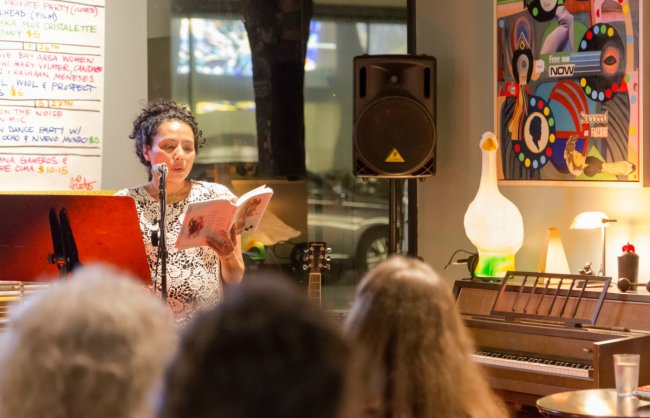
A writer performs her work for an audience

Author / Novelist / Poet
Learn how to write and refine original books of poetry and prose, pitch agents, work with editors, and build an audience for your work. 

Copywriter
Write persuasive brand, campaign, and product copy for print, web, and social.

Content Strategist
Plan voice, messaging, and editorial calendars; align content to audience and goals.

Editor
Develop, line-edit, and proof manuscripts; manage authors and production timelines.

Screenwriter / TV Writer
Write scripts, treatments, and show bibles for film, television, and streaming.

UX Writer / Content Designer
Craft clear in-product microcopy, flows, and help content to improve user experience.

Literary Agent / Scout
Identify promising manuscripts, negotiate deals, and guide authors’ careers.

Journalist / Feature Writer
Report, interview, and produce articles, profiles, and long-form pieces.

Communications / PR Specialist
Draft press releases, speeches, op-eds, and campaigns to shape public narrative.

Saint Mary's Testimonials

Mary Volmer

The English major at Saint Mary’s taught me to read and listen closely, to form arguments and express my ideas clearly and carefully. I grew to appreciate the importance of both the stories we hold dear, and the stories we take for granted. I gained analytic and expressive skills valuable in any field. I attended readings of renowned authors the department brought to campus and cautiously began to consider the writing life.

Mary Volmer '01 '05

19.5

Average Undergraduate Class Size 2021

School and Department Information