Kinesiology: Exercise Science, BS

Kinesiology: Exercise Science, BS

Turn your passion into your purpose by majoring in Kinesiology: Exercise Science. This hands-on, outcomes-driven program prepares you for high-demand fields like physical therapy, athletic training, strength and conditioning, sports medicine, and more. You’ll dive deep into anatomy, physiology, biomechanics, and exercise testing—while developing the critical thinking and ethical leadership skills that set Saint Mary’s graduates apart. Whether you’re aiming for graduate school or jumping straight into the fitness industry, a Saint Mary’s College Kinesiology degree gives you the foundation to excel and make a real impact.

Apply Request Info

Exercise Science Curriculum

Kinesiology: Exercise Science, BS

BS

This emphasis provides students with a broad knowledge base, critical thinking and communication skills, and practical experience in the exercise sciences. The interdisciplinary coursework, in addition to labs, research, and practicum experiences, educates students to become effective and socially responsible contributors to the scientific community and subject population. This curriculum also prepares students to pursue professional certifications, professional and graduate programs, and advanced careers in the field. Exercise Science majors are prominent in the wellness, sport, and fitness industries; health care settings, such as injury prevention and exercise rehabilitation; and as trainers and coaches for individual and team athletes.

Learning Outcomes

  • PLO 1: Describe the relationship between physical activity/sport and health, wellness, and quality of life.
  • PLO 2: DEVELOP and DELIVER multi-mode communications to diverse audiences that convey a clear understanding of relevant disciplinary information.
  • PLO 3: ANALYZE scholarly material and DEMONSTRATE critical and reflective thinking to bridge theory with practice.
  • PLO 4: EXAMINE how sociocultural, historical, and philosophical factors influence attitudes about and engagement in physical activity, sport, and health-oriented behavior.
  • PLO 5: EXPLAIN the scientific foundations of physical activity, nutrition, and fitness.
  • PLO 6: EXAMINE and EVALUATE health, fitness, and performance parameters in diverse populations.
  • PLO 7: APPLY academic methods and theories to real-life situations of personal wellness, athletic performance, and injury prevention.

Requirements

Chemistry Course

Take one course AND its accompanying lab from this category (CHEM). CHEM 105 and 105L are recommended.

  • Survey of Chemistry (3 units)
  • Survey of Chemistry Lab (1 units)
  • General Chemistry I (4 units)
  • General Chemistry I Laboratory (1 units)

Biology Course

Take one course AND its accompanying lab from this category. BIOL 110 and 110L are recommended.

  • Intro to Biology for Human Hea (5 units)
  • Intro to Biology for Hlth Lab
  • Introductory Microbiology (4 units)
  • Introductory Microbiology Lab
  • General Biology (5 units)
  • General Biology Laboratory
  • Human Biology (4 units)
  • Human Biology Lab
  • Intro Cell & Molecular Bio (5 units)
  • Intro Cell & Molec Bio Lab
  • Intro Organisms and Evolution (5 units)
  • Intro Organisms & Evol Lab

Math Course

Take one course from this category (MATH). MATH 104 is recommended.

  • Intro Probability & Statistics (3 units)
  • Applied Math for Scientists (4 units)
  • Calculus I (4 units)

Anatomy and Physiology Courses

Take either BIOL 215 and 225, or BIOL 250 and 251, with their corresponding labs.

  • Human Anatomy (5 units)
  • Human Anatomy Laboratory
  • Human Physiology (5 units)
  • Human Physiology Laboratory
  • Anatomy and Physiology I (4 units)
  • Anatomy and Physiology I Lab
  • Anatomy and Physiology II (4 units)
  • Anatomy and Physiology II Lab

Required Courses

Take the following required courses:

  • Introduction to Kinesiology (3 units)
  • Research/Writing Methods Kines (3 units)
  • Sport and Exercise Psychology (4 units)
  • Structural Biomechanics (3 units)
  • Nutrition for Sport/Phys Activ (4 units)
  • Exercise Physiology (5 units)
  • Exercise Physiology Lab
  • Motor Learning and Control (4 units)
  • Writing Circles (1 units)

Group A

Take 1:

  • Women in Sport (4 units)
  • History of Sport (4 units)
  • Sport and Social Justice (4 units)
  • Global Impact of Phys Inactiv (3 units)
  • Sport Sociology (3 units)
  • Multicultural Hlth & Wellness (4 units)
  • Internship (3-4 units)

Group B

Take 1:

  • Care/Prevention Athlet Injury (4 units)
  • Prin Strength Train/Condit (4 units)
  • Fit Assess/Exerci Prescrip (4 units)

Earn an Exercise Science, BS and a Single-Subject Teaching Credential at Saint Mary's in just four years through our Single Subject Teaching Credential Integrated Pathway!

Learn More

  • Body Conditioning (0.25 units)
  • Introduction to Kinesiology (3 units)
  • Intro to Sport Mgmt (3 units)
  • Introduction to Sport Mgt EL (1 units)
  • Excel Essentials (1 units)
  • KINES Elective (1-5 units)
  • Research/Writing Methods Kines (3 units)
  • Women in Sport (4 units)
  • History of Sport (4 units)
  • Sport and Exercise Psychology (4 units)
  • Sport and Social Justice (4 units)
  • Sport Marketing (3 units)
  • Data and Analytics in Sport (4 units)
  • Community Health (4 units)
  • Global Impact of Phys Inactiv (3 units)
  • Structural Biomechanics (3 units)
  • Nutrition for Sport/Phys Activ (4 units)
  • Care/Prevention Athlet Injury (4 units)
  • Prin Strength Train/Condit (4 units)
  • Prin Strength Train/Condit Lab
  • KINES UD Elective (1-5 units)
  • Sport Sociology (3 units)
  • Excel Essentials (1 units)
  • Legal Aspects of Sport (4 units)
  • Facility and Event Management (4 units)
  • Health Equity Program Plannin (4 units)
  • Multicultural Hlth & Wellness (4 units)
  • Exercise Physiology (5 units)
  • Exercise Physiology Lab
  • Motor Learning and Control (4 units)
  • Fit Assess/Exerci Prescrip (4 units)
  • Fit Assess/Exerci Prescrip Lab
  • Internship (3-4 units)
  • Internship (3-4 units)
  • Independent Study (3-4 units)
  • Human Motor Performance (3 units)
  • Psych Analysis Sport (3 units)
  • Ldshp/Governance in Sport Org (3 units)
  • Media & Public Rltns-Sprts Bus (3 units)
  • Planning & Staging Sport Event (3 units)
  • Physiology of Sports Coaching (3 units)
  • Socio-Cultural Aspects-Sport (3 units)
  • Colloquium (1 units)
  • Intro to Grad Study & Research (3 units)
  • Philosophical Basis of Kines (3 units)
  • Administration of Kinesiology (3 units)
  • Supervision & Legal Aspects (3 units)
  • Applied Concepts of Sport Coac (3 units)
  • Prof. Dev. Practicum (1 units)
  • Capstone: Portfolio Dev. (1 units)
  • Internship (1-4 units)
  • Independent Study (1-4 units)
  • Independent Study (1-3 units)

What can you do with a degree in Exercise Science?

A degree in Exercise Science provides students with a strong foundation in skills applicable to a wide variety of professions.
Image
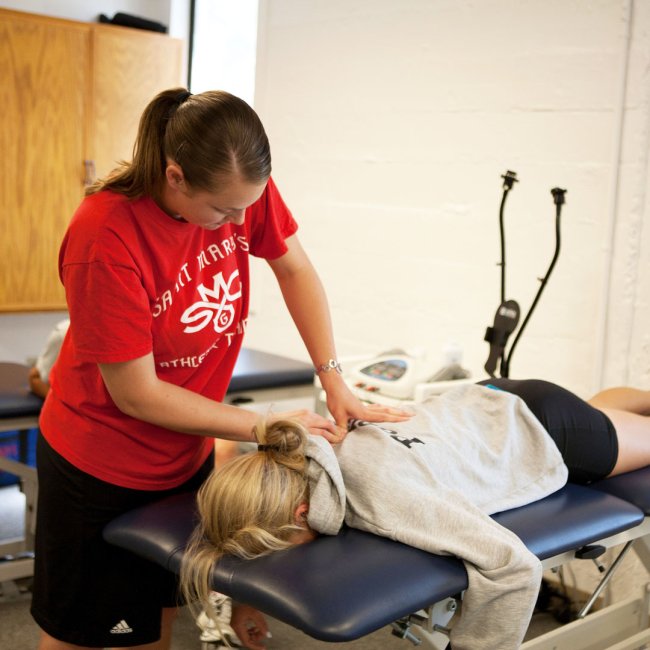
A student giving a massage

Physical Therapist
Help patients recover from injury or illness through customized movement plans and rehabilitation programs.

Strength & Conditioning Coach
Train athletes to improve performance, reduce injury risk, and reach peak physical potential.

Athletic Trainer
Work with sports teams or clinical settings to prevent, diagnose, and treat sports-related injuries.

Clinical Exercise Physiologist
Design and monitor exercise programs for individuals with chronic conditions such as heart disease or diabetes.

Personal Trainer
Coach clients one-on-one to improve fitness, build strength, and achieve health goals.
 

Fitness Director/Manager
Lead operations at gyms or wellness centers, managing staff and designing effective fitness programs.

Sport Nutritionist
Guide athletes and active individuals in optimizing performance and recovery through nutrition.

Exercise Physiologist (Research Focus)
Study how the body responds to exercise and contribute to evidence-based practices in health and performance.

Chiropractor
Diagnose and treat neuromuscular disorders, often integrating movement science to improve function and reduce pain.

Saint Mary's Testimonials

Tyler Carrino

“Kinesiology helped me become a more effective and responsive firefighter paramedic by improving how I care for both myself and the people I serve. Understanding body mechanics and movement allowed me to prevent injuries—both mine and those of the patients I assist. It also taught me how to move and lift safely, ensuring that I could provide care confidently and compassionately, especially in physically demanding or high-stress rescue situations.”

Tyler Carino, Class of 2020, Paramedic

Learn More About Our Exercise Science Program

Get to know our award-winning faculty and their specialties. Or explore an array of internship possibilities.

School and Department Information