
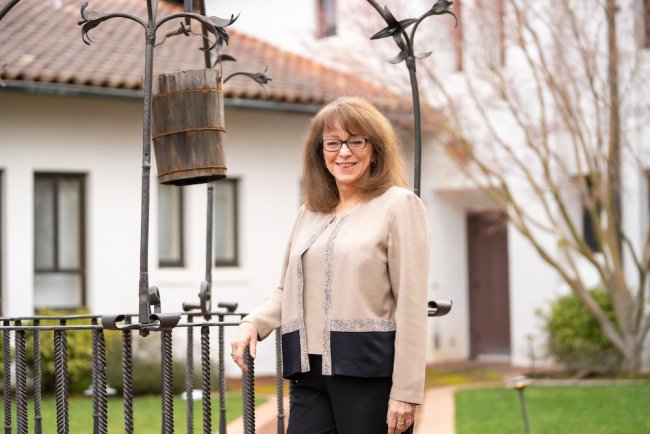
Barbara McGraw is founder and director of the Center for Engaged Religious Pluralism at Saint Mary’s. Her work with religious liberty in prisons has been bolstered by a $1 million grant from the Templeton Foundation for her Prison Religion Project. / Photo by Francis Tatem
Professor of the Year Barbara McGraw Would Like to Have a Conversation About Faith, Politics, and Leadership
She has been a leader in interfaith efforts, advocating for religious liberty in prisons, and a scholar focused on the importance of religious pluralism in the founding of the United States.
When Barbara McGraw arrived to begin teaching at Saint Mary’s nearly three decades ago, she was toting a freshly-minted PhD. She was also, as she likes to tell students, embarking on her third career.
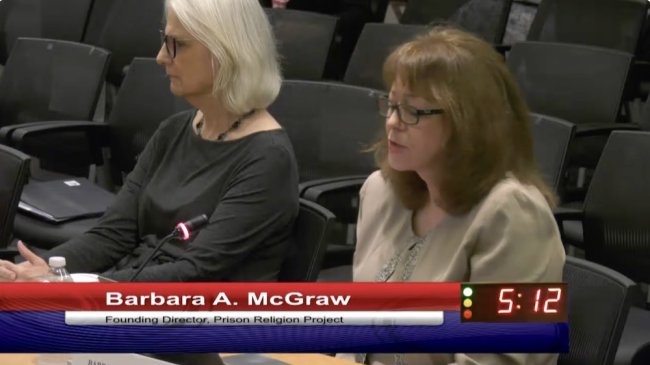
This prolific scholar has earned respect for her research and writing on the role of religion in the founding of the United States, and she is being recognized as the 2025–26 Professor of the Year at Saint Mary’s. She is a leading authority and tireless advocate for protecting religious liberty rights in the prisons—a topic on which she has given invited testimony before the US Commission on Civil Rights. At the College she holds appointments both in the Leadership, Ethics, and Law Department in the School of Economics and Business Administration and in the Department of Politics in the School of Liberal Arts. Her teaching and work as founder and director of the Center for Engaged Religious Pluralism at Saint Mary’s has touched the lives of generations of students.
What the Saint Mary’s community might not know: She has also been a high-powered mergers and acquisitions attorney in Los Angeles with Skadden, Arps, and before that, she tackled antitrust litigation with Sheppard, Mullin. That was her second career. And it’s the career she found her way to after a decade as a musician, playing banjo and guitar and more in gigs across the country as part of a duo and then a larger group. That was career number one.
Tracing the threads of McGraw’s professional endeavors is a fascinating exploration of ideas and ideals woven into the fabric of Saint Mary’s and the broader Lasallian educational mission. When it comes to religious liberty, they’re threads that are woven into the founding fabric of the democratic experiment known as the United States of America.
America’s Sacred Ground
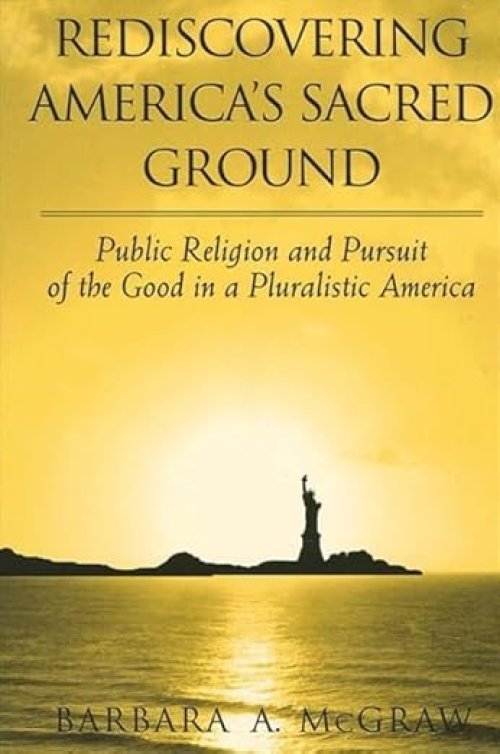
In her scholarship, Barbara McGraw is well known for her theory of the origins and meaning of the American founding—“the values and framework for governance and civil society underlying the Constitution—which she calls ‘America’s Sacred Ground,’” as Saint Mary’s colleagues wrote in nominating her for Professor of the Year. She is credited with coining that phrase, “America’s Sacred Ground,” a concept she explores in depth in her first book, published in 2003 by SUNY Press, Rediscovering America’s Sacred Ground: Public Religion and Pursuit of the Good in a Pluralistic America. John B. Cobb, a prominent theologian, wrote in his review of Rediscovering: “This nation badly needs the balanced, responsible analysis of the proper role of religion in our society that is offered in this book. Acceptance of ‘America’s Sacred Ground’ by all parties can provide the basis for civil discourse and moving ahead into new grounds.”
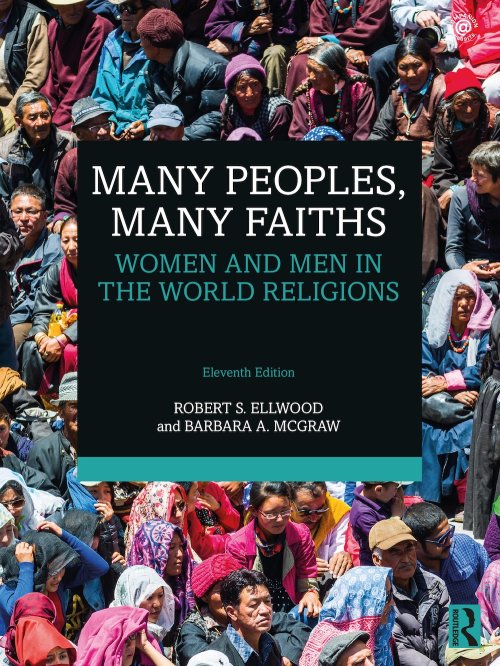
Expanding on the topic, McGraw also co-edited the anthology Taking Religious Pluralism Seriously: Spiritual Politics on America’s Sacred Ground. She edited The Wiley-Blackwell Companion to Religion and Politics in the US. And together with scholar Robert Ellwood—who helped steer McGraw to her career as a scholar and educator and toward work focused on religion in prisons—over the past quarter century, she has been co-author of Many Peoples, Many Faiths: Women and Men in the World Religions, now in its 11th edition, published by Routledge.
For McGraw, working on each new edition of Many Peoples, Many Faiths is illuminating and inspiring. “For every new edition, I would reread each chapter and was always inspired by each religion: ‘Ah, indigenous religion—yep, that’s it. Hinduism, so beautiful. Buddhism, Christianity, Islam—all of them so beautiful. And all these new religious movements—amazing what people are doing. In the last edition, we added a new section. Robert Ellwood wanted to address religion and violence. And I said, ‘Well, we can’t do that unless we also include religion and peace, right?’ So now we have a whole section on interfaith movements, too. I see it all as incredibly inspiring and beautiful— people seeking their highest expression of who or what they connect with, however they see the ultimate divine.”
A Journey to Advocating for Religious Liberty in Prisons
Barbara McGraw was born and raised in Rochester, New York. From the earliest years of elementary school, Barbara heard the refrain from parents and grandparents that she was going to college. The idea of finishing college and then embarking on a career in music and learning to play licks on an electric guitar like Jimmy Page—that was Barbara’s own idea. When she set out to study law after years of performing, her initial plan was to focus on entertainment law; it seemed a natural progression. But she found herself drawn to the field of law more broadly, when she began studying law at the University of Southern California, where she completed her Juris Doctor degree.

USC is also where she returned a decade or so later to begin graduate work in religion and social ethics. This was not something that she was encouraged to do since childhood. In fact, her parents were atheists. But it was after some spiritual experiences, as she describes them, that she found herself following a calling beyond managing mergers and acquisitions. And it was during the final phases of her PhD that she became involved in advocating for religious freedom for incarcerated people. Professor Ellwood involved her in her first case in 1997, which was with a man named William Rouser, who at the time was serving his life sentence in Pelican Bay prison in California.
Even though the First Amendment to the US Constitution protects religious liberty, that amendment was not followed to the letter or the spirit, especially if you weren’t an adherent to one of the major religions in the United States. William Rouser was an incarcerated Wiccan, a Pagan or neo-Pagan religion that includes incense, candles, wands and other items in its practice, to which Rouser had requested access. Rouser filed a lawsuit arguing that he was regularly harassed by guards and prevented from practicing his religion. In addressing cases like that at the beginning, McGraw says she would enlist pro bono work by big law firms such as Jones, Day, which she was grateful to have take over Rouser’s case because she didn’t have the resources to do it alone.
When McGraw was invited to speak before the US Commission on Civil Rights in 2024, she addressed in part a case before the Supreme Court right now involving a man who is Rastafarian and whose dreadlocks—which are central to the practice of his faith—were shorn to the scalp by prison staff in Louisiana only a few weeks before he was released from prison. The question is not whether it was wrong, because everyone agrees it was wrong, McGraw notes. The question is whether there is any monetary remedy for that violation under laws passed by Congress because there isn’t any other possible remedy. Arguments have been heard by the court; a decision has not yet been released.
McGraw also recounts a case that she uses in teaching, though not one she was involved with personally, that involved an incarcerated Christian who complained because the prison facility took over the chapel to use for drug rehabilitation programming. Prison officials responded by saying, essentially, that people could practice their religion in their cells. That solution was found to be inadequate, and the chapel was reopened for religious use.
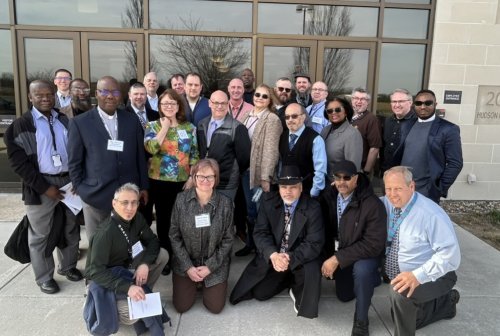
There’s no question lawsuits like this are an important recourse for those in prison who are having their religious liberty rights violated. But over the years, as McGraw worked with prison officials around the country, she was struck by how many of them were well-intentioned. “And I thought, what if we reached out to the people who are trying to do the right thing, instead of coming at them with lawsuits?” McGraw recounts. In 2004, she began training prison officials on religion and law in a program at the American Academy of Religion. That program, “Governmental Chaplaincy and Religious Diversity,” which she ended up leading for its last nine years until 2020, provided prison officials with tools and approaches to ensure the free practice of incarcerated individuals’ religion, eventually reaching more than 24 states, as well as leadership in the military and the Federal Bureau of Prisons. Her approach to the training workshops with prison officials is more like a workshop than a lecture. “I don't come in and give a talk,” she says. The goal is to explore many perspectives and make the process itself one of discovery.
When it comes to respecting religious diversity in prisons, one of the models McGraw points to is David Liebel, Director for Religious Services and Community Engagement for the Indiana Department of Correction. “He says, ‘We used to have this sort of push and pull, tug of war thing about religious accommodation when our approach was: How can we say no?”
Take the example of prayer beads: In some prisons, Hindus had been denied access to them, using the rationale that they could be used as a weapon. However, Catholics already were permitted to have rosary beads with a crucifix. Why should Hindu prayer beads be considered a safety risk when rosary beads are not? The solution to the tug of war, Liebel says: “‘We just decided to let go of the rope. Now, instead of how can we say no, we say, how can we say yes.’ That approach is actually improving prison culture overall.”
One of the points McGraw makes is that prisons are like cities unto themselves. And when it comes to respecting religion, they actually have the potential to be an exemplar of religious pluralism for society at large, she says. “Since our society is so divided, we could use the example of these prison cities for how we might do better, at least when it comes to respecting everyone’s religious rights.”
Interfaith-Intercultural Leadership
Back in the late 1990s, as Barbara McGraw was finishing her PhD in religion and social ethics, she began looking for teaching opportunities within academia. Her background in corporate finance, along with her JD, made for an interesting combination. Saint Mary’s, a pioneer in business ethics, was looking for someone to teach that course; McGraw also brought a background good for teaching business law.
The department faculty she joined taught undergraduate courses, with about five faculty, including only one woman. At the first department meeting McGraw attended, she was welcomed by a senior colleague, Professor Diana Wu—a moment that is etched in McGraw’s mind. “She stands up and she walks over to me and gives me a hug, and she says, ‘I've been waiting for you for so long.’ I was so moved, and she was a lovely mentor, a beautiful human being.”
The work that McGraw was doing in the prisons fed into an interest in interfaith endeavors more broadly, including at Saint Mary’s. “The Catholic Church has been on the forefront of interfaith engagement since the 1960s,” she points out. While she herself is not Catholic, she saw the opportunity to build a more robust infrastructure for interfaith programs and support of religious diversity on campus. After about a decade of teaching at SMC, that interest led her to propose the establishment of the Center for Engaged Religious Pluralism, which she founded at Saint Mary’s in 2008.
“I engaged all corners of the College on interfaith issues. I brought in people from the Interfaith Youth Core [now known as Interfaith America] and others to speak to people all over campus,” she says. “I did a presentation for the Brothers in their residence to show them that other Lasallian schools had opportunities and interfaith spaces. I spoke to Residence Life and faculty and staff to develop ideas for programming, and I invited students to take part in the work. People were very enthusiastic because others recognized the need for that work. At times I had up to 15 undergraduate student interns who did programming and spread the word.”
One of those early interns was Porsia Tunzi ’12, who is now teaching at Saint Mary’s. This past year, while McGraw was on sabbatical and leading work on her major grant from the John Templeton Foundation, Tunzi taught the course that McGraw developed, entitled Intercultural-Interfaith Leadership. One project from that fall course became a collaboration with the SMC Museum of Art and is on display this spring.
“The American founders talked about religious diversity and how important it is and why everyone should have freedom of conscience.”
The efforts undertaken under the aegis of the Center for Engaged Religious Pluralism also created the opportunity for developing a multidisciplinary minor in Interfaith Leadership. Beyond Saint Mary’s, McGraw is recognized as a leader in interfaith engagement, speaking at colleges and universities across the country. She is one of the founding board members of the Association for Interreligious/Interfaith Studies. “Interfaith engagement and religious diversity have really been at the heart of a lot of what I do,” McGraw says, “since I first got involved with the prisons in the late ’90s. Then it expanded to this idea that it is something that can be in all professions.”
A little over a decade ago, the Saint Mary’s Office of Mission & Ministry began to take on more of the campus-focused dimension of interfaith work. The Center for Engaged Religious Pluralism shifted its focus toward scholarship and public-facing work.
As for the inspiration for the Center’s founding and work at Saint Mary’s, McGraw points to the transformative power of Vatican II and the 1965 encyclical Nostra Aetate, issued by Pope Paul VI. It is also called The Declaration on the Relation of the Church to Non-Christian Religions. "Every Pope, even the most conservative since then, has recognized the duty of the Church to foster unity and charity among diverse religions, acknowledging and encouraging the spiritual and moral truths found among non-Christians," McGraw says. “It certainly is close to my heart, and has been a driving force in all my work here at Saint Mary’s. And it aligns with my work on the nation’s founding—how the American founders talked about religious diversity and how important it is and why everyone should have freedom of conscience.”
Civil Discourse
A commitment to civil discourse is at the heart of Barbara McGraw’s approach to university teaching. It is also part and parcel of workshops she leads in religion in prisons. And it’s a natural fit for someone who has devoted so much thinking and hands-on work in the interfaith field.
At Saint Mary’s, her classes are discussion-based. They also frequently feature what she calls an un-debate; the goal is not to win an argument with other students. The goal is for students to document what new perspectives and ideas they have learned and added to their own way of understanding an issue and engage in a respectful dialogue for mutual understanding. As colleagues attest, her course in Intercultural-Interfaith Leadership, which includes that component, has been one of the most popular electives in SEBA, “inspiring generations of students to develop empathy and leadership skills through deep dive into theories and Engaged Learning activities that animate the campus.”
During the COVID-19 pandemic, when in-person activities and events were precluded, McGraw’s approach to courses was "nevertheless," as she says, "we’re not giving up anything we were doing in person just because we are now online." For Intercultural-Interfaith Leadership, she had students assemble teams and learn the basics of animation and editing tools to create videos exploring different aspects of the subject. She tapped her own connections to put some students in touch with the top State Department diplomat for religious diversity and foreign affairs during the Obama Administration, Shaun Casey. Other students tackled interfaith leadership in healthcare, education, business, policing, and other professions. Those videos now have a home on the Center for Engaged Religious Pluralism website.
One anecdote McGraw tells about that first COVID-19 cohort is what the response was when she showed the videos to a new group of students the following fall. The reaction in general from the students was, she said, “Well, you can't expect us to do anything professional like that. I told them those were last semester’s students, and you can do it, too.” Not surprisingly, McGraw’s colleagues highlight that she both inspires her students—and holds them to a high bar.
From her perspective as an educator, McGraw says, “Teaching at Saint Mary’s has been an unbelievably rewarding experience.” In part, she says, that’s because students are willing to show up and engage together to be critical thinkers. “Not in the sense of criticizing, but in the sense of examining different ways of thinking about things and finding your own way,” she says. “It’s like Cardinal John Henry Newman's view of education as really being about freedom, because if you just stay stuck in an ideology that you already have, and you just stay there, you’re not really free until you’ve explored all the points of view and find out what you really believe. You may go back to that first thing, but you may also adjust and change your mind or bring in something you hadn’t thought of before. That creates a shift in perception.”
A Defining Moment in Teaching
One area where McGraw confesses she is not at her strongest is remembering names. But when she talks about Toussaint Bailey ’02, she has stories at her fingertips about having him in class. “He was the most engaging, interesting student with such a creative mind,” she says. “We’d be having a whole conversation about business ethics, and he would come up to me after class with these thought diagrams and say, ‘Here’s what I'm seeing: This is connected to this, this is connected to this.’ He was blowing me away!”
After Saint Mary’s, Bailey went on to earn a JD at the UCLA School of Law. He went on to become the founder and managing partner of Uplifting Capital, a minority-owned, majority-women-led investment firm that makes financially compelling investments that positively impact the most pressing global challenges. In May 2025, Bailey was back on campus with his wife, Denise Bailey ’02, and their children. The occasion: He was the keynote speaker for Undergraduate Commencement.
That happened to be a difficult time health-wise for Barbara McGraw. She was particularly ill—too weak to even walk more than a few feet. She subsequently found out she was suffering from acute anemia. But she was insistent on making it to the ceremony. A motorized cart was arranged to bring her to the stadium, so she could join other faculty to hear Bailey’s address. In that talk, in front of hundreds of assembled graduates, families and friends, Bailey personally thanked McGraw for the impact she has had on his life.
Taking It to the Next Level
On a weekday morning in February, McGraw is in conversation in the office of the Center for Engaged Religious Pluralism, when her phone alarm goes off. The sound is the call of a hunting horn, and along with that, one line of text is displayed: You can do it!!! That daily exhortation is a reminder that, whatever the day has dished up, it won’t be too much.
That sense of possibility was part of the motivation for taking her work with prisons to the next level and applying for a $1 million grant from the Templeton Foundation, based in Philadelphia. She partnered with the Advancement team at Saint Mary’s throughout the rigorous, detailed application process. Whether she would receive the grant or not had not yet been announced when McGraw was named Professor of the Year in May. When the good news came last summer, the Saint Mary’s story was also picked up by outside media.
Entitled “Prison Religion: Advancing Religious Liberty in Correctional Institutions as Exemplars of Pluralism and Institutional Change,” the project is expected to produce both scholarly insights and practical resources for use by correctional institutions, policymakers, and advocates for incarcerated people nationwide.
“While religion offers a vital source of meaning, belonging, and personal transformation for millions—including those who are incarcerated—many in our nation’s prisons are denied the right to practice their faiths due to systemic barriers,” McGraw explained. “This project will carefully examine the urgent need to ensure religious rights are respected in correctional settings, providing a prime example of religious pluralism for society.” As the Center for Engaged Religious Pluralism states: “The Prison Religion Project serves as a bridge to greater understanding at the intersection of religious pluralism, incarcerated people’s rights, and institutional policy.”
McGraw has assembled a multidisciplinary team of four scholars and practitioners, and the project includes Saint Mary’s staff and students. Saint Mary’s Professor of Management and Organization Theory Yuan Li is part of the team, as is scholar Eric Mazur from Virginia Wesleyan University, with consultants including James A. Sonne from Stanford Law and Kelli Willard West, who served for 15 years as the Religious Practices Coordinator for the Wisconsin Department of Corrections. The grant funds graduate researchers, including Saint Mary’s students Grant Allen, completing his Executive Doctorate in Business Administration, and Olivia Hayes, completing her master’s in Forensic Psychology. Saint Mary’s undergraduate students involved include Drew Paxman ’27, who is now pursuing an independent study with her as part of the grant, and Rebecca Carranza ’26. Both undergraduate students took Constitutional Law with McGraw, who sings their praises as two of the best students she's had.
Among the questions the project stakes out are: What are the best ways to navigate the complex legal and cultural challenges of accommodating diverse religions in prisons? What barriers stand in the way? What impact might fully embracing religious liberty have on inmates’ well-being, prison culture, and, ultimately, society? In seeking answers, McGraw makes clear, “The stakes go beyond the prison walls…Addressing the intersection of religious liberty and prisons offers a vision for a more compassionate future grounded in respect for the diverse experiences that define our humanity.”
Hope in Action
On April 30, Barbara McGraw will deliver a talk as part of the Professor of the Year celebration at the Soda Center on the Saint Mary’s campus. Not coincidentally, this is also the birthday of John Baptist de La Salle, the founder of the Brothers of the Christian Schools.
A working title is “Hope in Action: A Call to Our American and Lasallian Missions.” Religious diversity was not something De La Salle advocated; however, McGraw notes, he did push the boundaries of what was socially acceptable at the time. “What he did at the time was frowned upon—teaching the boys who were running around in the streets, whose parents were working in the factories and so forth.” And De La Salle is certainly an inspiring figure, committed to making a difference in the world—one who followed his calling against the current of his own social milieu. “And he created a movement that went all over the world,” McGraw says.
The year 2026 marks the 250th anniversary of the Declaration of Independence—an anniversary that comports with decades of scholarship McGraw has devoted to understanding how religious diversity was central to the establishment of the United States. “At the beginning of the nation, we didn’t live up to our high ideals at all,” she underscores. “But in some ways, we did. And over time, in appealing to those ideals, especially liberty and that everyone is created equal, we’ve done better and better. Even those who are arguing today about how the founders didn’t get it right and for a better way forward today—the vast majority are still appealing to those same values.”
In December, The Cambridge Companion to the Declaration of Independence was published. McGraw contributed a chapter entitled “A Theological Interpretation of the Declaration.” She traces the founders’ inspiration to the philosopher John Locke, who, decades earlier, wrote about the importance of enabling all people to practice their religion—including Christian denominations many would have considered beyond the pale at the time in England: Presbyterians, Anabaptists, Armenians, and Quakers. But he also advocated for freedom of religion for Muslims and Jews. Follow that arc of thought over a century and across the Atlantic, and you find founding fathers Richard Henry Lee and Thomas Jefferson writing about the importance of allowing Muslims, Hindus, and pagans to pray to their gods. Recognizing that these were flawed men who were products of their times, McGraw also hones in on the scope of vision at work: “It is true, we are not disposed to differ much, at present, about religion,” Richard Henry Lee wrote, “but when we are making a constitution, it is to be hoped, for ages and millions yet unborn, why not establish the free exercise of religion, as a part of the national compact.”
“We need to meet everyone where they are and be in solidarity to bring about the good society. That’s what my work is all about.”
So when it comes to ensuring freedom of religion, McGraw says, “It should be a component of the 250-year anniversary!”
McGraw has also recently completed a manuscript for what she describes as “a little book” called Let’s Save America Together. It is written for a general audience and makes the case that, even when Americans disagree, there are certain important values that can and should underpin the whole system. “John Adams and many others at the time talked about how important virtue was to liberty,” she says. “They have to go together.”
Here at Saint Mary’s, for understanding the fabric we are trying to weave as communities, she returns to the thread in Christianity that the Catholic Church has adopted: “The inherent worth and dignity of every person, every human being,” McGraw says, “and we need to meet everyone where they are and be in solidarity to bring about the good society. That’s what my work is all about.”
Steven Boyd Saum is Executive Director of Strategic Communications and Content for Saint Mary’s. Write him.


