Work Accommodations

Work Accommodations
Saint Mary’s College is committed to providing an inclusive and supportive work environment for all employees. SMC complies with the Americans with Disabilities Act (ADA) and applicable state laws to ensure equal employment opportunities for qualified individuals with disabilities.
The work accommodation process is designed to assist employees who may need modifications or adjustments to their work environment, job duties, or schedule to perform the essential functions of their position. Human Resources partners with employees, managers, and healthcare providers to identify effective and reasonable accommodations that support both individual and departmental needs.
Employees who believe they may need a workplace accommodation are encouraged to contact Human Resources to begin an interactive and confidential process.
1. Employee Request for Accommodation
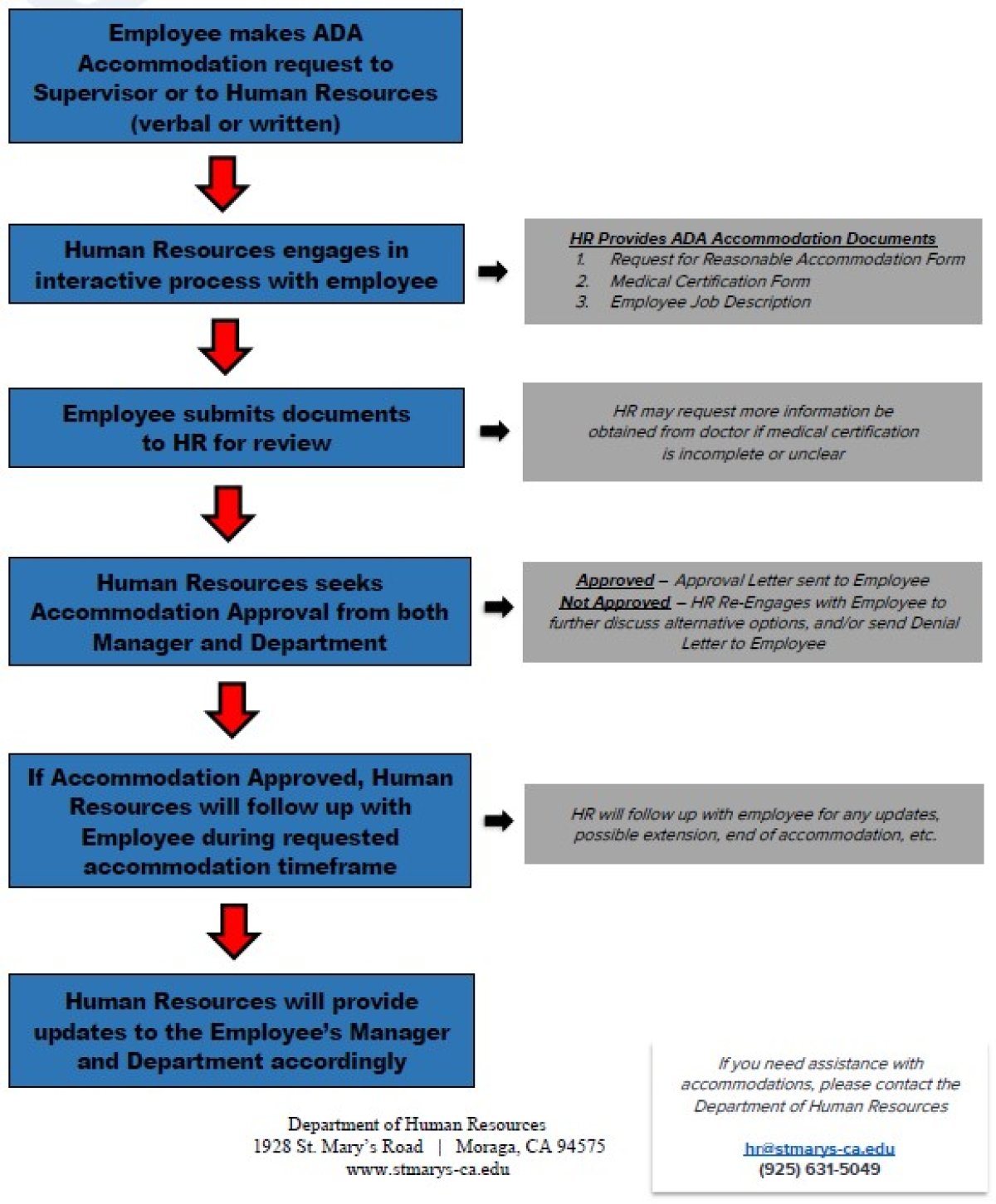
An employee who believes they need a workplace accommodation due to a medical condition or disability should notify Human Resources hr@stmarys-ca.edu as soon as possible. Requests may be made verbally or in writing to HR or the employee’s manager. Managers who receive a request must promptly refer the employee to HR.
Employees are required to complete a Request for a Reasonable Accommodation Form and may be required to provide supporting Medical Documentation from a licensed healthcare provider that identifies functional limitations and recommended accommodations.
2. Interactive Process
Upon receiving a request, Human Resources will initiate an interactive process—a collaborative dialogue between the employee, manager, and Human Resources to:
- Review the employee’s functional limitations and essential job duties.
- Identify potential reasonable accommodations.
- Evaluate the effectiveness and feasibility of each option, considering departmental needs and potential undue hardship.
Human Resources may request clarification or additional medical documentation if needed to fully understand the limitations and potential accommodations.
3. Determination and Implementation
After reviewing all relevant information, Human Resources, in consultation with the manager and department leadership, will determine whether a reasonable accommodation can be provided. Possible accommodations may include, but are not limited to:
- Modifying work schedules or job duties.
- Providing assistive equipment or technology.
- Making physical workspace adjustments.
- Allowing remote or hybrid work arrangements (when operationally feasible).
- Granting a leave of absence as an accommodation.
Human Resources will provide the employee with a written notice of the outcome and, if approved, will coordinate implementation with the employee’s department.
4. Confidentiality
All medical information and documentation provided during the accommodation process will be kept confidential and maintained separately from personnel files. Information will only be shared with individuals directly involved in evaluating or implementing the accommodation, as required by law.
5. Ongoing Review and Adjustments
Accommodations may be temporary or ongoing. HR will periodically review implemented accommodations to ensure effectiveness. Employees are encouraged to inform HR if their needs or medical condition changes, or if the accommodation is no longer effective.
6. Denial or Alternative Options
If a requested accommodation is denied, Human Resources will inform the employee in writing and explain the reason (e.g., undue hardship, lack of medical substantiation, or inability to perform essential job functions even with accommodation). When possible, Human Resources will explore alternative accommodations. If no reasonable accommodation is available, the employee may be eligible to apply for a leave of absence.
7. Questions and Support
Employees with questions about the work accommodation process may contact:
Human Resources hr@stmarys-ca.edu
An Interactive Process is required when an employee requests an accommodation or otherwise has a known limitation that requires one. Human Resources will engage the employee and the employee’s department in good faith and in a timely manner in the interactive process to determine what accommodation is appropriate. For pregnancy and pregnancy-related conditions, employees will participate in the interactive process with relevant personnel when appropriate.
Please note, no specific accommodation is guaranteed. Rather, accommodations are determined on an individualized basis and must be tailored to match the needs of the employee without placing an undue hardship on the department.
In making this determination, in conjunction with the appropriate departmental manager, may consider a number of relevant factors, including:
- The nature and duration of the requested accommodation.
- The impact of the requested accommodation on the performance of the employee’s essential functions or core work-related duties.
- Adherence to federal regulations for students requesting “reasonable” accommodation. A reasonable modification may require adjusting policies or procedures when necessary to support a student with a pregnancy-related condition.
- Any alternative accommodations.
Human Resources may require an employee to provide certification from a health care provider indicating a reasonable accommodation is advisable. The certification must include:
- The date the accommodation became or will become medically advisable;
- An explanation of the medical condition and need for a reasonable accommodation;
- The probable length of time the accommodation should be provided.
Once Human Resources has secured the requested certification, it will begin the interactive process to
determine the type and duration of the accommodation.
An undue hardship refers to a situation where providing a requested workplace accommodation would cause significant difficulty or expense for the employer. Under the Americans with Disabilities Act (ADA) and similar state laws, employers are required to provide reasonable accommodations to qualified employees with disabilities unless doing so would result in an undue hardship.
An undue hardship means an action that is unduly costly, extensive, substantial, disruptive, or would fundamentally alter the nature or operation of the business.
Factors Considered
When determining whether an accommodation creates an undue hardship, employers consider:
- Financial cost of the accommodation in relation to the organization’s resources.
- Size of the organization, including the number of employees and overall budget.
- Impact on operations, including how the accommodation affects workflow, safety, efficiency, or the ability of others to perform their duties.
- Nature of the work, including essential functions that must be maintained.
- Availability of alternatives that might meet the employee’s needs without causing hardship.
Examples
An accommodation may be considered an undue hardship if it:
- Requires significant structural changes to facilities that are not financially feasible.
- Eliminates essential job functions that must be performed by the employee.
- Causes disruption to business operations or creates safety risks.
- Results in substantial ongoing costs beyond what the organization can reasonably bear.