Section 3

Academic Planning & Academic Evaluations
Undergraduate Degree Requirements
See the Catalog for specific information about degree requirements including major, minor, certificate, and Core curriculum requirements.
In order to complete a traditional Bachelor’s degree, a student must fulfill the following academic requirements:
- A minimum of 124 units completed
- At least 50 units must be upper division (300 and 400 level)
- At least 31 of these upper division units must completed at SMC (also known as the “in residence” requirement)
- All major/program academic requirements
- All Saint Mary’s Core Curriculum requirements
- Have a cumulative, institutional, and major GPA of at least 2.0
- If the student has declared a minor or certificate program all requirements must be completed
Core Curriculum
The Core Curriculum includes study in four broad intellectual areas: Habits of the Mind, Pathways to Knowledge, Theological Understanding, and Engaging the World.
To learn more about the Core Curriculum visit the Core Curriculum website.
Core Curriculum resources for advisors:
FAQs for Students and Academic Advisors
How to Search for courses that meet Core requirements in GaelXpress
Finding Core Curriculum Courses using Power BI (user guide)
Jan Term Policies and Requirements
Jan Term 2027 Advising Cheat Sheet
Engaged Learning information & FAQs
Seminar Registration Info Fall 2026 & Spring 2027
Language Placement
One of the Core Curriculum requirements is language proficiency in a non-English language. The college offers several pathways to meet the language requirement which are described here and in the catalog.
The language requirement may be fulfilled in one of the following ways:
- By completing three years of the same language other than English in high school — including American Sign Language — with a grade of C- or better in each year.
- By completing the second semester-long college course (level II language) in a language other than English at an accredited college or university. American Sign Language is explicitly permitted.
- By passing a proficiency exam in a proctored environment with an assessment instrument approved by the Department of World Languages and Cultures or the Department of Classical Languages as appropriate (Examinations must be arranged through the Language and Proficiency Coordinator in the Department of World Languages and Cultures.).
- By scoring at least 3 on the College Entrance Examination Board Advanced Placement (AP) exam in the World Languages and Culture Exams. The College Board offers exams in Chinese, French, German, Japanese, Latin and Spanish,
- Via an exam score of 5 or higher on the International Baccalaureate (IB) Examination in language.
- Via a TOEFL consistent with current enrollment standards for international students who are non-native speakers of English.
- By achieving an intermediate level score on the Avant Language Placement Test in Reading, Contextualized Grammar, Writing, & Speaking. Results must be confirmed through oral and written proficiency testing with the Placement and Proficiency Coordinator
We recommend that students who still need to complete the language requirement do so early in their time at SMC.
What is the difference between proficiency and placement?
Students must demonstrate a Level II Proficiency in a language other than English
Proficiency is demonstrated achievement at a specific level. The proficiency is demonstrated by proctored, graded assessments.
Placement is a suggested starting point for a language class. The recommended placement is a guess based on high school work or unproctored exams or other criteria.
- For example: My advisee has taken two years of High School French with grades of A and A-. They would like to continue in French to complete their language requirement. The language coordinator gave them a suggested placement of level III class. But does the placement at level III mean they have achieved level II and have met the language requirement? No
How can I check to see if my advisee has met the language requirement?
Check the section titled “Second Language Proficiency” on your advisee’s Academic Evaluation. This section will list whether the Proficiency requirement has been met yet.
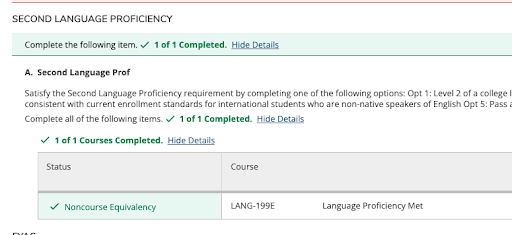
Note: In some cases, especially for transfer students, some students might not have submitted their High School Transcript and thus never received a language placement. If the student is planning to satisfy their language proficiency via High School it is important that the student submit their High School Transcript so that it can be evaluated.
What if my advisee wants to complete their language requirement by taking a college course elsewhere?
Some students opt to take a language course at a community college or another accredited college/university. We recommend that the student use the Transfer Equivalency Portal to check to make sure that the course will fulfill their Level II requirement. Some courses offered at quarter term institutions require a two course sequence to fulfill the second language requirement.
My advisee has more questions about the language requirement or is interested in taking the proficiency exam
If your advisee has any questions about language placement or the proficiency exam contact placementandproficiency-WLC@stmarys-ca.edu or have your advisee complete this form to request support.
Major/Minor Declaration & Changes
To declare their major/minor the student needs to submit an Undergraduate Major/Minor Declaration form. Any time a student needs to add or remove a major, minor or certificate program they need to resubmit the form. We recommend that advisors confirm with their advisees that the majors/minors/certificates listed on their academic evaluation are the programs that the student still wishes to pursue. Encourage your advisee to submit the declaration form anytime they need to change their major, minor, or certificate program.
Split Majors and Individualized Majors
The College offers two ways for students to create majors
- Split Major: A split major combines two existing majors. Students interested in pursuing a split major should consult with the chairs/directors of both major programs to create a degree plan. See the catalog for specific requirements for split majors. To request a split major, the student must submit an Individualized/Split Major Petition.
- Individualized Major: A student can request an individualized major when the program of study that they wish to pursue does not exist at SMC. See the Individualized Major Guidelines for more information. To request an individualized major, the student must submit an Individualized/Split Major Petition.
Double Majors
A student may complete two or more separate major fields of study. When advising students pursuing a double major it is important to keep in mind that each major must include at least 18 units of required that may not be able to be counted toward the student’s other majors, if any. Major and minor pairings that do not meet the overlap policy will not be approved.
Minor Fields of Study
Students have the option to declare a minor field of study. Minors are not required to earn an SMC degree. Each minor must include at least 6 units of coursework that may not be counted toward the student’s major(s) and other minors(s). Information about available minors can be found in the Catalog.
Creating a Plan to Graduation
We encourage every student to have an academic plan to graduation. This plan helps students stay on track to timely graduation. Many first-year students create a 4-year plan as part of FYAC. Similarly Transfer students often create a plan to graduation with their TAC. We recognize that a students’ plans change — perhaps they switched to a different major, or need to drop or retake a class. Other students want to graduate early or study abroad. Faculty advisors should regularly work with students to create and/or update the student’s plan to graduation.
There are several fillable templates to help students create a plan to graduation.
4- Year Plan Fillable Template
Path to Graduate Fillable Template (transfer)
In collaboration with academic majors and programs, we have created Sample Academic Plans 2026-2027 for most majors which can be adapted. To use these templates please make a copy of the sheet corresponding to the student’s major. The sample academic plans are updated annually to reflect changes in degree offerings and major requirements.
Tips for Creating a Plan to Graduation
- We recommend that you encourage your advisee to create a first draft of their plan to graduation prior to meeting with you and then you work together with your advisee to fine tune the plan. This gives students a sense of ownership over their plan
- Here are some steps that you or the student can take to draft the plan:
- Make List of all requirements (use GXP2)
- Track places where your major or minor satisfies the Core
- Are there elective choices in your major that can satisfy Core?
- Fill in all the courses that you have taken previously or are currently taking into the semesters in which you have taken them, including the credit count. This is easiest using the Timeline of your courses in GXP2.
- Add courses that have specific timeframe requirements
- WRIT-100 or 101 in the Fall of FY; JT in January of FY; Sem-150 in Spr of FY; WRIT-200+ to be completed by Fall of Soph year; Sem-250 in Fall of Soph year
- Plan your major courses semester by semester
- Do you know the sequence of course offerings?
- Distribute CORE, minor courses, electives in open spots.
- Check that all requirements in your list have been checked off
- Check that the total will reach 124 units
- Check that you will reach 50 Upper Division (UD) units
Further resources for creating academic plans:
Requesting changes to your advisee’s academic evaluation
You or your advisee may notice that something needs to be adjusted in their academic evaluation. For example, a course is not populating in the expected spot, or an alternate class has been approved to fulfill a requirement.
Changes to a student's academic evaluation are made through a form called the Academic Evaluation Change form (AEC). The form can only be submitted by the specific Director, Chair, Dean or TAO Director for that area of the evaluation. The table below indicates who to contact for different AECs.
Eval Issue | Who to contact? |
Issue in the student’s major(s) (i.e., substitution or waiver needed) | Major Department Chair/Program Director (see list on the Academic Affairs website) |
Issue in the student’s minor(s) or certificate(s) | The Department Chair/Program Director that oversees the minor/certificate |
Collegiate Seminar (substitutions or guidance) | Dr. Hilda Ma, Seminar Director |
January Term (substitutions or guidance) | Dr. Claire Williams (Fall 2026) |
Language Proficiency and Placement (i.e., student wants to take proficiency exam, placement not listed on eval) | Email placementandproficiency-WLC@stmarys-ca.edu or instruct your advisee to complete this form to request support |
Core Curriculum (substitutions or guidance) | The Core Curriculum Committee Chair, email ccc@stmarys-ca.edu
|
Not sure where to start | The Advising Office, tao@stmarys-ca.edu |
Once the AEC form is submitted, the form is processed by the Registrar’s Office.
Overview of Full-time, Part-time and Overload status
Recommended credit loads for each semester: To graduate with a traditional bachelor’s degree from Saint Mary’s students must complete 124 credits. This translates to roughly 15.5 credits per semester. We encourage students to take 14-17 units per semester to graduate on time.
Full-time students are allowed to enroll in up to 36 units per academic year as part of their tuition. The academic year includes Fall, January term, and Spring. Coursework completed as part of SMC Summer Session is not included in the 36 per year limit.
- Full time status = At least 12 credits per semester
- Part-time status = Less than 12 credits per semester
Part-time enrollment may affect financial aid awards, campus housing eligibility, health insurance, and time to graduation. To understand the impact of part-time status students should have a conversation with Financial Aid to inquire how their financial aid will be impacted. Students should also have a conversation with their advisor and/or the Advising Office to understand how part-time status will impact their timeline to graduation. Students who are intentionally planning to be part-time status should review and complete the Traditional Undergraduate Part Time Request Form. The Business Office will adjust the student’s tuition to the per-unit rate after approval of the part-time form. Athletes and International Students are generally not eligible to be enrolled part-time.
- Overload Status = At most 18 units may be taken during the Fall and Spring semesters, and at most 5 units in Jan Term. If a student exceeds this unit load or 36 units over the course of the year, additional units will be subject to overload fees (see the Tuition and Fees page for more information).
Overload registration requires the submission of an Overload Request Form to the Registrar’s Office. To qualify for overload registration the student must have a 3.0 cumulative GPA or higher and have advisor approval
Class Level Designations
Number of units per term completed can impact a student’s registration time. Note that these class level designations are based on units completed not units in progress.
First-years= 0- 29.99 units completed
Sophomores= 30- 59.99 units completed
Juniors= 60- 89.99 units completed
Seniors= 90 or more units completed
Catching up on Credits: Options When a Student Falls Behind
A variety of circumstances may cause a student to fall behind the pace to timely graduation.
Fortunately, there are many strategies that advisors can use to guide students back on track.
- Jan Term: Taking an additional Jan Terms beyond the number required can help students make up for lost credits. Jan Term is included in the price of tuition (if enrolled in full-time status during the fall) and offers unique opportunities to explore new topics.
- SMC Summer Session: Courses taken during the summer session can help students fulfill core curriculum requirements, meet major/minor requirements, or explore a new topic. Summer Session courses have a reduced tuition rate compared to the per credit rate and students may be eligible for financial aid.
- Transfer credit: Students can take courses at a community college or another accredited four year institution. Students must submit the official transcript to Saint Mary’s after completing the course. See section on Transferable Courses for more information.
- Credits already earned but not recorded: Some students may have completed credits (e.g., AP or IB exam scores or transfer coursework) that SMC has not received. Saint Mary’s requires either an official score report or an official transcript to review and add the credits to a student’s academic evaluation. Advisors should ask their advisees to review their academic evaluation to ensure that all credits earned have been accounted for.
- Overload registration: Please see the section in this handbook for more information. Be aware that an overload may not be feasible for some students based on their other commitments, needs, or current GPA.
Transferable Courses
The Transfer Equivalency Portal (TES) is the current go-to resource for exploring course-to-course equivalencies with hundreds of colleges and universities across the United States and our Study Abroad partner institutions. We highly recommend that students check in with their Advisor or TAO to ensure the course they wish to take will meet the graduation requirement they are seeking to fulfill before enrolling in the course.
Certain institutions and courses may not appear in the TES system. This does not necessarily mean that the course will not transfer, but only that they have not previously been presented for evaluation. If a course you advisee wishes to take does not appear in the TES system or the student is seeking for the course to meet a specific requirement not listed in the TES system, they should submit a Transfer Credit Approval Form. The Transfer Credit Approval (TCA) is a web based form used to process transfer equivalency requests. The TCA form will ask students to provide institution name, course information, course document(s), and proposed Saint Mary's equivalent(s) for the course they wish to take.
Transfer courses completed at California Community College must be designated University of California (UC) transferable courses. Visit Assist.org for the complete list of California community college UC transferable courses.
Additionally, each transferable course must have a grade of C- or better in order to receive SMC transfer credit.
After the student completes the course and receives a grade, the student must request an official transcript be sent from the institution where they took the course be sent to the SMC Registrar’s Office. Courses taken elsewhere will not be eligible to be added to the academic evaluation unless the student submits an official transcript. If the student opts to send the official transcript electronically, they should send it to registrar@stmarys-ca.edu or choose Saint Mary’s College of California from the drop down menu if the institution where they took the course uses a service such as Parchment or National Clearinghouse.
For more information about Transfer Credit Requirements see the Registrar’s website or the catalog.
Study Abroad
Saint Mary’s currently offers 17 transformative study abroad programs in 14 different countries. Students who participate in College-sponsored programs are able to apply their Saint Mary’s financial aid towards the cost of their study abroad program as well as Pell and Cal grant aid status.
Students applying for all semester or year-long programs must submit an Application for Study Abroad to the Center for International Programs by March 1st for all fall semester programs or by October 1st for all spring semester programs.
As part of the Application for Study Abroad students need to complete an academic plan with their advisor or Department Chair/Program Director. For further information and support working for advisees planning to study abroad please contact the Center for International Programs, studyabroad@stmarys-ca.edu.